

- Description
- Specifications
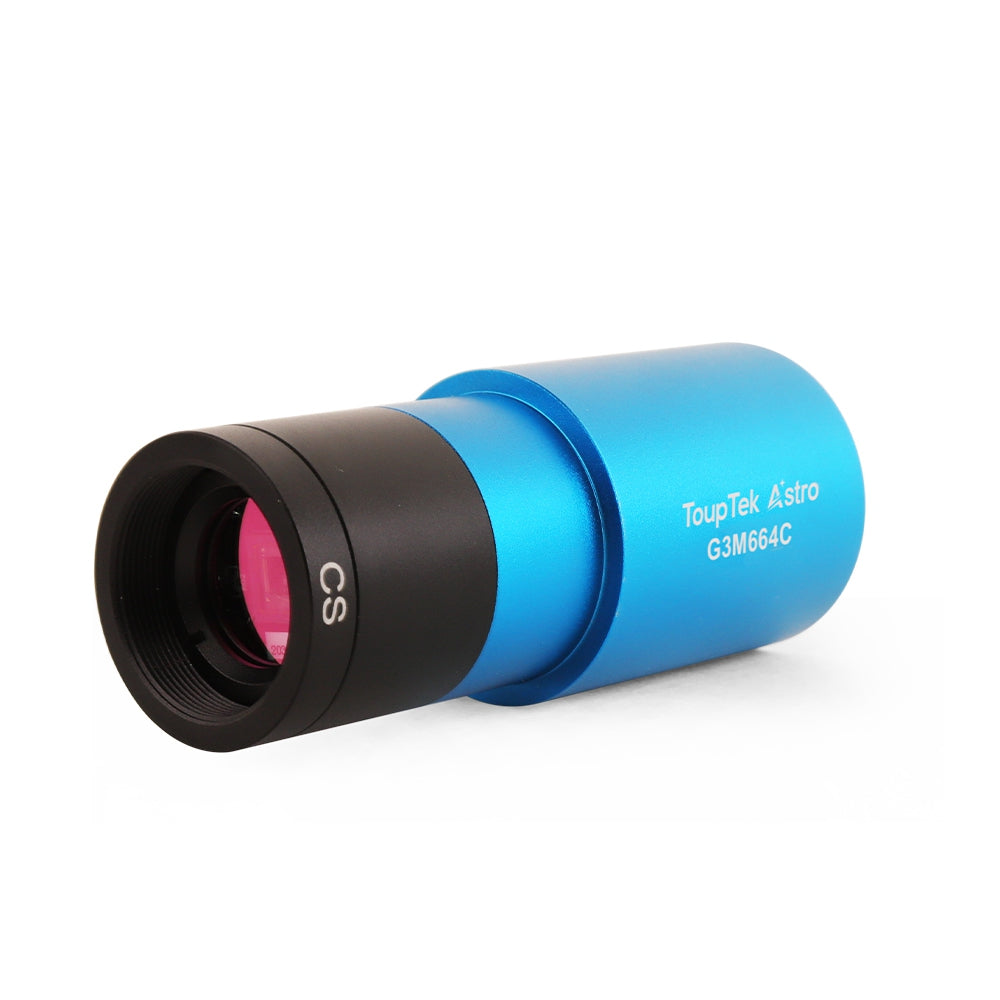
The ToupTek G3M664C is a compact colour planetary camera built on the Sony IMX664 back-illuminated sensor — a 3.2-megapixel 1/1.8" format camera with particularly strong near-infrared sensitivity and a large full well capacity that excels at preventing overexposure on bright planetary targets. The IMX664's wider pixel pitch (2.9 µm) and large full well make it an excellent choice for high-contrast planetary scenes and bright solar disc imaging.
Product Overview
The G3M664C uses Sony's IMX664 1/1.8" BSI sensor in a colour (RGGB Bayer) configuration. The sensor's strength lies in its high QE peak at 550nm, its exceptional near-infrared capability, and its large full well capacity — making it well-suited for targets where dynamic range and NIR sensitivity matter. Hardware ROI supports higher frame rates at smaller resolutions, and zero amp-glow is maintained at the hardware level throughout all gain settings.
Who Is This Product Best For?
Intermediate and advanced planetary imagers who prioritize dynamic range and near-infrared sensitivity over maximum pixel count. The IMX664's large full well prevents the overexposure issues that can affect smaller full-well cameras on very bright planetary targets, and its NIR response is a significant advantage for infrared planetary imaging.
Why Choose This Product?
- Sony IMX664 BSI sensor — strong NIR sensitivity and high peak QE at 550nm
- Large full well capacity — excellent dynamic range; reduces overexposure on bright planet discs
- 1/1.8" format — wider field of view than 1/2.8" cameras at the same focal length
- 2.9 µm pixels — good match for typical telescope focal lengths without extreme oversampling
- High frame rate — capable of effective lucky imaging at full resolution
- Zero amp-glow — hardware-level suppression for clean captures at any gain
- C-mount compatibility — standard integration with telescope setups and OAGs
Recommended Uses
- Planetary imaging with emphasis on dynamic range — bright planet discs without overexposure
- Near-infrared planetary imaging
- Lunar surface imaging and mosaic work
- Solar imaging with appropriate filters
- Lucky imaging and video stacking workflows
- Autoguiding via guide scope or OAG
Compatibility and Accessory Notes
- Connection: C-mount (Standard and Extended versions available)
- Filters: 1.25" mounted filters via included extension tube
- Software: ToupSky, SharpCap, FireCapture, NINA, PHD2, ASCOM; INDI for Linux
- Power: USB 3.0 bus-powered
Important Limitations
- Not for deep-sky imaging — uncooled; thermal noise increases with long exposures
- Not for visual observing — requires computer and capture software
- Colour output — for narrowband imaging a monochrome camera is preferred
Frequently Asked Questions
How does the G3M664C compare to the G3M662C?
The G3M662C uses the IMX662 STARVIS 2 in a 1/2.8" format; the G3M664C uses the IMX664 in a larger 1/1.8" format. The G3M664C covers more sky, has stronger NIR sensitivity, and typically has a larger full well. The G3M662C has a higher peak QE and STARVIS 2 technology. Choose the G3M664C when wider field and NIR performance are priorities; choose the G3M662C for maximum sensitivity and frame rate.
Is the G3M664C good for near-infrared imaging?
Yes. The IMX664 has strong spectral response into the near-infrared, making it notably capable for infrared planetary and lunar imaging when used with an IR-pass filter. This is one of the IMX664's key differentiators from other sensors in this format.
Our Recommendation
The ToupTek G3M664C occupies a useful niche for planetary imagers who want a larger sensor format, strong NIR sensitivity, and excellent dynamic range at a competitive price. It is a solid mid-range choice and a particularly good option for those regularly imaging bright targets where the large full well provides a real advantage. For maximum frame rate and STARVIS 2 performance, consider the G3M662C. For deep-sky work, see ToupTek's ATR and SkyEye cooled cameras.
| Specification | Detail |
|---|---|
| Sensor | Sony IMX664 (Colour, RGGB Bayer, BSI) |
| Sensor Format | 1/1.8" |
| Resolution | 3.2 MP (2064 × 1544) |
| Pixel Size | 2.9 µm |
| Full Well Capacity | High (large full well — consult ToupTek spec sheet) |
| NIR Response | Strong (high QE at 550nm, extended NIR) |
| ADC | Native 12-bit |
| Hardware ROI | Yes |
| Interface | USB 3.0 |
| Mount | C-mount / CS-mount |
| Back Focus (Standard) | 17.5 mm |
| Back Focus (Extended) | 12.5 mm |
| Filter Compatibility | 1.25" mounted filters via extension tube |
| Cooling | None (uncooled) |
| Amp Glow | Zero amp-glow (hardware level) |
| Power | USB 3.0 bus-powered |
| OS Compatibility | Windows, Linux, macOS (INDI) |
| Software | ToupSky, SharpCap, FireCapture, NINA, PHD2, ASCOM |
You may also like
Recently viewed
Recent Blog Posts
View all
Your Guide Graph Is Lying to You
Read More

D-Size vs V-Size: A Complete Guide to Telescope Dovetail Systems
Read More

What Is Back Focus in Astrophotography? Telescope Reducers, Flatteners, and Spacing Explained
Read More