

- Description
- Specifications
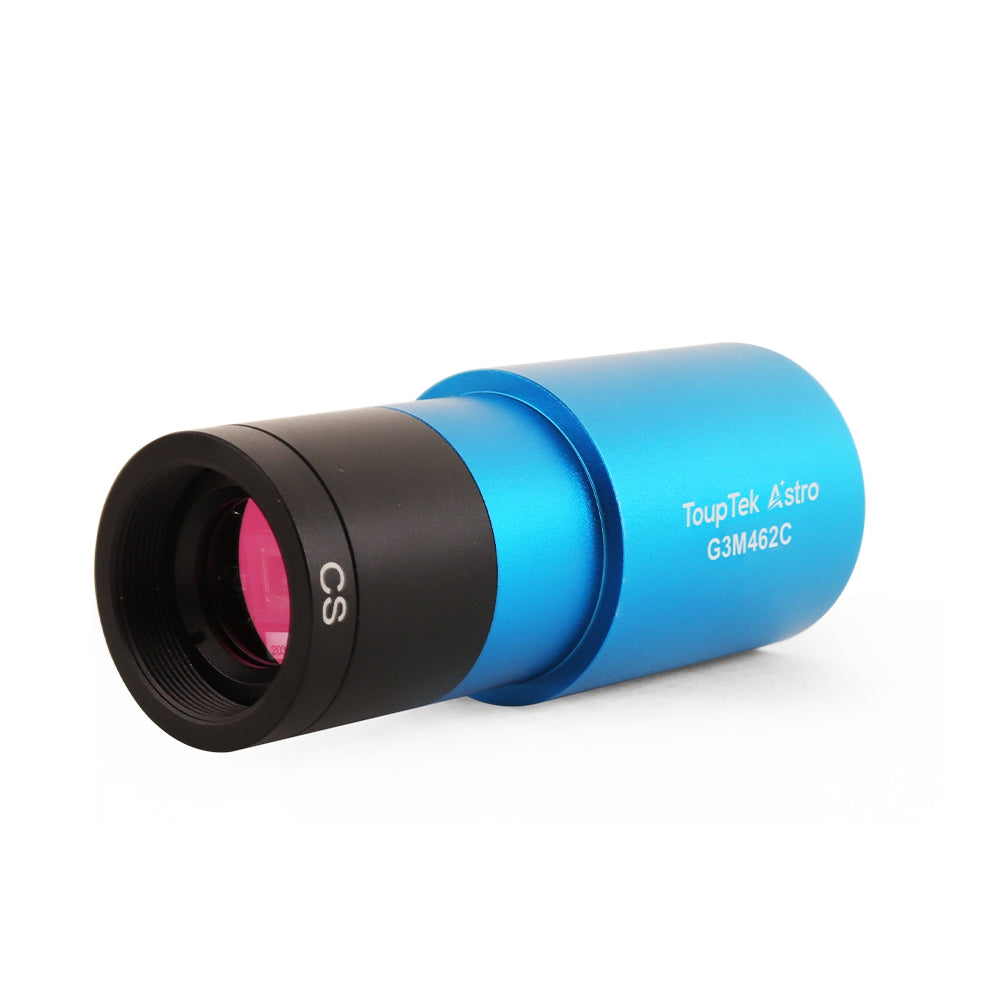
The ToupTek G3M462C is a compact, high-speed colour planetary camera built around the Sony IMX462 back-illuminated CMOS sensor. Combining a peak quantum efficiency exceeding 89%, ultra-low read noise of 0.49 e⁻, and a blazing 152 FPS at full 1920×1080 resolution, the G3M462C is purpose-built for lucky imaging — capturing hundreds of frames per second so you can select only the sharpest moments of atmospheric calm. Whether you are imaging Jupiter, Saturn, the Moon, or the Sun (with a solar filter), the G3M462C delivers the speed and sensitivity needed to produce outstanding results.
Product Overview
The G3M462C uses Sony's IMX462 1/2.8" back-illuminated sensor with native 12-bit ADC and an ultra-compact C-mount body. Powered by USB 3.0, it requires no external power supply. The 512MB DDR3 buffer ensures rock-solid data transmission even during sustained high-speed capture, while hardware-level zero amp-glow technology keeps your frames clean regardless of gain or exposure settings. It also supports hardware ROI for even higher frame rates at reduced resolution.
Who Is This Product Best For?
The G3M462C is ideal for beginner and intermediate planetary imagers who want a fast, capable, affordable camera for the solar system. It suits anyone upgrading from a webcam or entry-level camera, and works equally well as a guiding camera on a guide scope or OAG due to its compact C-mount body and high sensitivity.
Why Choose This Product?
- 152 FPS at full resolution — capture hundreds of frames per second for excellent atmospheric lucky imaging results
- >89% peak quantum efficiency — outstanding low-light sensitivity on the Sony IMX462 back-illuminated sensor
- Ultra-low read noise (0.49 e⁻ min) — clean frames even at high gain settings
- Zero amp-glow at hardware level — no thermal artifacts to clean up in post-processing
- 512MB DDR3 buffer — stable high-speed data delivery via USB 3.0 with no dropped frames
- Native 12-bit ADC — 4096 tonal levels per channel for smooth, detailed captures
- C-mount design — fits standard telescope nose pieces, OAGs, and guide scopes with a 1.25" extension tube adapter included
- Compact and lightweight — easy to handle and store, ideal for travel and portable setups
Recommended Uses
- High-speed planetary imaging — Jupiter, Saturn, Mars, Venus, Uranus, Neptune
- Lunar surface detail capture — craters, rilles, mountains, and terminator detail
- Solar photography with an appropriate solar filter
- Lucky imaging and image stacking workflows in AutoStakkert!, RegiStax, or WinJUPOS
- Autoguiding via a guide scope or off-axis guider (OAG)
- Double star and bright deep-sky object observation and imaging
Compatibility and Accessory Notes
- Connection: Standard C-mount (17.5mm back focus) or Extended Version (12.5mm back focus for OAG compatibility)
- Filter compatibility: Accepts 1.25" mounted filters via the included 1.25" extension tube
- Software: Compatible with ToupSky, SharpCap, FireCapture, NINA, PHD2, and ASCOM-based platforms
- Operating system: Windows (ASCOM and direct driver); Linux and macOS supported via INDI
- Power: USB 3.0 bus-powered — no external power supply required
- Sensor: Sony IMX462 colour (RGGB Bayer), 1/2.8" format, 1920×1080, 2.9 µm pixels
Important Limitations
- Not designed for deep-sky imaging — no TEC cooling; thermal noise increases with long exposures
- Not for visual observing — camera output only, requires a computer and capture software
- Colour camera — narrowband imaging is possible but monochrome cameras (G3M462M) are preferred for narrowband work
- Small sensor format — 1/2.8" sensor produces a narrow field of view on most telescopes
Frequently Asked Questions
Is the G3M462C good for beginners?
Yes. It is one of the most beginner-friendly planetary cameras available. USB bus power, compact size, and wide software support make it easy to get started without additional equipment.
Can I use the G3M462C for autoguiding?
Yes. The compact C-mount body and high sensitivity make it an excellent guide camera on a guide scope or off-axis guider. PHD2 and NINA both support ToupTek cameras directly.
Can it be used for deep-sky imaging?
Not ideally. Without active cooling, thermal noise accumulates in long exposures. For deep-sky work, consider ToupTek's ATR or SkyEye cooled camera series.
What is the difference between the Standard and Extended versions?
The Standard version has a 17.5mm back focus distance (C-mount standard). The Extended version has a 12.5mm back focus with a longer front barrel, making it easier to use with off-axis guiders from more brands.
Does it include a filter?
The G3M462C is available with an IR cut filter or AR glass window. Select your preference at checkout. The 1.25" extension tube included with the camera can accept 1.25" mounted filters.
What software works with the G3M462C?
ToupSky (free), SharpCap, FireCapture, NINA, PHD2, Sequence Generator Pro, and any ASCOM-compatible platform. INDI drivers are available for Linux and StellarMate users.
How fast can it go?
Up to 152 FPS at full 1920×1080 resolution via USB 3.0. Using hardware ROI, frame rates can go significantly higher at reduced resolutions.
Our Recommendation
The ToupTek G3M462C is an excellent first planetary camera and a smart choice for anyone looking to upgrade their solar system imaging setup without breaking the budget. Its combination of high frame rate, exceptional sensitivity, and zero amp-glow makes it a serious performer at its price point. If you plan to do narrowband solar imaging or need maximum sensitivity in a monochrome chip, consider the G3M462M instead. For deep-sky imaging, step up to the ToupTek ATR or SkyEye series.
| Specification | Detail |
|---|---|
| Sensor | Sony IMX462 (Colour, RGGB Bayer) |
| Sensor Format | 1/2.8" |
| Resolution | 2.1 MP (1920 × 1080) |
| Pixel Size | 2.9 µm |
| Peak QE | >89% |
| Read Noise | 0.49–2.1 e⁻ |
| Full Well Capacity | 11.8 ke⁻ |
| Dynamic Range | 75 dB |
| Max Frame Rate | 152 FPS @ 1920×1080 (USB 3.0) |
| ADC | Native 12-bit (16-bit output via 2×2 binning) |
| Buffer | None (direct USB 3.0 streaming) |
| Interface | USB 3.0 |
| Back Focus (Standard) | 17.5 mm (C-mount) |
| Back Focus (Extended) | 12.5 mm (OAG-optimized) |
| Mount | C-mount / CS-mount |
| Filter Compatibility | 1.25" mounted filters via extension tube |
| Binning | Digital 1×1 to 8×8; Hardware 1×1 to 2×2 |
| Hardware ROI | Yes |
| Cooling | None (uncooled) |
| Amp Glow | Zero amp-glow (hardware level) |
| Power | USB 3.0 bus-powered |
| OS Compatibility | Windows, Linux, macOS (INDI) |
| Software | ToupSky, SharpCap, FireCapture, NINA, PHD2, ASCOM |
| Spectral Range | 380–690 nm (with IR cut filter) |
You may also like
Recently viewed
Recent Blog Posts
View all
Your Guide Graph Is Lying to You
Read More

D-Size vs V-Size: A Complete Guide to Telescope Dovetail Systems
Read More

What Is Back Focus in Astrophotography? Telescope Reducers, Flatteners, and Spacing Explained
Read More