
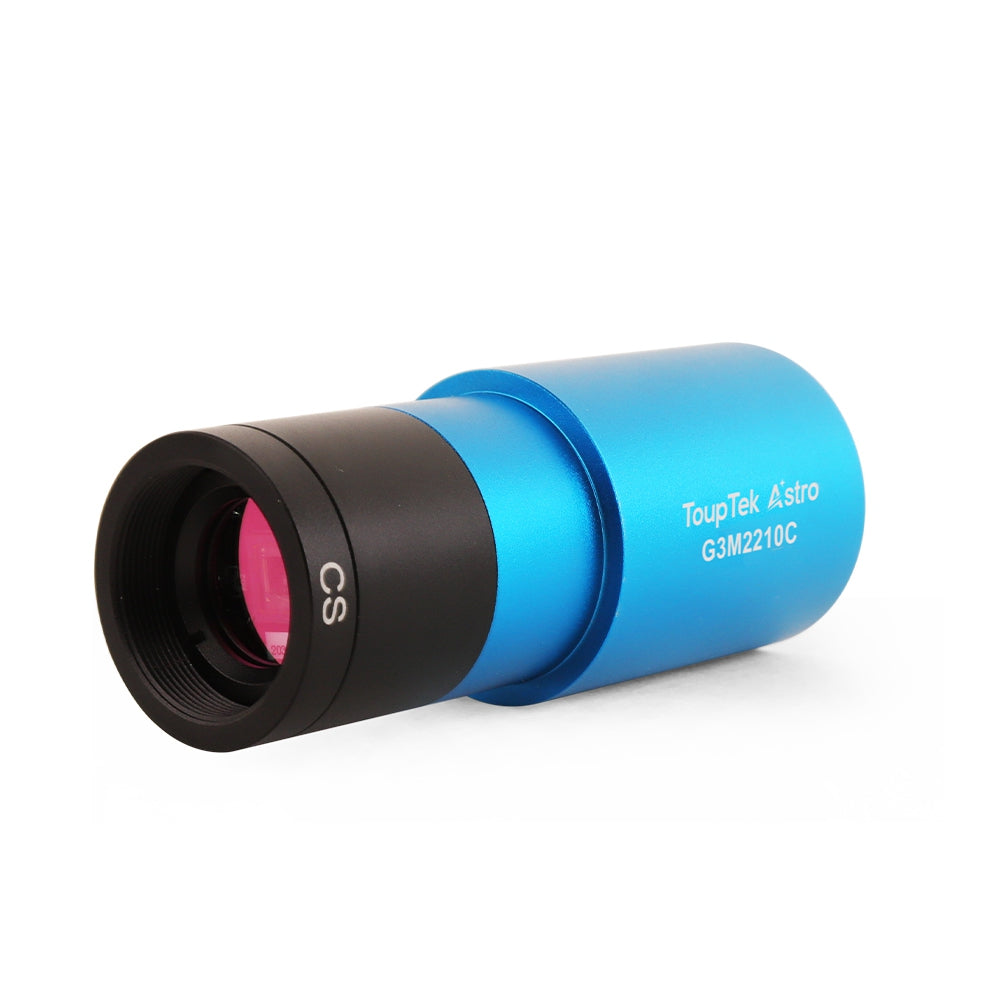

- Description
- Specifications
The ToupTek G3M2210C is a compact colour planetary camera featuring the Sony IMX585 back-illuminated CMOS sensor in a large 1/1.2" format. With 8.3 megapixels and a significantly larger sensor than typical planetary cameras, the G3M2210C captures a wider field of view while still delivering the high frame rates needed for effective lucky imaging. The larger sensor makes it particularly well-suited for planetary conjunction shots, full-disc lunar captures, and high-resolution widefield planetary work.
Product Overview
The G3M2210C uses Sony's IMX585 1/1.2" BSI sensor in a colour (RGGB Bayer) configuration. The 512MB DDR3 buffer enables stable USB 3.0 data delivery, and HCG and LCG gain modes allow optimization for different target brightness levels. Hardware ROI permits higher frame rates at reduced sensor area when speed is more important than field coverage. Zero amp-glow is achieved at the hardware level for clean captures at all gain settings.
Who Is This Product Best For?
The G3M2210C is ideal for intermediate and advanced imagers who want the widest possible field of view in a compact planetary camera. The large 1/1.2" sensor is excellent for multi-planet imagery, full-disc planetary captures, and wide-field lunar mosaic work where smaller sensor cameras require many more panels to cover the same area.
Why Choose This Product?
- Large 1/1.2" Sony IMX585 sensor — much wider field of view than 1/2.8" planetary cameras
- 8.3MP colour imaging — high detail across the full planetary or lunar disc
- HCG / LCG mode switching — flexible for both dim and bright solar system targets
- 512MB DDR3 buffer — stable high-speed data delivery at planetary frame rates
- Zero amp-glow at hardware level — consistently clean frames at any gain
- Compact C-mount body — easy integration with standard telescope setups
Recommended Uses
- Wide-field planetary captures covering full planetary discs in a single frame
- Multi-planet conjunction photography
- Full-disc and wide-field lunar imaging
- Solar disc imaging with appropriate filters
- Lucky imaging with wider-field stacking
Compatibility and Accessory Notes
- Connection: C-mount (Standard and Extended versions available)
- Filters: 1.25" mounted filters via included extension tube
- Software: ToupSky, SharpCap, FireCapture, NINA, PHD2, ASCOM; INDI for Linux
- Power: USB 3.0 bus-powered
Important Limitations
- Not for deep-sky imaging — uncooled; thermal noise accumulates in long exposures
- Not for visual observing — requires computer and capture software
- Colour output — for narrowband or LRGB work, consider the G3M2210M monochrome version
- Large sensor generates more data — fast storage and USB 3.0 host recommended
Frequently Asked Questions
What is the difference between the G3M2210C and the G3M678C?
Both are 8.3MP cameras but with different sensors and formats. The IMX678 in the G3M678C has a 1/1.8" format with 2.0 µm pixels; the IMX585 in the G3M2210C has a larger 1/1.2" format with 2.9 µm pixels and a wider field of view. The IMX585 captures a broader sky area in a single frame, while the IMX678 has slightly smaller pixels for higher angular sampling at equivalent focal lengths.
What software is compatible?
ToupSky, SharpCap, FireCapture, NINA, PHD2, and all ASCOM-compatible platforms. INDI drivers are available for Linux users.
Our Recommendation
If you want the widest possible field coverage from a compact planetary camera without moving to the larger G3CMOS series, the ToupTek G3M2210C is an excellent choice. Its 1/1.2" IMX585 sensor covers significantly more sky than standard 1/2.8" planetary cameras, making it ideal for full-disc planetary shots, conjunctions, and wide lunar captures. For narrowband or LRGB work, choose the G3M2210M. For deep-sky imaging, see ToupTek's ATR and SkyEye cooled series.
| Specification | Detail |
|---|---|
| Sensor | Sony IMX585 (Colour, RGGB Bayer, BSI) |
| Sensor Format | 1/1.2" |
| Resolution | 8.3 MP (3840 × 2160) |
| Pixel Size | 2.9 µm |
| ADC | Native 12-bit |
| Buffer | 512MB DDR3 |
| Gain Modes | HCG, LCG |
| Hardware ROI | Yes |
| Interface | USB 3.0 |
| Mount | C-mount / CS-mount |
| Back Focus (Standard) | 17.5 mm |
| Back Focus (Extended) | 12.5 mm |
| Filter Compatibility | 1.25" mounted filters via extension tube |
| Cooling | None (uncooled) |
| Amp Glow | Zero amp-glow (hardware level) |
| Power | USB 3.0 bus-powered |
| OS Compatibility | Windows, Linux, macOS (INDI) |
| Software | ToupSky, SharpCap, FireCapture, NINA, PHD2, ASCOM |
You may also like
Recently viewed
Recent Blog Posts
View all
Your Guide Graph Is Lying to You
Read More
D-Size vs V-Size: A Complete Guide to Telescope Dovetail Systems
Read More
What Is Back Focus in Astrophotography? Telescope Reducers, Flatteners, and Spacing Explained
Read More