

- Description
- Specifications
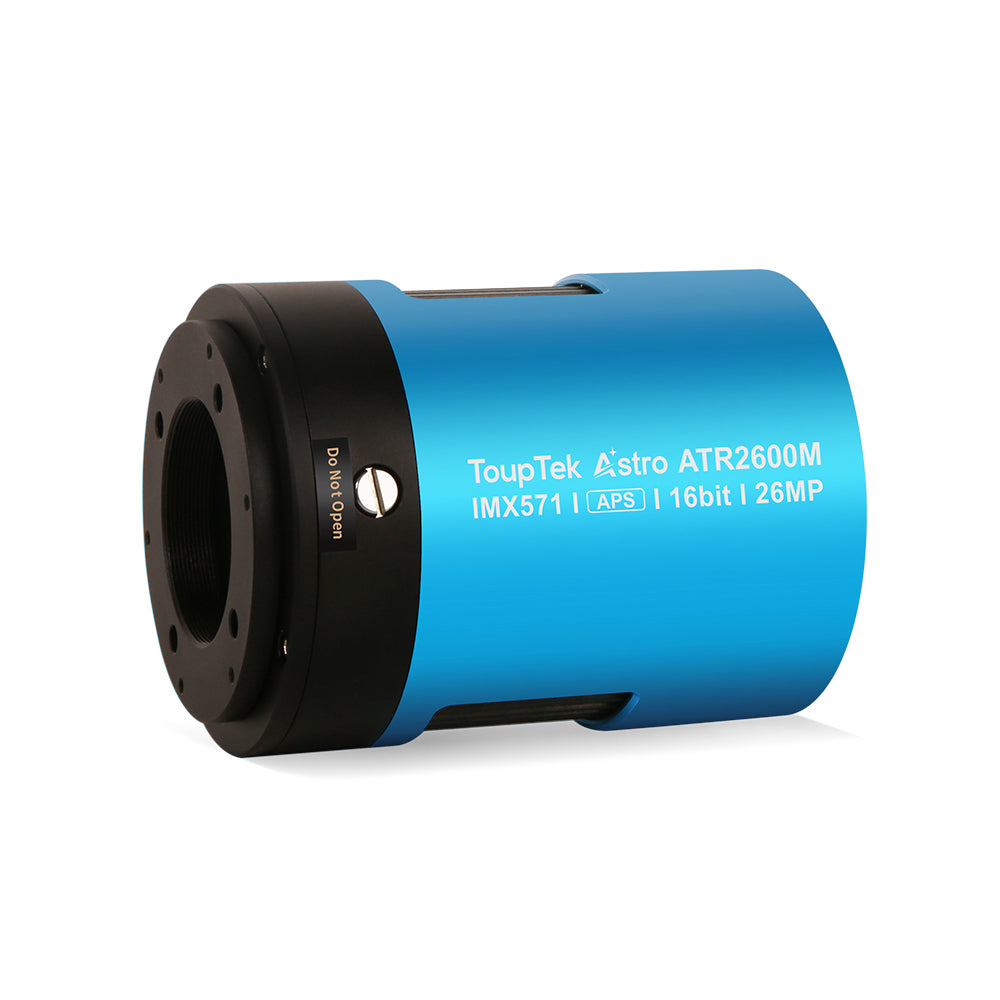
The ToupTek ATR2600M is a flagship monochrome deep sky cooled camera built around the Sony IMX571 APS-C format back-illuminated CMOS sensor. The IMX571 is one of the most respected deep sky imaging sensors available — delivering exceptional quantum efficiency, extremely low read noise, and a large APS-C image circle that covers nearly all telescope field sizes. The ATR2600M represents ToupTek's highest-performance monochrome deep sky camera.
Who Is This Product Best For?
The ATR2600M is best suited for serious and advanced astrophotographers who use full narrowband and LRGB filter sets for deep sky imaging. Its APS-C sensor format makes it compatible with the widest range of telescopes and imaging systems. It is the camera of choice for demanding narrowband imaging projects including full Hubble Palette (SHO) composites and extended mosaic work.
Why Choose This Product?
- Sony IMX571 APS-C Monochrome Sensor: Industry-leading sensitivity, ultra-low read noise, and a large APS-C image circle for maximum field coverage.
- Dual-Stage TEC Cooling: Up to 45°C below ambient with ±0.1°C precision control — essential for long narrowband exposures.
- Anti-Dew Window Heater: Four-level adjustable heating for condensation-free operation in all conditions.
- 512 MB DDR3 Buffer + USB 3.0 5 Gbps: Stable high-speed data transfer for demanding APS-C resolution imaging.
- Zero Glow Design: Minimizes amp glow artifacts that can contaminate long-exposure frames.
- Up to 1-Hour Exposures: Captures the faintest faint nebular extensions and galaxy halos.
- HCG/LCG/HDR Multi-Mode: Optimizes sensor performance for different imaging targets and sky conditions.
- Bonus Inclusion: Free Tilter included with purchase for improved flat field correction across the APS-C image circle.
Recommended Uses
- Full narrowband (Ha, SII, OIII) Hubble Palette imaging of emission nebulae
- LRGB monochrome deep sky imaging of galaxies and nebulae
- Large-scale multi-panel mosaic projects
- Long-exposure scientific and photometric imaging
Compatibility and Accessory Notes
- Requires external 12V 3A DC power supply or stable 11–14V lithium battery
- Compatible with ToupTek OAG-L, OAG-X, AFW-L filter wheel, and StellaVita controller
- APS-C sensor requires 2" or 36mm filters to avoid vignetting
- M42 thread connection; adapters may be required for some telescopes
- Compatible with INDI, ASCOM, SharpCap, NINA, and APT
Important Limitations
- External power supply required — not USB-powered
- Monochrome sensor — requires separate filter sets for colour imaging
- APS-C sensor requires 2" or 36mm filters to avoid vignetting — 1.25" filters will not fully cover the sensor
- Not recommended for beginners without prior experience with cooled monochrome cameras
Frequently Asked Questions
Why is the IMX571 considered a top deep sky sensor?
The IMX571 combines APS-C size, back-illuminated architecture, exceptional quantum efficiency, and ultra-low read noise — making it one of the most versatile and high-performing sensors for deep sky imaging across a wide range of telescope types.
What filter size do I need?
36mm unmounted or 2" mounted filters are required to cover the APS-C sensor without vignetting. 1.25" filters are not recommended for this sensor.
What is the Free Tilter included for?
The included tilter allows fine adjustment of the camera angle relative to the imaging plane, helping to achieve a flat, evenly-illuminated field across the large APS-C sensor circle.
Our Recommendation
The ToupTek ATR2600M is the pinnacle of ToupTek's monochrome deep sky camera lineup. If you are serious about narrowband imaging and want an APS-C format camera that will serve demanding imaging projects for years, the ATR2600M is an outstanding investment. The free tilter adds immediate practical value. Not recommended for beginners or those new to monochrome filter-based imaging.
| Specification | Detail |
|---|---|
| Sensor | Sony IMX571 (Monochrome, APS-C, BSI) |
| Sensor Format | APS-C (23.5 × 15.7mm) |
| Resolution | 26.1 MP (6252 × 4176) |
| Pixel Size | 3.76 µm |
| Cooling | Dual-stage TEC (ΔT -45°C below ambient) |
| ADC | 16-bit |
| Buffer | 512MB DDR3 |
| Full Well | 51 ke⁻ |
| Read Noise | 1.0 e⁻ min |
| Dynamic Range | ~86 dB |
| Interface | USB 3.0 |
| Power | 12V DC |
| Back Focus | 17.5 mm |
| Front Thread | M54×0.75 |
| Anti-Dew | Yes |
| Amp Glow | Zero amp-glow |
| Included | M42 Tilter (free) |
| OS Compatibility | Windows, Linux, macOS (INDI) |
| Software | ToupSky, SharpCap, NINA, PHD2, ASCOM |
You may also like
Recently viewed
Recent Blog Posts
View all
Your Guide Graph Is Lying to You
Read More

D-Size vs V-Size: A Complete Guide to Telescope Dovetail Systems
Read More

What Is Back Focus in Astrophotography? Telescope Reducers, Flatteners, and Spacing Explained
Read More