
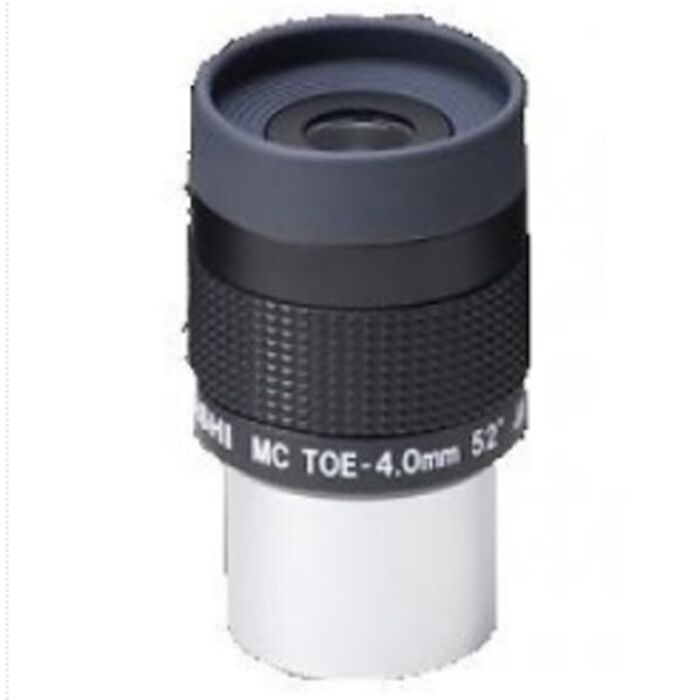

- Description
- Specifications
- Downloads
Product Overview
The TOE 4 mm is built for high-magnification visual observing. Paired with a premium telescope, Takahashi designed the TOE range to deliver performance close to the diffraction limit across the entire field of view. The apparent field is 52° — similar to Takahashi's LE series — with 10 mm of eye relief.
The optical design uses six elements in four groups, chosen to minimise spherical aberration, chromatic aberration, field curvature and astigmatism together rather than trading one against another.
Who It's For
This is a good match if you observe planets, the Moon or double stars and want a short-focal-length eyepiece that holds up under high power.
Key Features & Design
- 4 mm focal length: high magnification on any telescope.
- 52° apparent field: matched to Takahashi's LE series.
- 10 mm eye relief: generous for this focal length.
- 6 elements in 4 groups: controls spherical and chromatic aberration, field curvature and astigmatism.
- Close to the diffraction limit across the field: Takahashi's stated design target for the range on a premium telescope.
Optical / Mechanical Design
Six elements in four groups is a substantial design for a 4 mm eyepiece, and the element count is what buys the correction. Four separate aberrations are being controlled at once here — spherical and chromatic error, which soften the image everywhere, and field curvature and astigmatism, which specifically degrade the outer field. Simpler high-power designs typically correct the centre and let the edges go, or hold the field and give up eye relief. Retaining 10 mm of eye relief at 4 mm focal length is the practical benefit: the eye sits at a workable distance rather than pressed against the lens, which matters over a long planetary session.
Recommended Uses
High-magnification visual observing: planetary detail, lunar features, and splitting double stars.
Compatibility and Accessory Notes
Fits standard focusers and diagonals. Takahashi publishes this eyepiece as not parfocal, so a touch of refocusing is needed when swapping eyepieces. The TOE line also includes 3.3 mm, 5.5 mm, 7.5 mm and 10 mm focal lengths, all of which we stock — tell us your telescope's focal length and we will suggest a set that spaces the magnifications sensibly.
Good to Know Before You Order
A visual eyepiece: designed for the eye rather than a sensor, with no application in a prime-focus imaging train.
Not parfocal: refocusing is needed between TOE focal lengths.
Magnification depends on your telescope: divide your focal length by 4. On a long instrument that is a lot of magnification, so it pairs well with a longer TOE for less steady nights.
Frequently Asked Questions
Is it difficult to set up?
No — it drops into the focuser or diagonal like any eyepiece, with a touch of refocusing when you swap.
What magnification will I get?
Your telescope's focal length divided by 4. A 1000 mm telescope gives 250x.
What is it best used for?
Planets, the Moon, and double stars.
How does it compare with the 3.3mm?
Same 52° field and 10 mm eye relief; the 3.3 mm gives more magnification and asks more of the seeing.
Can I use it for astrophotography?
It is a visual eyepiece with no application in a prime-focus imaging train.
Bottom Line
A six-element 4 mm eyepiece with a 52° field and 10 mm of eye relief — Takahashi's high-power option for planetary and lunar work.
| Product name | TOE 4mm Eyepiece |
|---|---|
| Product code | TKA00615 |
| Focal length | 4mm |
| Apparent field of view | 52° |
| Eye relief | 10mm |
| Optical design | 6 elements in 4 groups |
| Parfocal | No |
| Application | Visual observing — not for astrophotography |
Shopping Guide
- Takahashi English Catalog 2025 — PDF, 8.63 MB
You may also like
Recently viewed
Recent Blog Posts
View all
Your Guide Graph Is Lying to You
Read More

D-Size vs V-Size: A Complete Guide to Telescope Dovetail Systems
Read More

What Is Back Focus in Astrophotography? Telescope Reducers, Flatteners, and Spacing Explained
Read More