

- Description
- Specifications
- Downloads
Product Overview
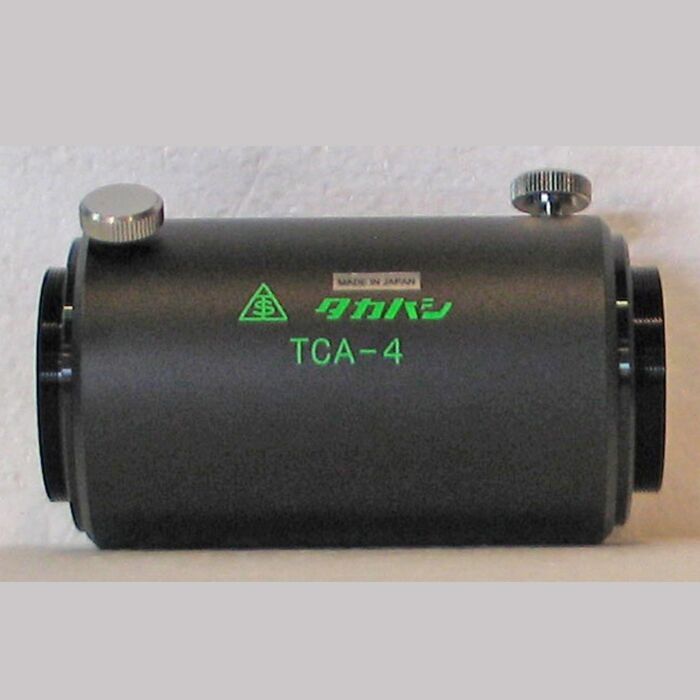
The TCA-4 is Takahashi's camera adapter for variable eyepiece projection, accepting both .965″ and 1.25″ eyepieces. Eyepiece projection puts an eyepiece between the telescope and the camera and uses it to magnify the image onto the sensor — a way of reaching effective focal lengths far beyond the telescope's native figure, which is what lunar and planetary imaging often calls for.
The "variable" part is what makes it useful: the projection distance adjusts, and that distance sets the amount of magnification. One adapter and one eyepiece therefore cover a range of image scales rather than a single fixed one.
Who It's For
This is a good match if you image the Moon or planets and want more image scale than prime focus provides, using eyepieces you already own.
Key Features & Design
- Variable projection distance: magnification adjusts rather than being fixed.
- Takes .965″ and 1.25″ eyepieces: including older Takahashi .965″ oculars.
- Mechanical adapter: the magnification comes from the eyepiece you fit, not from optics built into the adapter.
Optical / Mechanical Design
In eyepiece projection the eyepiece sits inside the imaging train and projects a magnified real image onto the sensor. The magnification depends on the eyepiece's focal length and on how far the sensor sits behind it — extend the distance and the image scale grows. A fixed-length adapter locks you to one figure; the TCA-4's adjustable projection distance lets you tune the scale to the target and the seeing on the night, which matters because the useful magnification on any given evening is set by the atmosphere rather than by the equipment.
Recommended Uses
High-magnification lunar and planetary imaging, where prime focus gives a smaller image scale than the target deserves.
Compatibility and Accessory Notes
Accepts .965″ and 1.25″ eyepieces. Takahashi does not publish the camera-side thread or mount for the TCA-4 on this listing, so the connection to your particular camera body is the piece worth confirming — send us your camera and the eyepiece you plan to project with, and we will confirm the fit and the adapters you need.
Good to Know Before You Order
The eyepiece and camera are separate: the TCA-4 is the mechanism that holds them in relation to each other. The image scale comes from the eyepiece you fit and the distance you set.
Camera-side connection is not published here: that is the detail to pin down for your body, and it is a quick check for us.
Best suited to bright targets: projection magnification spreads the light over more pixels, which suits the Moon and planets rather than faint deep-sky objects.
Frequently Asked Questions
Is it difficult to set up?
The assembly itself is straightforward — eyepiece in, camera on, distance set. Finding the projection distance that gives the scale you want takes a little experimentation on the first night, and that is normal for projection work.
What eyepieces does it take?
.965″ and 1.25″.
What is it best used for?
Lunar and planetary imaging at high magnification.
How is this different from prime focus?
Prime focus uses the telescope alone and gives its native focal length. Eyepiece projection adds an eyepiece to magnify the image further, at the cost of brightness.
Will it fit my camera?
Tell us the body and we will confirm the connection for you.
Bottom Line
A variable eyepiece projection adapter for .965″ and 1.25″ eyepieces — the route to high image scale on the Moon and planets, with the scale adjustable to the night.
| Product name | TCA-4 Camera Eyepiece Projection |
|---|---|
| Product code | TKA00210 |
| Eyepiece sizes accepted | .965" and 1.25" |
| Projection | Variable |
| Optics | None in the adapter — magnification comes from the fitted eyepiece |
| Application | Lunar and planetary imaging |
Shopping Guide
- Takahashi English Catalog 2025 — PDF, 8.63 MB
You may also like
Recently viewed
Recent Blog Posts
View all
Your Guide Graph Is Lying to You
Read More
D-Size vs V-Size: A Complete Guide to Telescope Dovetail Systems
Read More
What Is Back Focus in Astrophotography? Telescope Reducers, Flatteners, and Spacing Explained
Read More