

- Description
- Specifications
- Downloads
Product Overview
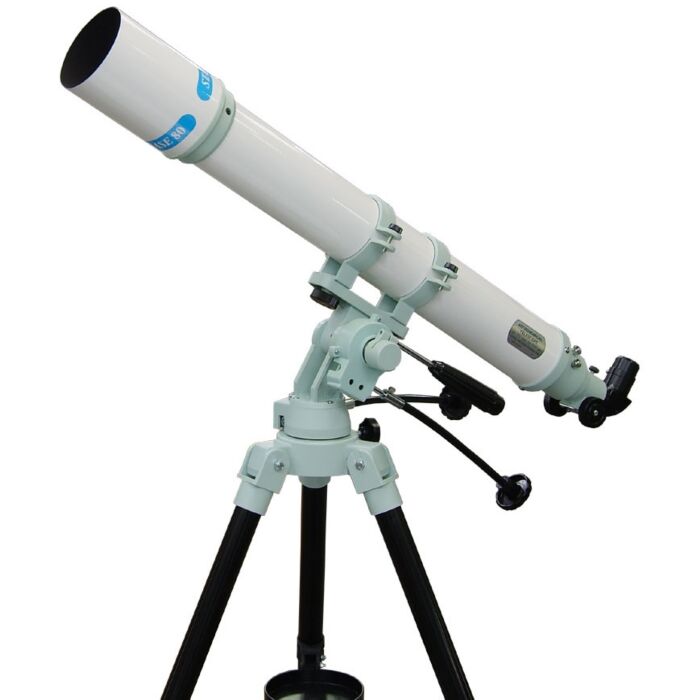
The Starbase 80 is Takahashi's entry-level telescope and a complete observing outfit rather than an optical tube. It is an 80 mm f/10 achromatic doublet refractor at 800 mm focal length, supplied with an alt-azimuth mount with slow-motion controls, an adjustable tripod, a star diagonal, and two orthoscopic eyepieces at 6 mm and 14 mm.
It is made in Japan under contract to Takahashi at a factory in Hanamaki. From lens coating to final assembly, every step is carried out there by the factory's craftsmen.
Who It's For
This is a good match if you want a complete, ready-to-observe refractor with Takahashi's build behind it — particularly for the Moon, planets and double stars, which is where an f/10 achromat is at its best. Everything needed for a first night is in the box.
Key Features & Design
- 80 mm f/10 achromatic doublet: 800 mm focal length.
- Complete outfit: alt-azimuth mount, tripod, star diagonal and two eyepieces included.
- 6 mm and 14 mm orthoscopic eyepieces: roughly 133x and 57x on this telescope.
- Alt-azimuth mount with slow motion controls: intuitive up-down, left-right movement with fine adjustment for tracking by hand.
- 1.25″ single-speed rack-and-pinion focuser.
- Made in Japan: built at Hanamaki under contract to Takahashi.
Optical / Mechanical Design
An f/10 achromatic doublet is a deliberate choice rather than a compromise. Achromats show some colour fringing on bright objects, and the amount depends strongly on focal ratio — a fast achromat shows a great deal, a slow one very little. At f/10 the 80 mm objective is slow enough that false colour is well controlled on the Moon and planets, which is what this telescope is built for. The trade is a longer tube and a narrower field than a fast apochromat would give.
The two supplied orthoscopic eyepieces suit the same intent. Orthoscopics have a modest apparent field but excellent contrast and sharpness on axis, which is exactly the priority for lunar and planetary observing. At 800 mm, the 14 mm gives about 57x for general viewing and the 6 mm about 133x for close-up work — a sensible pair to start with.
Recommended Uses
Visual observing of the Moon, planets, double stars and brighter deep-sky objects. Its size and the alt-azimuth mount also make it straightforward to carry outside and set up quickly, and it works for terrestrial viewing.
Compatibility and Accessory Notes
The focuser takes 1.25″ eyepieces, so the whole standard 1.25″ range works with it, including Takahashi's own TPL Plössl and Starbase orthoscopic eyepieces — both of which we stock if you want to extend the magnification range beyond the two supplied. A 6x30 finder and bracket are available separately.
The mount is alt-azimuth, which moves in altitude and azimuth rather than following the sky's rotation on one axis. That suits visual observing well; for long-exposure astrophotography an equatorial mount is the usual requirement, and we can talk that through if imaging is where you are heading.
Good to Know Before You Order
Built for visual observing: the alt-azimuth mount and f/10 achromatic optics are aimed at the eye rather than a camera. Short exposures of the Moon are within reach; long-exposure deep-sky imaging asks for a different setup, and we can point you at one.
Some colour fringing on the brightest objects: that is inherent to an achromatic doublet, and f/10 keeps it modest — on the Moon and planets, which is this telescope's purpose, it is well controlled.
No case included.
Everything needed to observe is in the box: mount, tripod, diagonal and two eyepieces, so there is nothing else to buy before the first night.
Frequently Asked Questions
Is it difficult to set up?
No — the tripod legs adjust, the mount head takes the tube, and the alt-azimuth movement is the intuitive kind: up-down and left-right, with slow-motion controls for fine adjustment. There is no polar alignment to perform.
What is included?
The 80 mm optical tube, alt-azimuth mount, tripod, star diagonal, and 6 mm and 14 mm orthoscopic eyepieces.
What magnifications do the supplied eyepieces give?
About 57x with the 14 mm and about 133x with the 6 mm.
What is it best used for?
The Moon, planets, double stars and brighter deep-sky objects.
Can I photograph through it?
Short lunar exposures work. Long-exposure deep-sky imaging needs an equatorial mount and a different optical approach.
Can I add more eyepieces?
Yes — the focuser is a standard 1.25″ fitting. Takahashi's TPL and Starbase eyepieces are natural additions and we stock them.
Bottom Line
A complete 80 mm f/10 refractor made in Japan — mount, tripod, diagonal and two orthoscopic eyepieces included, set up for the Moon, planets and double stars from the first night.
| Product name | Starbase 80 |
|---|---|
| Product code | STK08000 |
| Aperture | 80mm |
| Focal length | 800mm |
| Focal ratio | f/10 |
| Optical design | Achromatic doublet refractor |
| Focuser | Rack and pinion, single speed, 1.25" |
| Mount | Alt-azimuth with slow motion controls |
| Tripod | Included, adjustable legs |
| Included accessories | Star diagonal; 6mm and 14mm orthoscopic eyepieces |
| Mount weight | 8.2 lbs |
| Manufactured | Hanamaki, Japan |
| Case included | No |
Shopping Guide
- Takahashi English Catalog 2025 — PDF, 8.63 MB
You may also like
Recently viewed
Recent Blog Posts
View all
Your Guide Graph Is Lying to You
Read More
D-Size vs V-Size: A Complete Guide to Telescope Dovetail Systems
Read More
What Is Back Focus in Astrophotography? Telescope Reducers, Flatteners, and Spacing Explained
Read More