
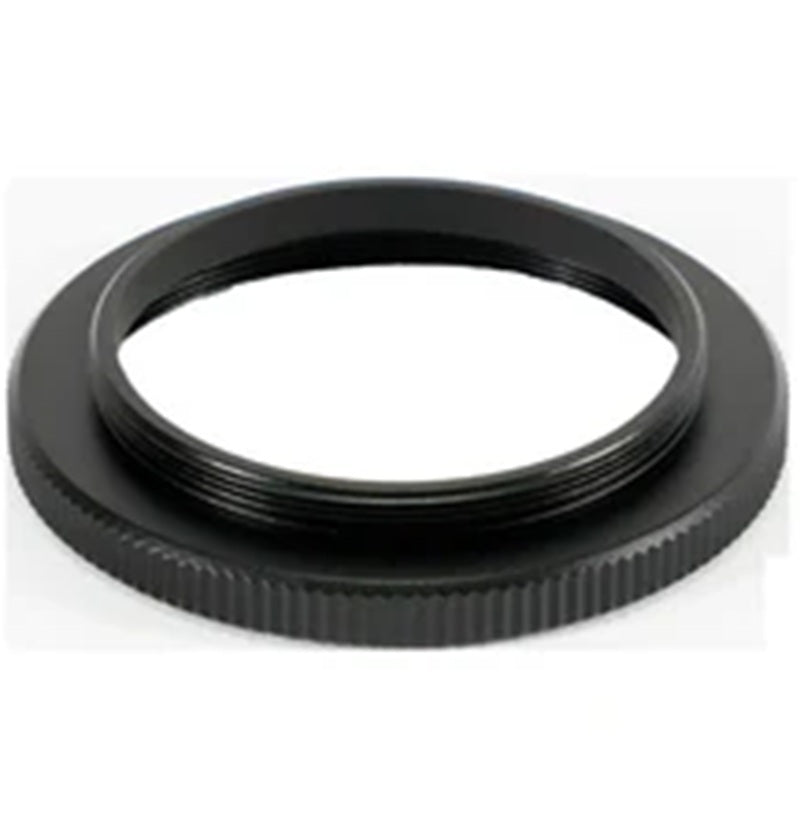

- Description
- Specifications
- Downloads
Product Overview
A Takahashi thread adapter ring that converts between M52 and M48 in an imaging train. M48 is the widely used 2-inch filter thread that most camera adapters, filter drawers and spacers are built around, so a ring like this is often the piece that lets a Takahashi corrector meet the rest of a train without an improvised solution in the middle.
Who It's For
This is a good match if you have an M52 thread on one side of your imaging train and an M48 interface on the other, and you want Takahashi's own ring rather than a third-party adapter to bridge them.
Key Features & Design
- M52 to M48 conversion: the two thread standards named in the model.
- Mechanical only: no optical elements — it does not change focal length, focal ratio or field.
- Takahashi-made: machined to Takahashi's own thread tolerances, which is the reason to use the manufacturer's ring in a train built around their correctors.
Recommended Uses
Joining an M52 component to an M48 one in a Takahashi imaging train — between a corrector and a camera adapter, between spacers, or where a filter drawer or accessory arrives on the M48 standard.
Compatibility and Accessory Notes
Takahashi publishes M52 × 0.75 as the camera-side thread on the FC/FS Multi Flattener 1.04x and on the Multi Reducer 0.85x, so that is the most common place an M52 face turns up in a Takahashi train. If that is the M52 in your setup, tell us and we will confirm the pairing before you order.
Takahashi publishes the thread standards for this ring but not its optical length, and optical length is what decides whether your train still lands on its required backfocus. Send us the corrector, spacers and camera you are joining and we will work the total through with you.
If you need M52 to M54 instead, that is a separate Takahashi ring — the M52-M54 Ring — and we stock it alongside this one.
Good to Know Before You Order
Optical length is not published: every ring in a train adds to the backfocus total. If your corrector has a spacing figure to hit, that total is the thing to get right — and it is a calculation we are happy to do for you.
Mechanical only: this ring changes the thread, nothing else. It has no effect on focal length, focal ratio, image circle or corner correction.
Thread pitch is not published either: Takahashi lists the ring by its M52 and M48 designations without stating the pitch on each face. If you are mating it to a non-Takahashi component, send us the part and we will confirm the thread before you order.
Frequently Asked Questions
Is it difficult to set up?
No — it threads on between the two components. The thinking happens beforehand, in the backfocus total.
What threads does it convert?
M52 and M48.
Does it change my focal length or image circle?
No — there are no optics in it.
Where does the M52 side usually connect?
Takahashi publishes M52 × 0.75 as the camera-side thread on the FC/FS Multi Flattener 1.04x and the Multi Reducer 0.85x. Send us your corrector and we will confirm it against your train.
How do I know it will not upset my spacing?
Send us your train and we will add it up. That is the part worth checking, and it takes us a couple of minutes.
What is the difference between this and the M52-M54 ring?
Only the camera-side thread. This one lands on M48, the 2-inch filter thread standard; the other lands on M54.
Bottom Line
A Takahashi M52-to-M48 thread ring — the piece that joins a Takahashi corrector to the M48 standard the rest of an imaging train is usually built on, with the backfocus total being the thing to confirm.
| Product name | M52-M48 Ring |
|---|---|
| Product code | TSB00261 |
| Thread A | M52 |
| Thread B | M48 |
| Thread pitch | Not published by Takahashi |
| Optical length | Not published by Takahashi |
| Optics | None — mechanical adapter only |
Shopping Guide
- Takahashi English Catalog 2025 — PDF, 8.63 MB
You may also like
Recently viewed
Recent Blog Posts
View all
Your Guide Graph Is Lying to You
Read More

D-Size vs V-Size: A Complete Guide to Telescope Dovetail Systems
Read More

What Is Back Focus in Astrophotography? Telescope Reducers, Flatteners, and Spacing Explained
Read More