

- Description
- Specifications
- Downloads
Product Overview
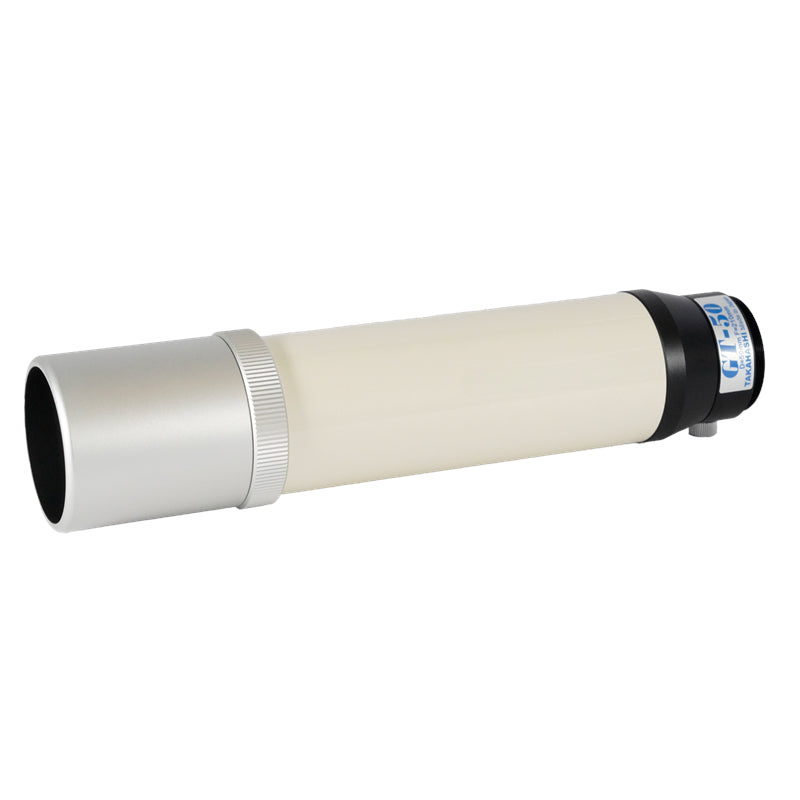
The GT-50 is Takahashi's compact guidescope: a 50 mm two-element cemented achromat at 210 mm focal length, working at roughly f/4.2. It is 253 mm long, 53 mm in tube diameter, and weighs about 350 g — light enough to carry alongside a main optical tube without eating meaningfully into mount payload.
Takahashi's "GT" tube holders — the versions with a built-in guide-telescope mounting point — are designed around this guider, which is why the naming matches.
Who It's For
This is a good match if you are imaging with a Takahashi refractor on a GT-series tube holder and want the guider the holder was designed to carry.
Key Features & Design
- 50 mm aperture, 210 mm focal length: a conventional guidescope focal length, long enough to give a guide star reasonable image scale.
- Two-element cemented achromat: a simple, stable design — guiding needs a stable centroid rather than colour-perfect optics.
- Approx. 350 g, 253 mm long, Ø53 mm tube: minimal load on the mount.
- Matched to Takahashi GT holders: the GT tube holders carry a mounting point built for this guider.
Optical / Mechanical Design
Guiding works by watching a star through a second, smaller telescope and feeding corrections to the mount so a long exposure through the main instrument stays on target. What matters in a guidescope is not resolution but rigidity — any flexure between guider and main tube shows up as drift the software cannot correct, because the guider reports the star as stationary while the main optic moves. That is the argument for a short, light, stiff tube mounted directly to the same holder as the main telescope rather than on a bracket of its own, which is exactly what the GT arrangement gives.
At 210 mm and 350 g it is a sensible pairing for the small and mid-size Takahashi refractors.
Recommended Uses
Autoguiding long-exposure deep-sky astrophotography on a Takahashi refractor.
Compatibility and Accessory Notes
Mounts to Takahashi's GT-series tube holders. We stock those — including the 125 mm GT for the TSA-120 and FSQ-106EDX, the 95DS-GT for the FC-100DL and the 68S-GT for the FOA-60.
The GT Mount Adapter (Takahashi code KA00556) is the part that takes a camera or eyepiece at the back: M42 P0.75 at both ends, or 31.7 mm, and it ships with two lock screws and the GT-50 seal. It is a separate item — tell us which guide camera you are using and we will confirm whether you need it.
Good to Know Before You Order
The guide camera is separate: the GT-50 is the optic. Most modern guide cameras thread or slot straight in via the GT Mount Adapter.
Designed around GT holders: if your tube holder is not a GT version, tell us what you have and we will work out how to mount it.
An achromat, deliberately: guiding does not need apochromatic correction, and the simpler design keeps the weight and the price down.
Frequently Asked Questions
Is it difficult to set up?
On a GT tube holder it mounts directly, which is the point of the pairing. The setup work is on the software side — calibrating the guider with your mount — and that is the same for any guidescope.
What are the optical specs?
50 mm aperture, 210 mm focal length, two-element cemented achromat.
How much does it weigh?
About 350 g, and it is 253 mm long.
What connects my guide camera?
The GT Mount Adapter — M42 P0.75 or 31.7 mm. Sold separately; ask us and we will confirm what your camera needs.
Bottom Line
A 50 mm, 210 mm, 350 g achromatic guidescope built to ride on Takahashi's own GT tube holders.
| Product name | GT-50 |
|---|---|
| Product code | GT05000 (Takahashi) / TGT5000 (vendor SKU) |
| Optical design | Two-element cemented achromat |
| Aperture | 50mm |
| Focal length | 210mm |
| Tube outside diameter | Ø53mm |
| Overall length | Approx. 253mm |
| Weight | Approx. 350g |
| Mounting | Takahashi GT-series tube holders |
| GT Mount Adapter (KA00556, sold separately) | M42 P0.75 both ends / 31.7mm; supplied with 2 lock screws and GT-50 seal |
Shopping Guide
- Takahashi English Catalog 2025 — PDF, 8.63 MB
You may also like
Recently viewed
Recent Blog Posts
View all
Your Guide Graph Is Lying to You
Read More

D-Size vs V-Size: A Complete Guide to Telescope Dovetail Systems
Read More

What Is Back Focus in Astrophotography? Telescope Reducers, Flatteners, and Spacing Explained
Read More