

- Description
- Specifications
- Downloads
Product Overview
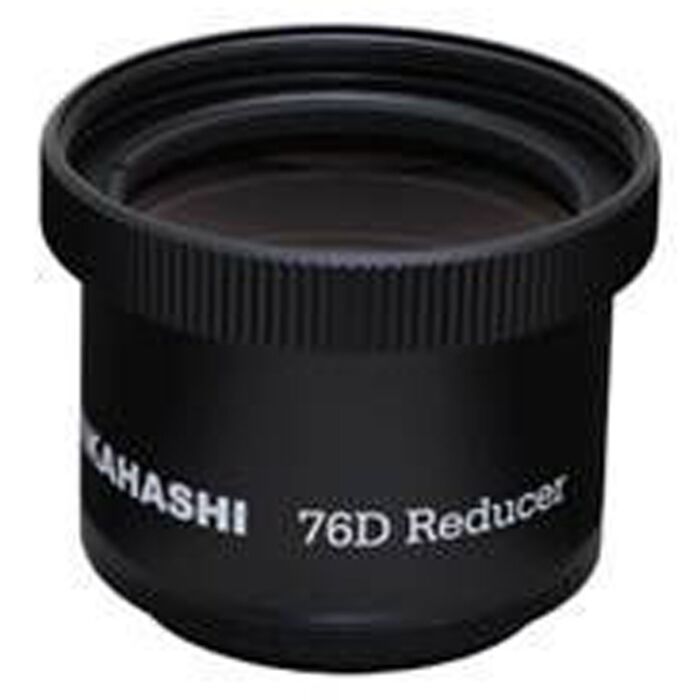
Takahashi's dedicated reducer for the FC-76D, and compatible with all FC-76 and FS-78 tubes. On the FC-76D it produces 417 mm at f/5.5 with a 36 mm image circle — a faster, wider system than the telescope's native configuration, with enough illuminated field to cover an APS-C sensor comfortably.
Who It's For
This is a good match if you image with an FC-76D, FC-76 or FS-78 and want a faster focal ratio and a wider field.
Key Features & Design
- 417 mm at f/5.5 on the FC-76D: the headline configuration this reducer was designed around.
- 36 mm image circle: consistent across all three compatible telescopes.
- Dedicated design: built for the FC-76D specifically rather than adapted from a general-purpose corrector.
- Also fits FC-76 and FS-78: each with its own resulting focal length and ratio.
Optical / Mechanical Design
A reducer shortens effective focal length and speeds the focal ratio, which shortens exposures and widens the field — but only holds up if the corners stay sharp. Takahashi publishes a 36 mm image circle for this reducer on all three compatible tubes, which covers an APS-C sensor (roughly 28 mm diagonal) with real margin, and reaches most of a full-frame sensor's 43 mm diagonal without covering its corners. The three telescopes each land at a slightly different focal length behind it — 417 mm on the FC-76D, 438 mm on the FC-76, 462 mm on the FS-78 — because each starts from a different native focal length.
Recommended Uses
Wide-field deep-sky imaging on a small Takahashi refractor: large nebulae, star fields, and widefield framing where the native focal ratio would ask for longer exposures.
Compatibility and Accessory Notes
| Telescope | Focal length with reducer | Focal ratio | Image circle |
|---|---|---|---|
| FC-76D | 417mm | f/5.5 | 36mm |
| FC-76 | 438mm | f/5.8 | 36mm |
| FS-78 | 462mm | f/5.9 | 36mm |
Takahashi does not publish the backfocus figure on this listing, and that is the number that decides corner star shape once your camera and filters are in the train. Send us the camera and any filter drawer or spacers you are running and we will work the total through with you before you order.
Good to Know Before You Order
An imaging corrector, not a visual one: it is designed for a camera at the focal plane and has no application in a visual train with an eyepiece.
36 mm image circle: that covers APS-C with margin. A full-frame sensor's corners fall outside it, so full-frame users should expect fall-off at the extremes.
Backfocus is not published here: it is the figure worth pinning down for your exact camera, and we will do that with you.
Frequently Asked Questions
Is it difficult to set up?
No — it threads into the train. The work is in getting the spacing to the sensor right, and that is a number we can give you for your setup.
What does it do to my focal length?
417 mm at f/5.5 on the FC-76D, 438 mm at f/5.8 on the FC-76, 462 mm at f/5.9 on the FS-78.
Will it cover my camera?
The 36 mm image circle covers APS-C comfortably. Full-frame corners sit outside it.
Which telescopes does it fit?
The FC-76D, all FC-76 tubes, and the FS-78.
Bottom Line
A dedicated reducer that takes the FC-76D to 417 mm at f/5.5 over a 36 mm field — a faster, wider version of a small Takahashi refractor for imaging.
| Product name | FC-76D Reducer |
|---|---|
| Product code | TKA18580 |
| Focal length with FC-76D | 417mm |
| Focal ratio with FC-76D | f/5.5 |
| Focal length with FC-76 | 438mm |
| Focal ratio with FC-76 | f/5.8 |
| Focal length with FS-78 | 462mm |
| Focal ratio with FS-78 | f/5.9 |
| Image circle | 36mm (all models) |
| Compatible telescopes | FC-76D, FC-76, FS-78 |
| Application | Astrophotography — not for visual use |
Shopping Guide
- Takahashi English Catalog 2025 — PDF, 8.63 MB
You may also like
Recently viewed
Recent Blog Posts
View all
Your Guide Graph Is Lying to You
Read More

D-Size vs V-Size: A Complete Guide to Telescope Dovetail Systems
Read More

What Is Back Focus in Astrophotography? Telescope Reducers, Flatteners, and Spacing Explained
Read More