
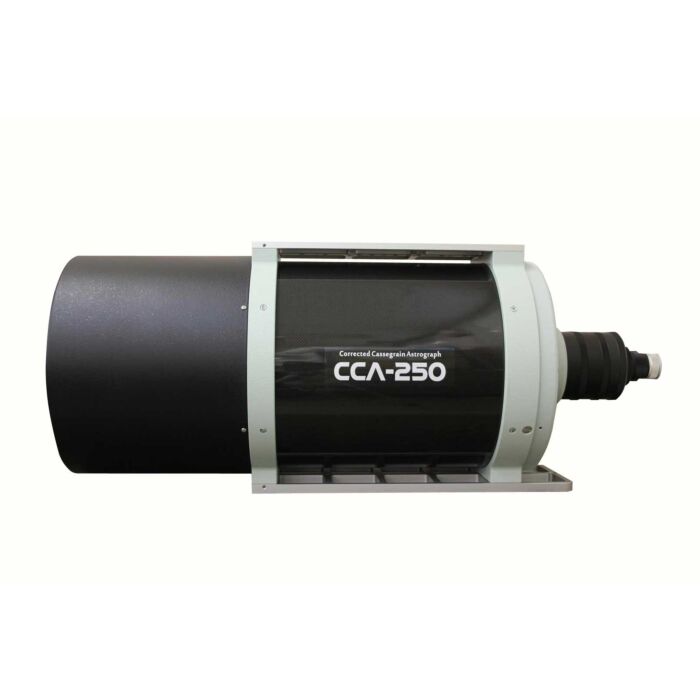

- Description
- Specifications
- Downloads
Product Overview
The CCA-250 replaces Takahashi's Baker-Ritchey-Chrétien BRC-250 as their flagship astrograph. It is a 250 mm aperture instrument working at 1250 mm and f/5 natively, built in carbon fibre, with electric focus driven by a moving secondary mirror rather than a conventional drawtube.
The "tri-focal" name describes its three working configurations: f/5 native, f/3.9 with the reducer, and f/8. That range covers wide-field deep-sky work at one end and high-resolution imaging at the other, from a single optical tube.
The optical performance figures are the headline: a 2 micron RMS spot radius on axis, and an Ø88 mm image circle spanning 4° of sky, 60% illuminated at its edge. Limiting stellar magnitude is 14.5.
Who It's For
This is a good match if you are equipping an observatory or a permanent pier and want one instrument that covers wide-field and high-resolution imaging without changing telescopes. The 88 mm image circle suits large-format sensors, and the computer-controlled focus fits a rig that runs unattended.
Key Features & Design
- 250 mm aperture at f/5: 1250 mm native focal length.
- Three focal ratios: f/5 native, f/3.9 with reducer, f/8.
- Ø88 mm image circle: 4° of sky, 60% illuminated at the edge — well beyond full-frame.
- 2 micron RMS spot radius on axis: the on-axis optical performance figure Takahashi publishes.
- Internal moving-secondary electric focus: computer-controlled over USB, with no external drawtube to flex.
- Carbon fibre tube: holds focus across temperature changes better than metal.
- Back focus 155.4 mm to 193.9 mm with the CAA removed.
- Limiting stellar magnitude 14.5.
Optical / Mechanical Design
Two design choices set this instrument apart from a conventional Cassegrain astrograph. The first is focusing by moving the secondary mirror internally rather than racking a drawtube: nothing outside the tube moves, so a heavy camera train never loads a focuser, and there is no drawtube flexure to introduce tilt as the telescope tracks. The focus motor is computer-controlled over USB, which is what makes automated focus runs practical on a rig that images unattended.
The second is carbon fibre. An aluminium tube changes length as it cools through the night, and on a fast f/5 system the depth of focus is shallow enough that thermal drift shows up in the stars. Carbon fibre's low coefficient of expansion largely removes that, which matters more here than it would on a slower instrument.
The Ø88 mm image circle is the figure that justifies the rest. A full-frame sensor spans 43 mm diagonally, so 88 mm leaves the entire frame well inside the well-corrected field, with room for medium-format sensors too. Combined with a 2 micron on-axis RMS spot, the system is resolving finer detail than most sensors will sample at 1250 mm.
Recommended Uses
Observatory-based deep-sky astrophotography across a wide range of targets: extended nebulae and galaxy fields at f/3.9, general deep-sky work at f/5, and small galaxies and planetary nebulae at f/8. Also usable visually.
Compatibility and Accessory Notes
The back focus range is 155.4 mm to 193.9 mm with the camera angle adjuster removed — generous, and enough to accommodate a filter wheel and off-axis guider in the train. The f/3.9 configuration requires the matching reducer, which is a separate item. We stock the CCA-250 reducer and the camera angle adjuster; tell us your camera, filter wheel and guiding arrangement and we will map the full train and its spacing with you before you order.
The optical tube is supplied without a mount. At 50.16 lb before a camera train, it wants a substantial equatorial mount — we can go through mount options with you.
Good to Know Before You Order
Mount not included: this is an optical tube assembly. The tube alone is 50.16 lb, and the camera, filter wheel and guider add to that, so the mount is a significant part of the decision. We are happy to work through it with you.
The reducer is separate: f/5 and f/8 are available from the tube as supplied; f/3.9 needs the matching reducer, which we stock.
Focus is computer-controlled: the electric moving-secondary focuser connects over USB to control software. That is a strength for automated imaging, and it does mean a computer is part of the setup rather than an optional extra.
Size: 34.25″ long and 12.05″ in outside diameter — an observatory or permanent-pier instrument rather than something to carry to a dark site.
Frequently Asked Questions
Is it difficult to set up?
The optics need no collimation fuss from you in normal use, and focus is handled by software rather than by hand. The demanding parts are the mount and the pier, which is true of any instrument this size — and we will help you specify both.
What are the three focal ratios?
f/5 native at 1250 mm, f/3.9 with the reducer, and f/8.
What sensor size will it cover?
The Ø88 mm image circle covers full-frame with a wide margin and reaches into medium format.
How much back focus do I have to work with?
155.4 mm to 193.9 mm with the CAA removed — room for a filter wheel and off-axis guider.
Does it need a computer?
The electric focuser is computer-controlled over USB, so yes for focusing.
Can I use it visually?
Yes — Takahashi describes it as a visual as well as a photographic instrument, though the design priorities are photographic.
Bottom Line
A 250 mm carbon fibre astrograph working at f/3.9, f/5 and f/8, with an 88 mm image circle and computer-controlled internal focus — an observatory instrument built to cover most of deep-sky imaging from one tube.
| Product name | CCA-250 Tri-Focal Astrograph |
|---|---|
| Product code | TCK25010 |
| Aperture | 250mm |
| Focal length | 1250mm |
| Focal ratio | f/5 native; f/3.9 with reducer; f/8 |
| Optical design | Tri-focal corrected Cassegrain astrograph |
| Image circle | Ø88mm (60% illuminated), 4° diameter |
| Optical performance | 2 micron RMS spot radius on axis |
| Limiting stellar magnitude | 14.5 |
| Focuser | Internal moving secondary, electric, computer-controlled via USB |
| Back focus | 155.4mm – 193.9mm (CAA removed) |
| Tube construction | Carbon fibre |
| Optical tube length | 34.25" |
| Optical tube diameter | 12.05" outside |
| Weight | 50.16 lbs |
| Mount | Not included |
Shopping Guide
- Takahashi English Catalog 2025 — PDF, 8.63 MB
You may also like
Recently viewed
Recent Blog Posts
View all
Your Guide Graph Is Lying to You
Read More
D-Size vs V-Size: A Complete Guide to Telescope Dovetail Systems
Read More
What Is Back Focus in Astrophotography? Telescope Reducers, Flatteners, and Spacing Explained
Read More