




- Description
- Specifications

Product Overview
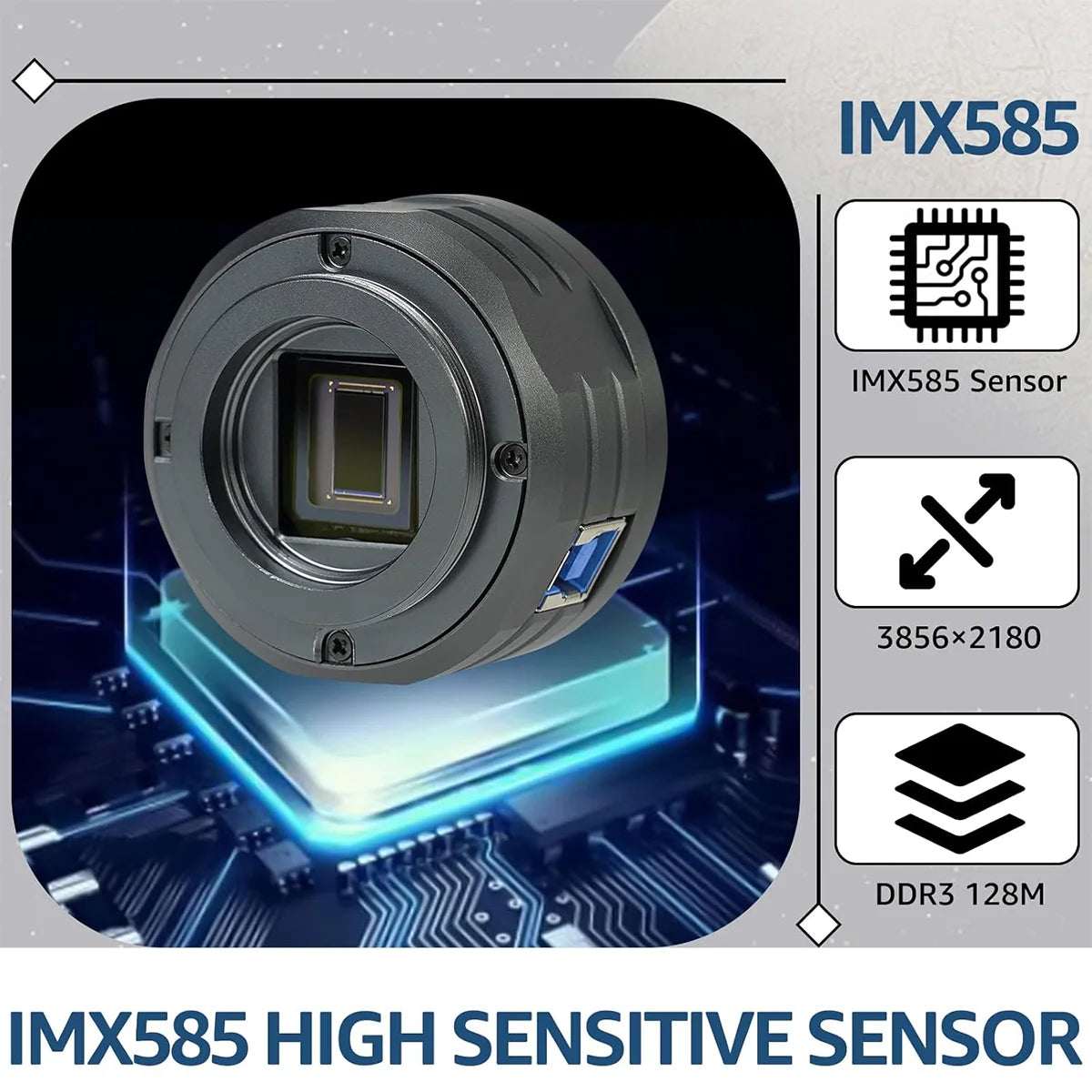
The SVBONY SV705C is an uncooled colour camera for planetary, lunar and solar imaging and electronically assisted astronomy, built on the Sony IMX585 back-illuminated sensor. The 1/1.2″ chip measures 11.2 x 6.3 mm (12.85 mm diagonal) and records 3856 x 2180 (8.3 MP) at 2.9 µm, at up to 45 fps full frame or 187 fps at 1920 x 1080 with ROI. SVBONY lists a QE peak of about 90%, read noise from 6.5 down to 0.7 e⁻, a 38 ke⁻ full well, 12-bit ADC, 128 MB buffer, USB 3.0 and an ST4 guide port.


Who It's For
This is a good match if you image planets and the Moon and want a larger 8.3 MP sensor than typical planetary cameras, or if you want one camera for planetary capture, live-stacked EAA of brighter deep-sky objects and guiding. SVBONY states the IMX585 has about 1.7 times the sensitivity and three times the full well of the IMX485.
Key Features & Design
- Sony IMX585 back-illuminated sensor: 8.3 MP, 2.9 µm pixels, around 90% peak QE and strong near-infrared response.
- No amp glow: SVBONY designs the camera to avoid amp glow at long exposures and high gain.
- HCG dual-gain mode: reduces read noise at high gain while keeping dynamic range.
- 38 ke⁻ full well: wide dynamic range for bright planets and lunar highlights.
- USB 3.0 with 128 MB buffer: frames are cached when the USB link is busy, helping slower computers.
- ROI and 2 x 2 binning; exposure 32 µs to 2000 s.


Camera Design
The IMX585 is a rolling-shutter colour sensor with back-illuminated pixels. Its 2.9 µm pixel size suits planetary imaging with a Barlow at moderate focal ratios, while the large 12.85 mm diagonal frames the whole lunar disc at shorter focal lengths and leaves room for planets to drift. ROI cropping raises the frame rate sharply on small targets, from 45 fps at full resolution to 187 fps at 1920 x 1080, and the ST4 port allows the camera to be used as an autoguider.


Recommended Uses
- Planetary imaging: Jupiter, Saturn, Mars and Venus in colour.
- Lunar and solar imaging: solar only with proper solar filtration.
- EAA and nebula imaging: SVBONY notes the near-infrared response for live-stacked deep-sky and nebula work.
- Autoguiding: ST4 with PHD2 and ASCOM.


Compatibility and Accessory Notes
- Adapters: 1.25″, 2″, M42 x 0.75, CS and C connections; an M42-CS adapter tube, T2 adapter and 1.25″ T-adapter are included.
- Back focus: SVBONY publishes 6.5 mm / 12.5 mm.
- Operating systems: Windows, Linux, Raspberry Pi, macOS and Chrome OS; drivers and software are on SVBONY's website.
- Computer: SVBONY recommends at least an Intel 4th-generation i5 with 4 GB RAM (desktop) or 6th-generation i5 with 8 GB RAM (laptop).
- Styles: SVBONY also offers the SV705C with an SV226 filter drawer, a 1.25″ UV-IR cut filter, a 1.25″ UHC filter or a filter kit; those are separate styles.


What's in the Box
- 1 x SVBONY SV705C planetary camera
- 1 x USB 3.0 cable
- 1 x ST4 guiding cable
- 1 x M42-CS adapter tube
- 1 x T2 adapter
- 1 x 1.25″ T-adapter
- 1 x 2″ dust cover
- 1 x user manual
- 1 x cleaning cloth


Good to Know Before You Order
- Prime-focus camera: it replaces the eyepiece; imaging through an eyepiece needs an eyepiece projection adapter.
- Mount: SVBONY recommends a refractor or reflector on an equatorial mount.
- Uncooled sensor: built for short exposures and live stacking rather than long cooled integrations.
- Weight: SVBONY publishes a package weight of 575 g; the camera measures Ø58 x 38.3 mm.


Frequently Asked Questions
Is it difficult to set up?
No. Install the driver and capture software from SVBONY's website, fit the 1.25″ T-adapter, slide the camera into your focuser or diagonal and connect USB 3.0. Focusing on a bright planet or the Moon is the main step.
Can I use it for deep-sky?
For live-stacked EAA and brighter nebulae, yes; SVBONY highlights its near-infrared sensitivity and lack of amp glow. For long-exposure deep-sky imaging, a cooled camera keeps noise lower.
Can it guide?
Yes. It has an ST4 port and works with PHD2 and ASCOM.
Bottom Line
In short: an 8.3 MP colour camera on the Sony IMX585 with 2.9 µm pixels, a 38 ke⁻ full well and no amp glow, suited to planetary, lunar and solar imaging, EAA and guiding.
| Model | SV705C |
|---|---|
| Sensor | IMX585 |
| Total pixels | 8.3 megapixels |
| Diagonal | 12.85 mm |
| Max resolution | 3856 x 2180 |
| Pixel size | 2.9 µm x 2.9 µm |
| Chip size | 11.2 mm x 6.3 mm |
| Frame rate | 45 fps |
| Shutter | Rolling shutter |
| Exposure range | 32 µs – 2000 s |
| Readout noise | 6.5 e⁻ – 0.7 e⁻ |
| QE peak | ≈90% |
| Full well | 38 ke⁻ |
| ADC | 12 bit |
| ROI | Yes |
| BIN | 1 x 1, 2 x 2 |
| Digital noise reduction | HCG |
| Compatible OS | Windows, Linux, Raspberry Pi, Mac OS, Chrome OS |
| Caching | 128 MB |
| Guiding port | ST4 |
| Data port | USB 3.0 |
| Adapter | 1.25″ / 2″ / M42 x 0.75 / CS / C |
| Back focal length | 6.5 mm / 12.5 mm |
| Protective window | AR coating |
| Working humidity | 30%–80% |
| Storage humidity | 20%–90% |
| Operating temperature | -10 °C to +50 °C |
| Storage temperature | -20 °C to +60 °C |
| Product size | Ø58 x 38.3 mm |
| Package weight | 575 g |
| Net weight | Not published by vendor |
| Recommended use | Planetary, lunar and solar imaging; EAA; autoguiding |
You may also like
Recently viewed
Recent Blog Posts
View all
Your Guide Graph Is Lying to You
Read More

D-Size vs V-Size: A Complete Guide to Telescope Dovetail Systems
Read More

What Is Back Focus in Astrophotography? Telescope Reducers, Flatteners, and Spacing Explained
Read More