




- Description
- Specifications

Product Overview
The SVBONY SV305C Pro is a compact uncooled colour camera built for autoguiding and for high-frame-rate planetary and lunar imaging. It uses the Sony IMX662 back-illuminated 1/2.8″ CMOS sensor with 2.9 µm pixels, records 1920 x 1080 at up to 99 fps over USB 3.0, and carries a 6-pin ST4 guide port for direct mount corrections. SVBONY lists read noise at 0.7 e⁻, peak QE at 91% and full well at 38.2 ke⁻. The body measures Ø49.5 x 65 mm and weighs 135 g.


Who It's For
This is a good match if you need a guide camera for a guide scope or off-axis guider and want the same camera to double as a colour planetary and lunar imager. The small 2.9 µm pixels suit short-focal-length guide scopes, and the 99 fps full-HD rate is fast enough for lucky imaging of Jupiter, Saturn, Mars and the Moon.
Key Features & Design
- Sony IMX662 back-illuminated sensor: 1/2.8″ colour CMOS, 2.9 µm pixels, with good near-infrared response and resistance to overexposure.
- 0.7 e⁻ read noise: keeps faint guide stars and short planetary frames clean.
- USB 3.0 (5 Gbps): SVBONY quotes ten times the throughput of USB 2.0 for smooth transfer during capture.
- ST4 guide port: works with PHD2 and ASCOM for autoguiding through the mount's guide input.
- 1920 x 1080 at 99 fps: high frame rate for planetary lucky imaging.
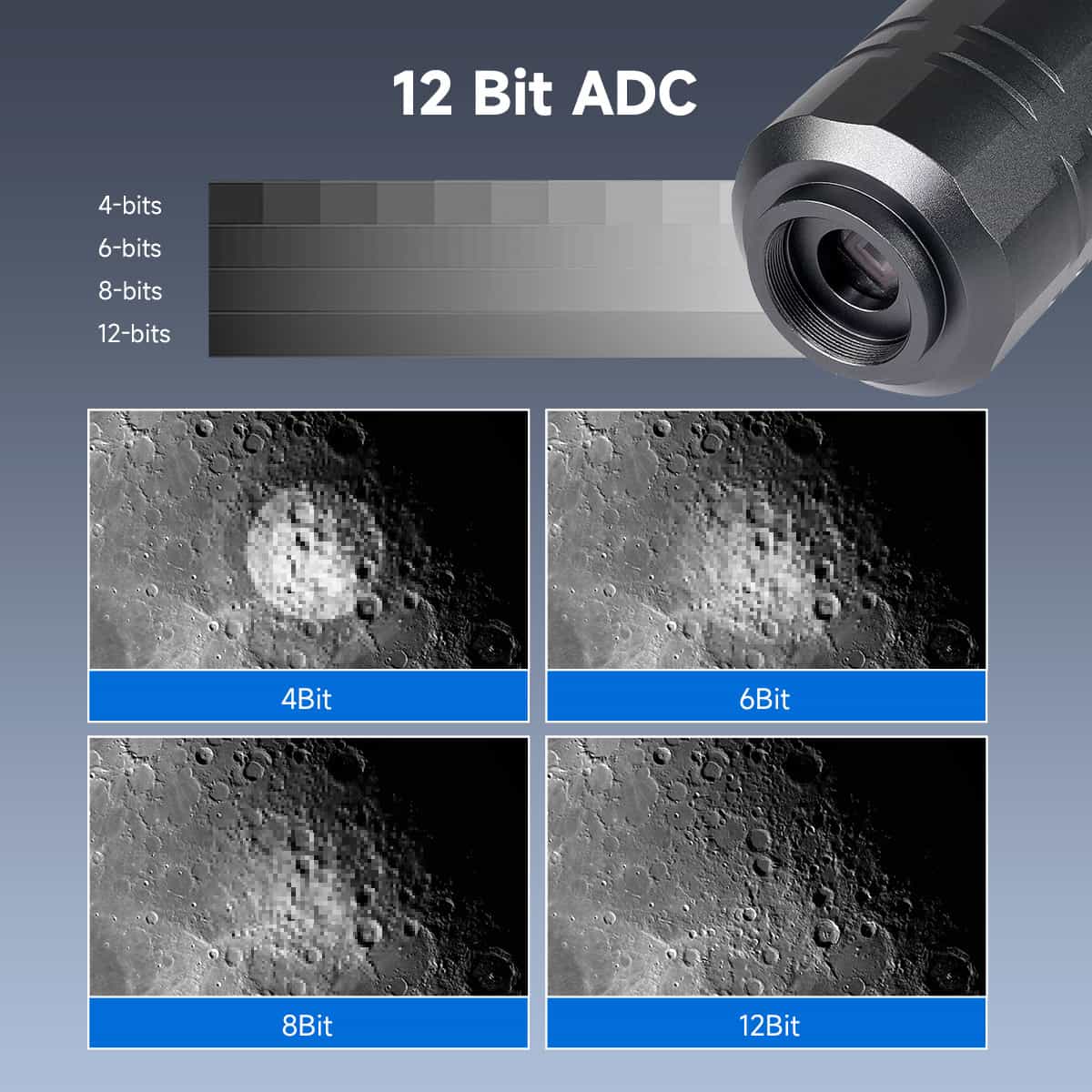
- ADC: 10-bit/12-bit, with 8-bit/12-bit output.
- AR-coated protective window in front of the sensor.


Camera Design
The IMX662 is a back-illuminated rolling-shutter sensor. Moving the wiring behind the photodiodes raises sensitivity, which SVBONY puts at a 91% peak QE, and extends useful response into the near infrared — helpful for guiding on faint stars and for IR-pass planetary work in unsteady seeing. With 2.9 µm pixels, a 38.2 ke⁻ full well and 0.7 e⁻ read noise, the camera favours short exposures: guide frames of a second or two, or thousands of planetary frames for stacking.


Recommended Uses
- Autoguiding: on a guide scope or off-axis guider, with corrections sent through ST4 or ASCOM via PHD2.
- Planetary imaging: colour video capture of Jupiter, Saturn and Mars for stacking.
- Lunar imaging: close-up crater and terminator detail at high frame rates.


Compatibility and Accessory Notes
- Operating systems: Windows (Windows 7 is not supported), Linux, Raspberry Pi and macOS.
- Software: SVBONY recommends SharpCap on Windows and AstroDMx Capture on Linux, Raspberry Pi and macOS; PHD2 and ASCOM for guiding.
- Cables: SVBONY lists a 2 m USB 3.0 cable and a 1.5 m 6-pin guiding cable.
- Guide scope option: SVBONY also offers this camera paired with its SV106 guide scope as a separate style.


Good to Know Before You Order
- Uncooled sensor: the camera is designed for guiding and short-exposure planetary capture rather than long cooled deep-sky integrations.
- Computer required: it runs from capture or guiding software over USB 3.0.
- Colour sensor: for imaging only, with no application in visual observing.
- This listing is the camera only; the SV106 guide scope bundle is a separate style.
Frequently Asked Questions
Is it difficult to set up?
No. Install the driver and your capture or guiding software, connect the USB 3.0 cable, and for ST4 guiding run the 6-pin cable to the mount's guide port. PHD2 walks you through calibration.
Can I use it for both guiding and planetary imaging?
Yes. SVBONY designs it for ST4/ASCOM guiding with PHD2 and lists 1920 x 1080 at 99 fps for planetary capture.
Does it need ST4 to guide?
No. It can guide through the ST4 port or through ASCOM pulse guiding, whichever your mount supports.
Will it run on a Mac or Raspberry Pi?
Yes. SVBONY lists macOS, Linux and Raspberry Pi support, with AstroDMx Capture recommended on those platforms.
Bottom Line
In short: a 135 g colour guide camera with a Sony IMX662 sensor, 0.7 e⁻ read noise and an ST4 port, fast enough at 99 fps in full HD to serve as a planetary and lunar camera too.
| Brand | SVBONY |
|---|---|
| Model | SV305C Pro |
| Sensor | 1/2.8″ CMOS Color |
| Sensor model | SONY IMX662 |
| Pixel size | 2.9 µm x 2.9 µm |
| Maximum frame rate | 1920 x 1080 @ 99 fps |
| USB type | USB 3.0 |
| Shutter | Electronic rolling shutter |
| ADC | 10 bit/12 bit, out 8 bit/12 bit |
| QE | 91% |
| Full well | 38.2 ke⁻ |
| Read noise | 0.7 e⁻ |
| Protective window | AR coated window |
| Supported OS | Windows (without Win 7), Linux, Raspberry Pi, Mac OS |
| Recommended software | Windows: SharpCap / Linux, Raspberry Pi, Mac OS: AstroDMx Capture |
| Cable 1 | 2 m USB 3.0 cable |
| Cable 2 | 1.5 m 6-pin guiding cable |
| Working humidity | 30%–80% |
| Storage humidity | 20%–90% |
| Operating temperature | -10 °C to 50 °C |
| Storage temperature | -20 °C to 60 °C |
| Weight | 135 g |
| Size | Ø49.5 x 65 mm |
| Recommended use | Autoguiding, planetary and lunar imaging |
You may also like
Recently viewed
Recent Blog Posts
View all
Your Guide Graph Is Lying to You
Read More

D-Size vs V-Size: A Complete Guide to Telescope Dovetail Systems
Read More

What Is Back Focus in Astrophotography? Telescope Reducers, Flatteners, and Spacing Explained
Read More