






- Description
- Specifications

Product Overview
The SVBONY SV240 is a 2″ multi-bandpass filter for deep-sky imaging with colour cameras under light-polluted skies. It passes the H-alpha (656.3 nm), OIII (495.9 and 500.7 nm) and H-beta (486.1 nm) emission lines, adds a near-infrared passband averaging over 95% transmission across 830–870 nm, and blocks the bands where most artificial light sits. It is built on a 2 mm substrate with a 44 mm clear aperture and threads into M48 x 0.75 filter cells, drawers and wheels. Published FWHM figures are 24 nm, 20 nm and 115 nm, and the filter weighs 12.5 g.

Who It's For
This is a good match if you image with a one-shot-colour camera from a city or suburban site and want one filter that handles emission nebulae as well as broader targets such as galaxies, reflection nebulae and star clusters, without moving to a monochrome camera and filter set. It also suits imagers whose camera has strong near-infrared sensitivity, such as models built on the Sony IMX585 or IMX464.
Key Features & Design
- Multi-band passband: H-alpha, OIII and H-beta in the visible plus a near-infrared window, for colour imaging in a single exposure set.
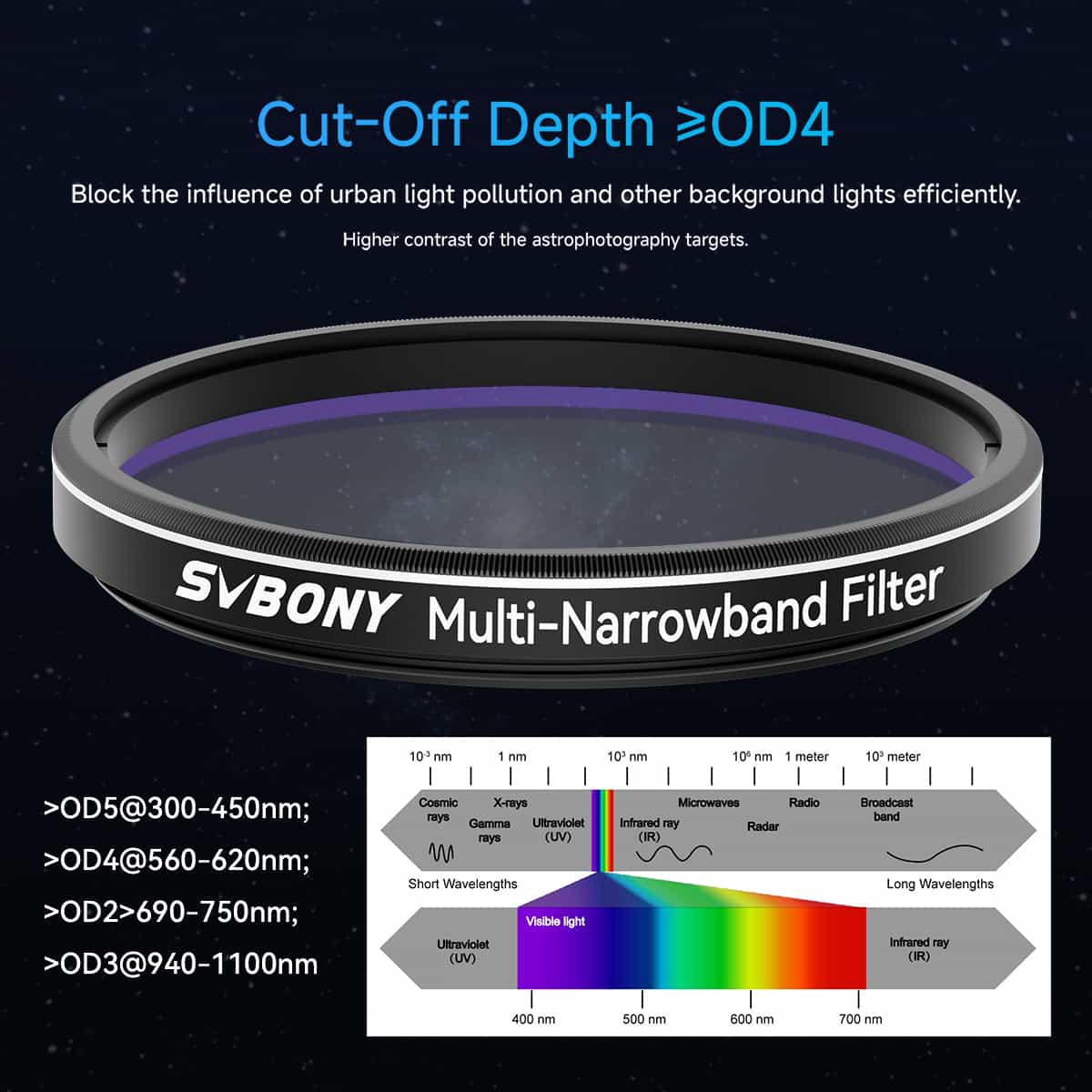
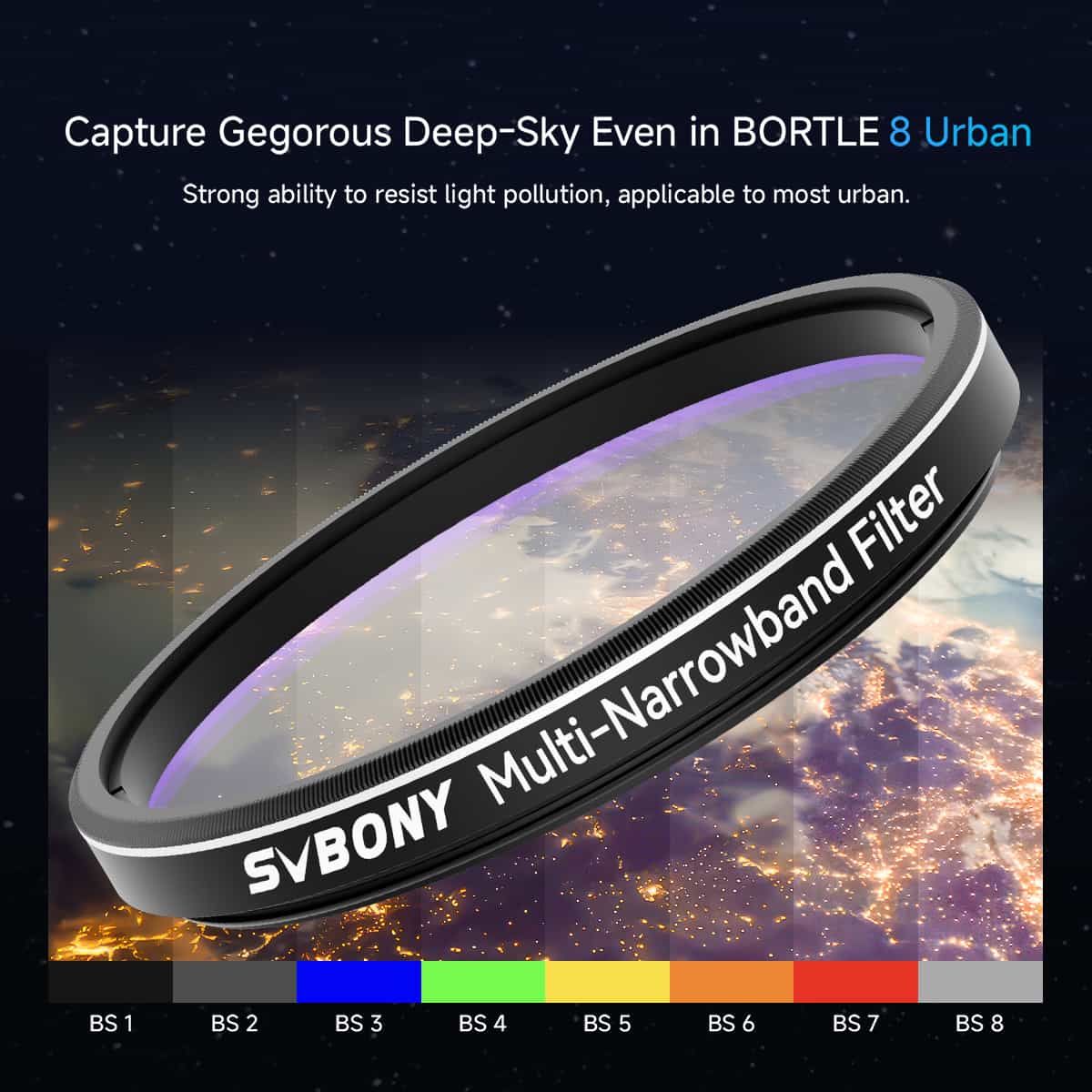
- Deep blocking: >OD5 at 300–450 nm, >OD4 at 560–620 nm, >OD2 at 690–750 nm and >OD3 at 940–1100 nm. SVBONY rates it for skies up to Bortle 8.
- High line transmission: >95% at 486.1 nm, >92% at 495.9 nm, >85% at 500.7 nm and >95% at 656.3 nm.
- Wide working range: controlled from 300 to 1100 nm, so stray infrared beyond the NIR window is blocked.
- 2″ format, M48 x 0.75 thread: single thread, 44 mm clear aperture, 2 mm substrate.
- Optical quality: 60/40 surface quality and 1/4λ surface parallelism.


Optical Design
The SV240 uses a multilayer interference coating to open narrow windows at the main nebular emission lines while rejecting the sodium and mercury bands typical of urban lighting. Compared with a dual-band H-alpha/OIII filter, the added H-beta line and the near-infrared window let more continuum light from stars and galaxies through, which keeps colour balance more natural and makes broadband targets workable. Modern sensors with high near-infrared quantum efficiency gain signal in that window, where artificial light pollution is weaker, improving signal-to-noise and contrast.

Recommended Uses
- Emission nebulae and supernova remnants from light-polluted skies with a colour camera.
- Galaxies, reflection nebulae and star clusters, where a dual-band filter would cut too much continuum light.
- One filter across several rigs: the same filter serves different telescope and camera combinations that use 2″ filters.

Compatibility and Accessory Notes
- Thread: M48 x 0.75, for 2″ filter drawers, filter wheels, nosepieces and flattener or reducer filter threads.
- Cameras: SVBONY recommends NIR-enhanced colour sensors such as the IMX585 and IMX464, and notes that cameras with an AR-coated protective window suit the filter best. A camera with a built-in UV/IR cut window blocks the NIR passband.
- Telescopes: SVBONY recommends a reflector or APO refractor, because near-infrared light can show halos around bright stars in optics not corrected that far into the infrared.
- SVBONY options: SVBONY also lists the SV240 paired with an SV226 filter drawer and with an SV220 7 nm H-alpha/OIII filter.


Good to Know Before You Order
- Imaging filter: it is designed for cameras and has no application in visual observing.
- Not a solar filter: it is not designed for imaging or viewing the Sun.
- Near-infrared halos: with refractors not corrected into the NIR, bright stars can show halos; reflectors and APO refractors avoid this.
- This listing is the filter only. The SV226 drawer and SV220 combinations SVBONY offers are separate.
Frequently Asked Questions
Is it difficult to set up?
No. It threads into any M48 x 0.75 filter holder, drawer or wheel position in front of the camera, and focus is set as usual through your capture software.
How does it differ from the SV220?
The SV220 is a dual narrowband filter aimed at emission nebulae, planetary nebulae and supernova remnants. The SV240 adds H-beta and a near-infrared window, so it also works on galaxies, reflection nebulae and star clusters.
Which cameras suit it?
Colour cameras with good near-infrared sensitivity, such as IMX585- and IMX464-based models, with an AR-coated rather than UV/IR-cut protective window.
Can it be used on broadband targets?
Yes. SVBONY describes it as combining the behaviour of the SV220 and a UHC filter, so it performs on both narrowband and broadband targets.
Can I use it for visual observing?
No. It is an imaging filter and is not suited to visual use or to solar observing.
Bottom Line
In short: a 2″ M48 multi-bandpass filter that passes H-alpha, OIII, H-beta and a near-infrared window for colour-camera deep-sky imaging from city skies, best paired with a reflector or APO refractor and an NIR-sensitive sensor.
| Brand | SVBONY |
|---|---|
| Model | SV240 |
| Name | Multi-Narrowband Filter |
| Size | 2″ |
| Substrate thickness | 2 mm |
| Clear aperture | 44 mm |
| Wavelength range | 300–1100 nm |
| FWHM | 24 nm, 20 nm, 115 nm |
| Blocking | >OD5 @ 300–450 nm; >OD4 @ 560–620 nm; >OD2 @ 690–750 nm; >OD3 @ 940–1100 nm |
| Peak transmittance | >95% @ 486.1 nm; >92% @ 495.9 nm; >85% @ 500.7 nm; >95% @ 656.3 nm; Tavg >95% @ 830–870 nm |
| Surface quality | 60/40 |
| Surface parallelism | 1/4λ |
| Thread | M48 x 0.75, single thread |
| Net weight | 12.5 g (0.44 oz) |
| Use case | Colour-camera deep-sky imaging under light pollution |
You may also like
Recently viewed
Recent Blog Posts
View all
Your Guide Graph Is Lying to You
Read More

D-Size vs V-Size: A Complete Guide to Telescope Dovetail Systems
Read More

What Is Back Focus in Astrophotography? Telescope Reducers, Flatteners, and Spacing Explained
Read More