


- Description
- Specifications
Product Overview
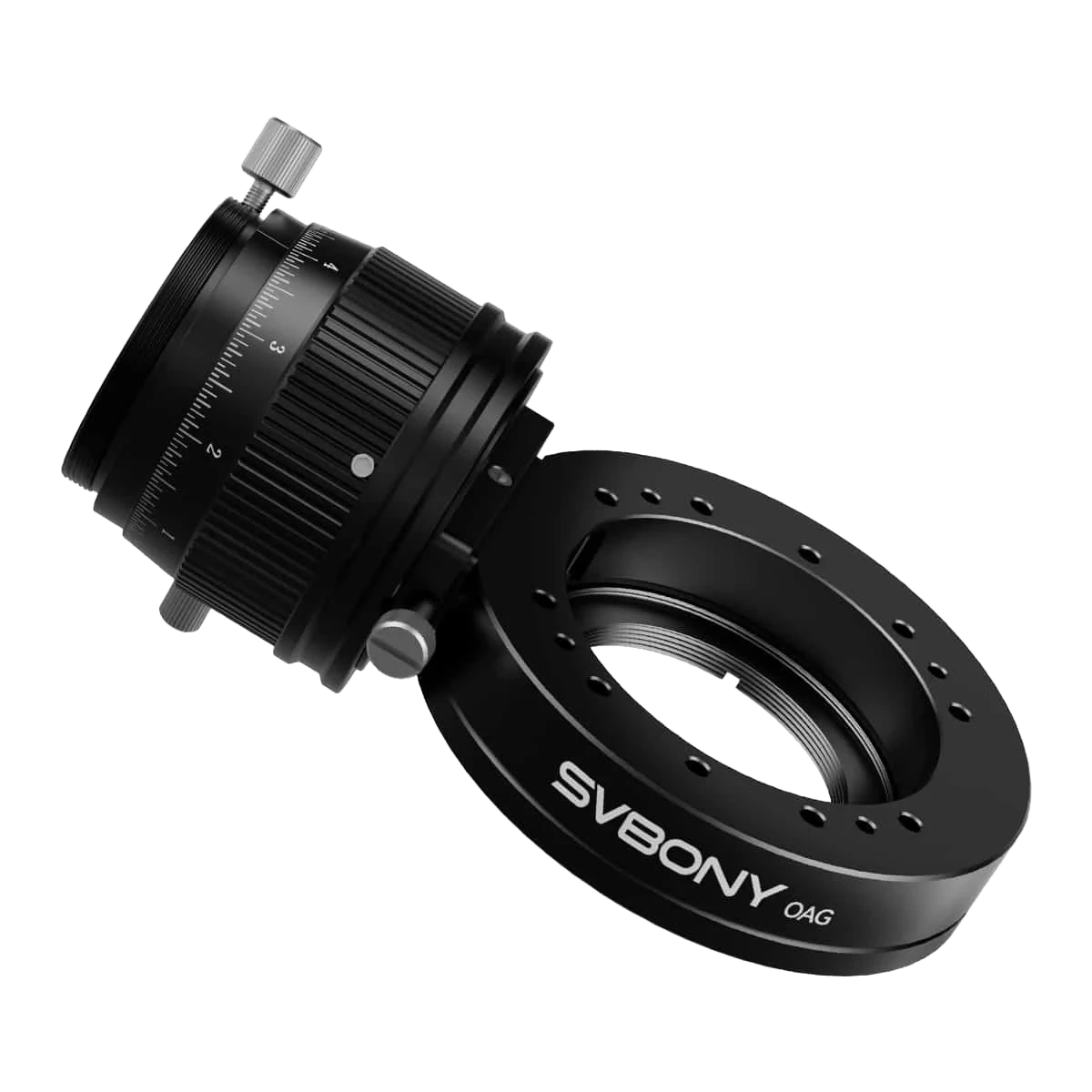
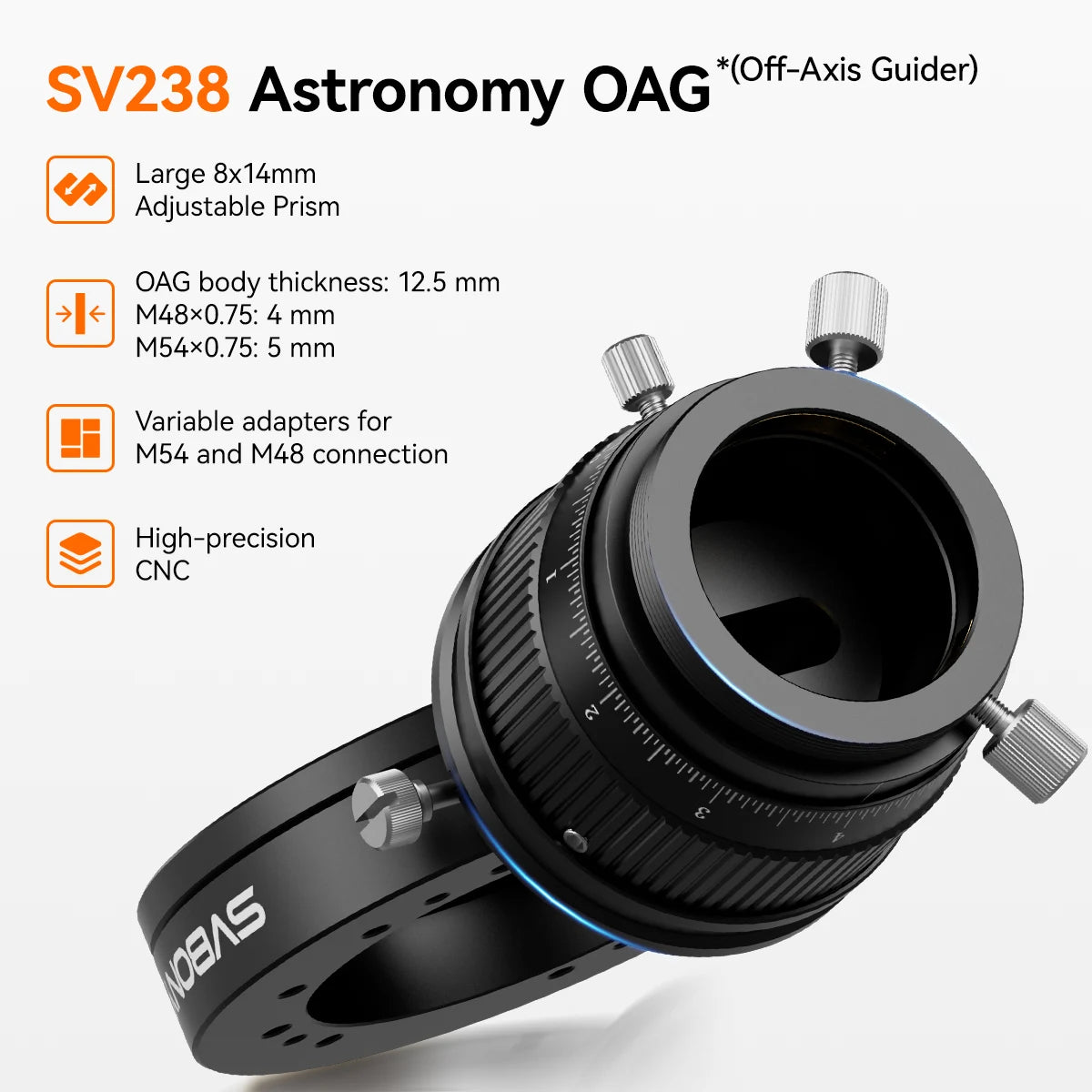
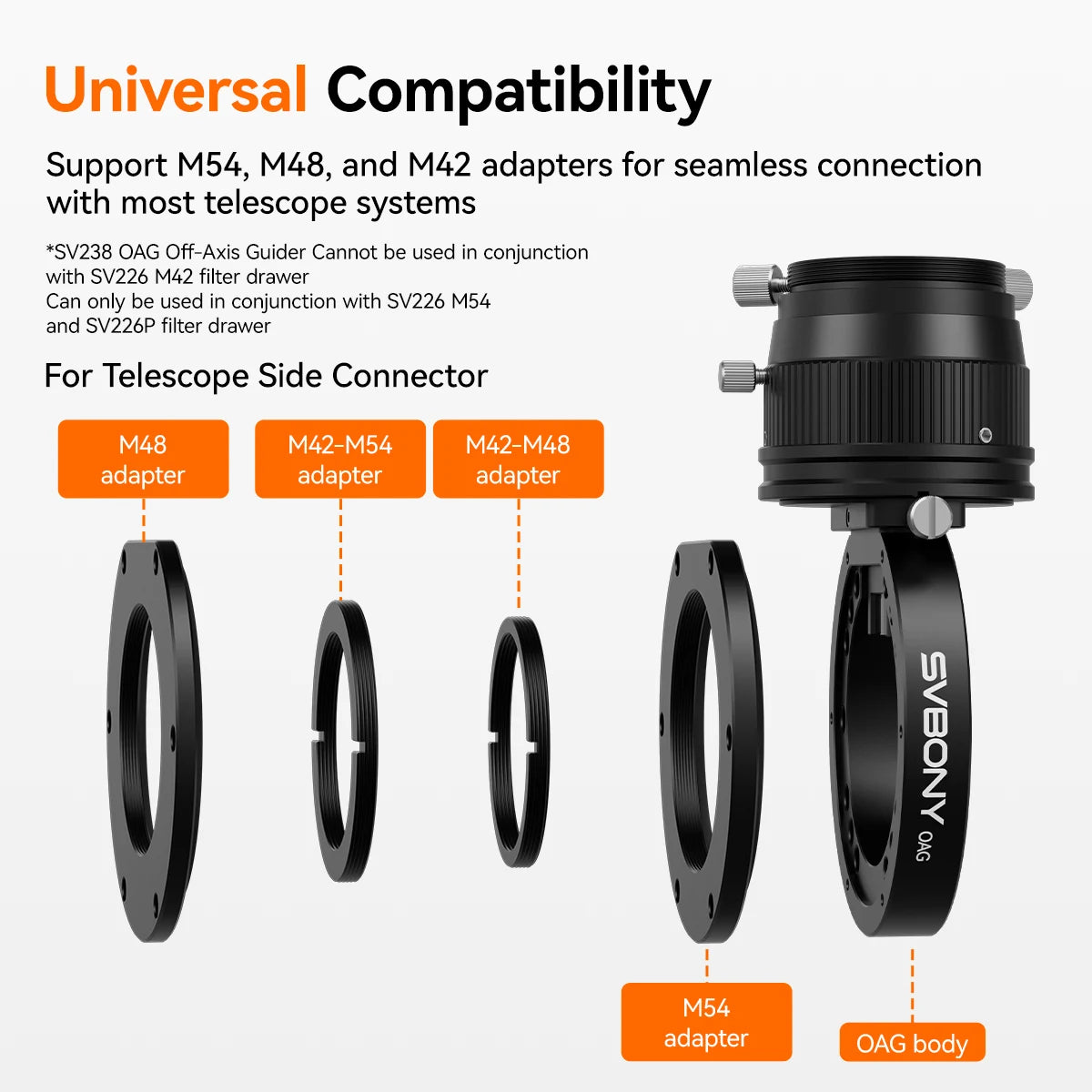
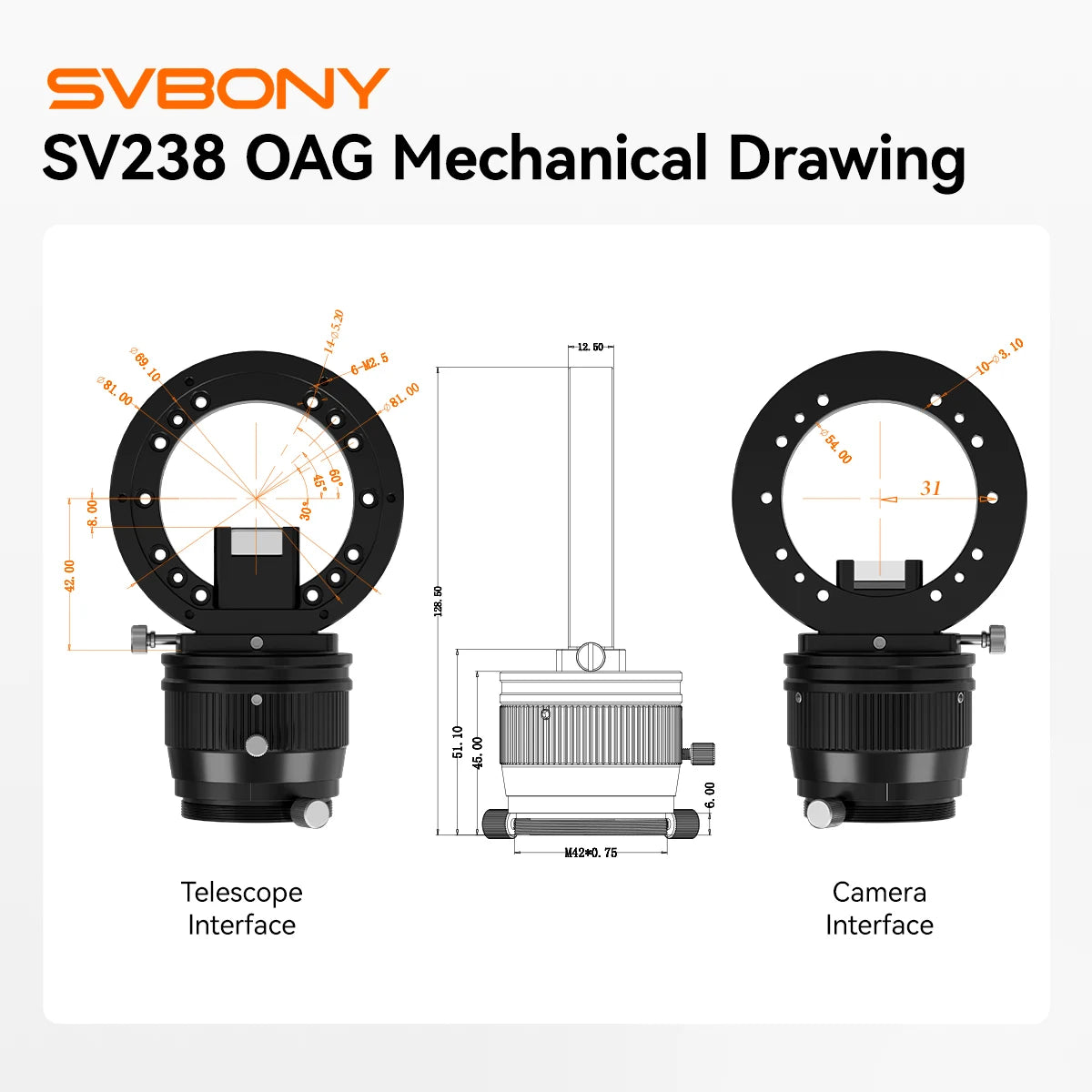
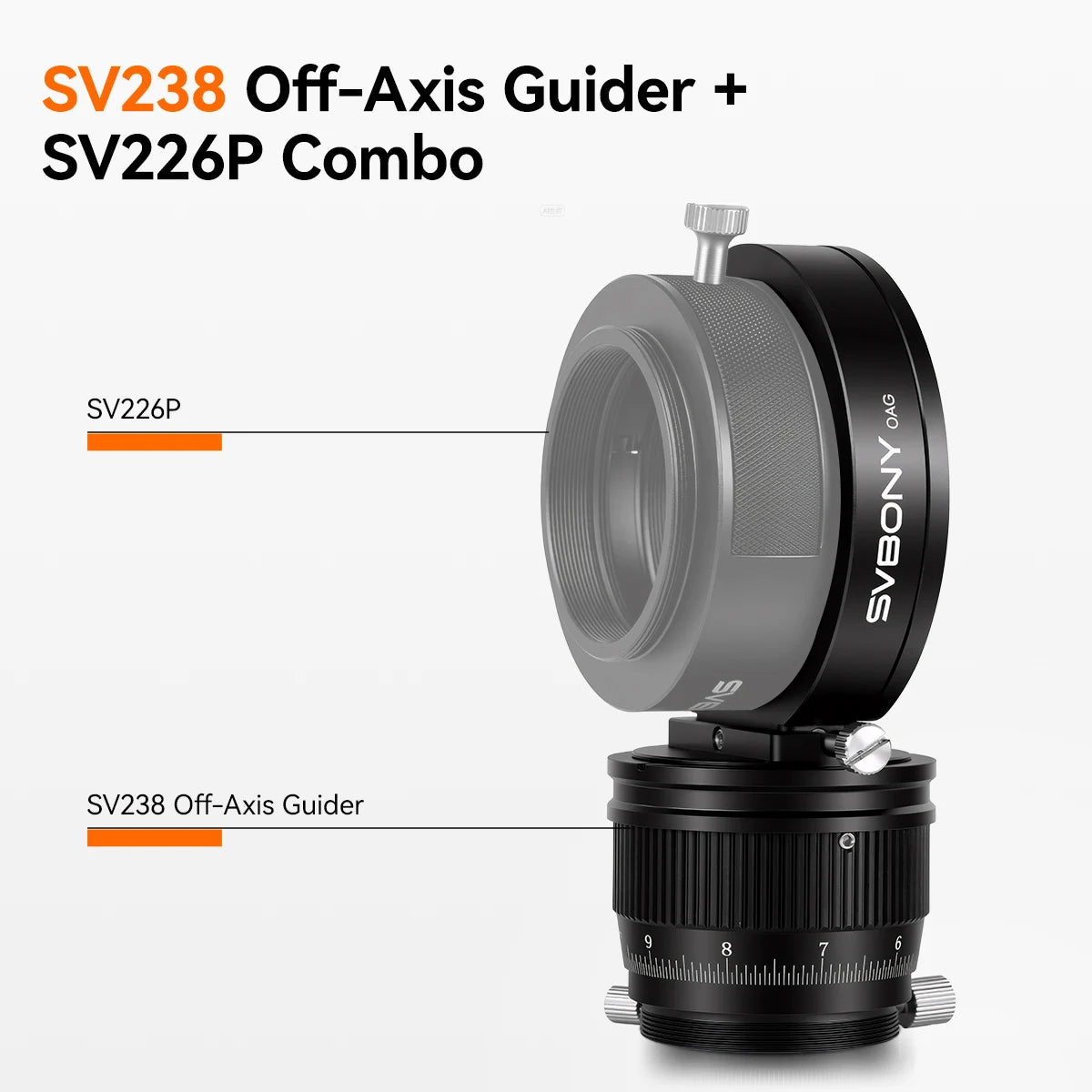
The SVBONY SV238 is an off-axis guider that picks off a small part of your imaging telescope's light with an 8 x 14 mm prism and sends it to a 1.25″ guide-camera port. Guiding through the main optics removes the flexure that can creep in between a separate guide scope and the imaging telescope. The CNC-machined aluminium body is 12.5 mm thick, the prism height is adjustable, and the telescope side takes M54 or M48 x 0.75 threads, with adapters down to M42 included. SVBONY rates it for sensors up to APS-C.
Who It's For
This is a good match if you image deep-sky targets at long focal lengths, where small amounts of guide-scope flexure show up as elongated stars, or if you image through a Maksutov or SCT, whose moving primary mirror makes off-axis guiding the reliable choice.
Key Features & Design
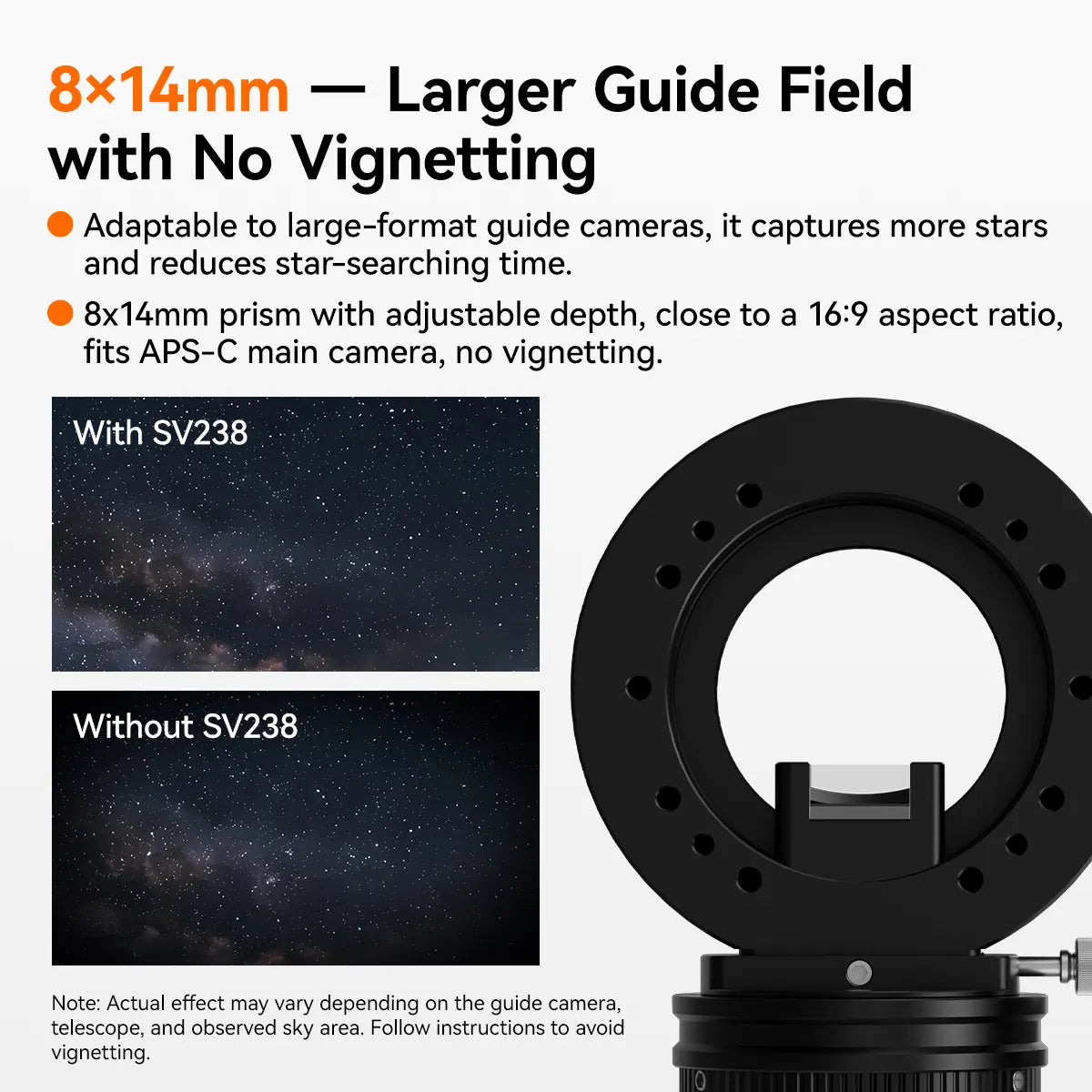
- 8 x 14 mm prism with adjustable height: a large pick-off area for finding guide stars, positioned to stay clear of the main sensor.
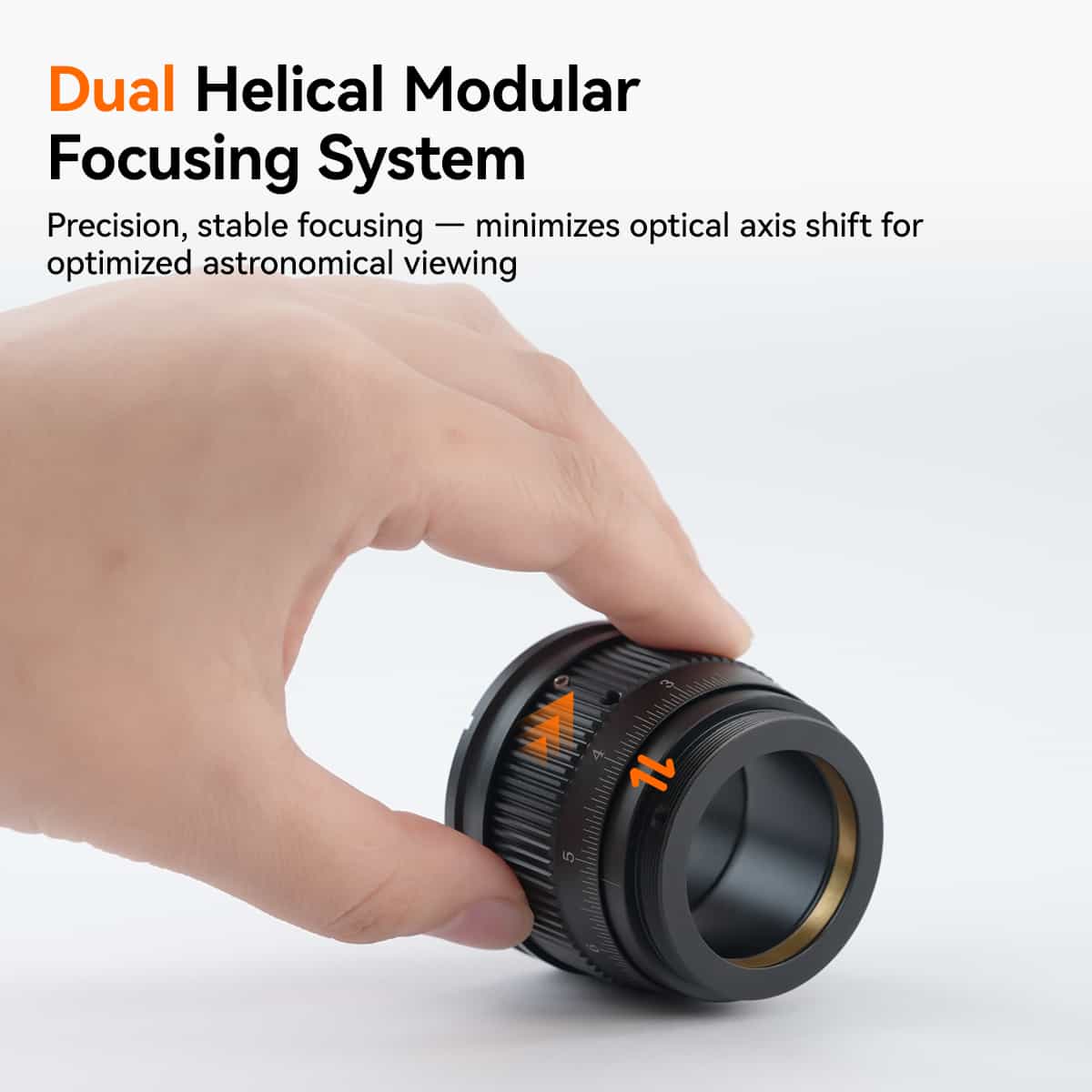
- Dual helical focuser on the guide port: focuses the guide camera independently and locks firmly.
- 12.5 mm body thickness: leaves room in a 55 mm backfocus budget for a filter drawer and camera.
- M54 / M48 telescope side: 4 mm (M48 x 0.75) and 5 mm (M54 x 0.75) connections, with M54–M42 and M48–M42 adapters included.
- Screw-connection main-camera side: bolts directly to cameras and filter drawers through M2.5 and M3 holes.
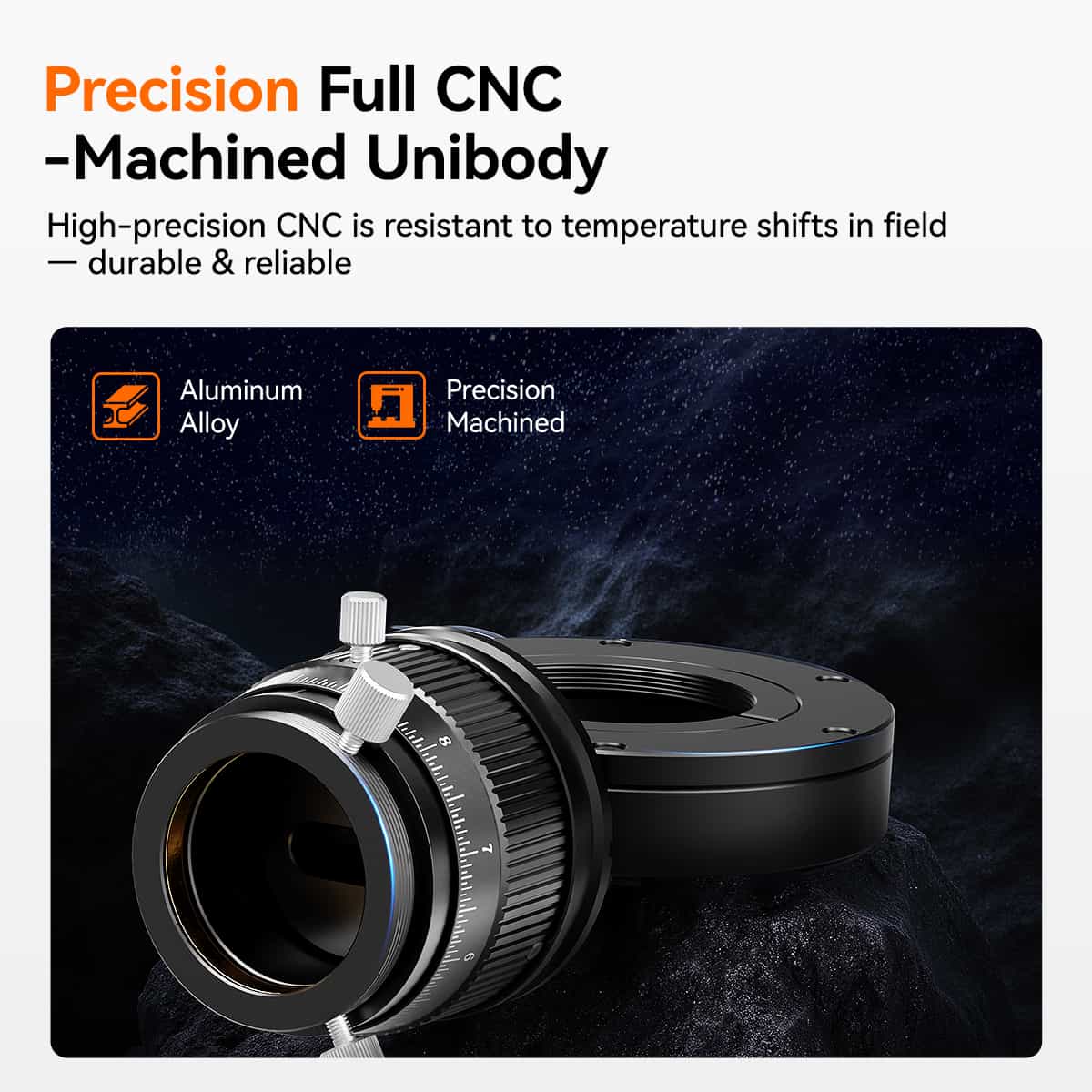
- CNC-machined aluminium: resists thermal deformation through a night of imaging.
Mechanical Design
The SV238's optical thickness is 16.5 mm with the M48 adapter and 17.5 mm with the M54 adapter. In SVBONY's example train, a camera with 17.5 mm of flange depth, the 21 mm SV226P filter drawer and the SV238 with its M48 adapter add up to the 55 mm backfocus that most reducers and flatteners need. The recommended assembly order is telescope, then reducer or flattener, then OAG, then filter drawer or wheel, then camera, so the guide camera sees unfiltered light even when you image in narrowband.
Recommended Uses
- Long-focal-length deep-sky imaging where a guide scope would flex.
- Maksutov and SCT imaging, including the SVBONY MK127 with its 0.65x reducer and M42 adapter.
- Narrowband imaging, with the OAG ahead of the filter so the guide camera keeps full-spectrum light.
Compatibility and Accessory Notes
- Main cameras listed by SVBONY: SV605CC, SV405CC, SV605MC, ZWO ASI533MC Pro, ASI260C Pro, ASI2600MC, ASI662MC, Altair 294C, 533M and 26C, Player One Uranus-C Pro, ATR294C and QHY5III585M.
- Guide cameras listed by SVBONY: SV905C, ZWO ASI120MM Mini, ASI220MM Mini, ASI290MM Mini and GPM662M. Recommended guide-sensor size is 1/3″ to 1/1.8″.
- Filter drawers: the SVBONY SV226P (M42, 21 mm) bolts directly to the SV238. The SV226 M54 drawer is the larger-format option.
- Telescopes named by SVBONY: SV555, SV503 and SV550 with flattener, and MK105 and MK127 with the M42 adapter.
Backfocus is the figure that ties an OAG train together. Send us your telescope, corrector, filter and camera, and we will work out the spacing with you.
What's in the Box
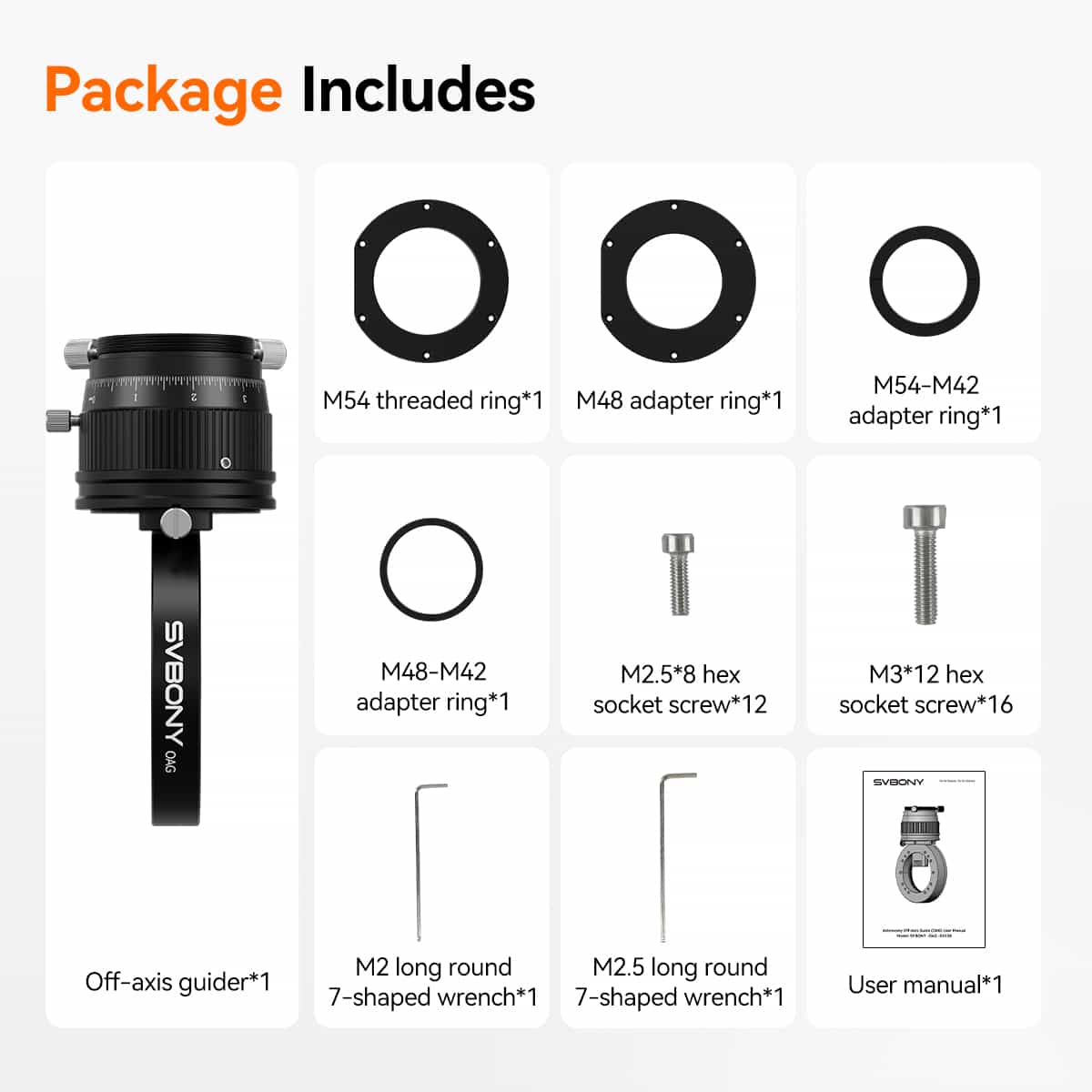
- Off-axis guider
- M54 threaded ring
- M48 adapter ring
- M54–M42 adapter ring
- M48–M42 adapter ring
- 12 x M2.5 x 8 hex socket screws
- 16 x M3 x 12 hex socket screws
- M2 and M2.5 hex wrenches
- User manual
Good to Know Before You Order
- Sensor size: rated up to APS-C. Full-frame trains need a larger prism and M54 or M68 threads.
- Guide camera sold separately, along with the main camera.
- Filter drawer recommended: SVBONY pairs the SV238 with a filter drawer, and the SV226P is its matched M42 option.
- Imaging only: it has no application in a visual train with an eyepiece.
Frequently Asked Questions
Is it difficult to set up?
It takes one careful session. Focus the main camera first, then slide the guide camera in its 1.25″ port until guide stars are tightest, adjust the prism height, and lock it. After that, the focus stays set for that imaging train.
Why use an OAG instead of a guide scope?
An OAG guides through the same optics as the imaging camera, so mirror shift and flexure between two separate scopes no longer affect tracking. That matters most at long focal lengths and on Maksutovs and SCTs.
What if I can't find a guide star?
Rotate the OAG to a different quadrant, adjust prism height, and use 1–3 second guide exposures with higher gain or 2x2 binning.
Does the prism shadow the main sensor?
On sensors up to APS-C it is positioned to stay clear. If a shadow appears, retracting the prism 0.5–1 mm resolves it.
Bottom Line
In short: a 12.5 mm off-axis guider with an 8 x 14 mm adjustable prism, M54/M48/M42 connections and a helical 1.25″ guide port, for flexure-free guiding through your imaging telescope with sensors up to APS-C.
| Model | SV238 (W9196A) |
|---|---|
| Prism size | 8 x 14 mm, height adjustable |
| Telescope interface | M54 / M48 |
| M48 x 0.75 connection | 4 mm |
| M54 x 0.75 connection | 5 mm |
| Main camera interface | Screw connection |
| Guide camera interface | 1.25″, dual helical focuser |
| OAG body thickness | 12.5 mm |
| Optical thickness | 16.5 mm with M48 adapter; 17.5 mm with M54 adapter |
| Applicable main sensors | Up to APS-C |
| Recommended guide sensor | 1/3″ to 1/1.8″ |
| Adapters included | M48; M54–M42; M48–M42 |
| Material | CNC-machined aluminium |
| Weight | Not published by vendor |
| Use case | Off-axis autoguiding for deep-sky imaging |
You may also like
Recently viewed
Recent Blog Posts
View all
Your Guide Graph Is Lying to You
Read More

D-Size vs V-Size: A Complete Guide to Telescope Dovetail Systems
Read More

What Is Back Focus in Astrophotography? Telescope Reducers, Flatteners, and Spacing Explained
Read More