



- Description
- Specifications

Product Overview
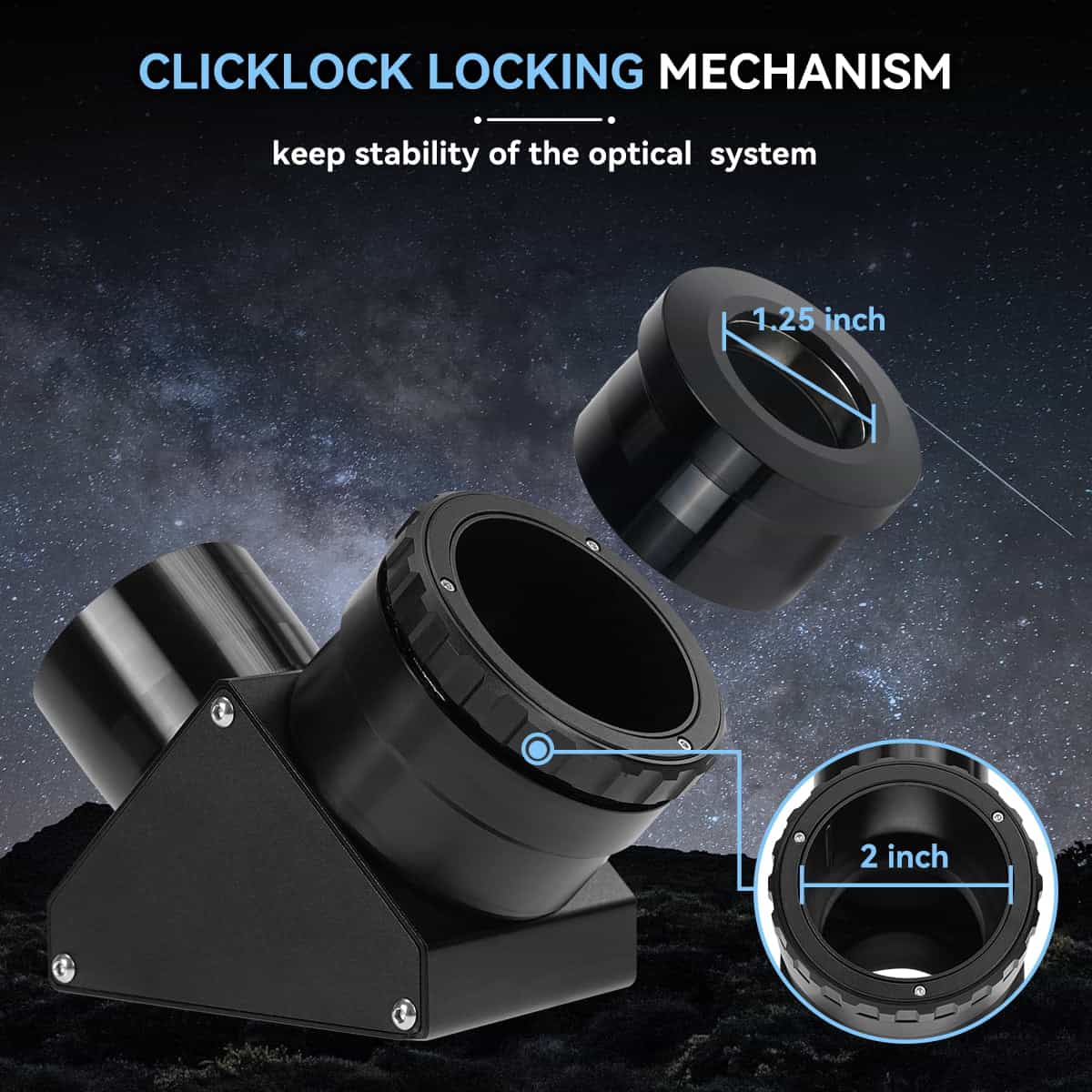
The SVBONY SV223 2″ is a 90° mirror star diagonal with a dielectric-coated mirror rated at more than 99% reflectivity and 1/10λ flatness on an 11.5 mm thick substrate. A Clicklock clamp holds 2″ eyepieces and accessories, a 2″-to-1.25″ adapter is included, and the telescope-side barrel carries an M48 x 0.75 filter thread. Clear aperture is 43 mm, optical length is approximately 109.1 mm, and it weighs 573.7 g.

Who It's For
This is a good match if you observe through a refractor, SCT or Maksutov with a 2″ focuser or visual back and want a comfortable viewing angle, a secure grip on heavy 2″ eyepieces, and the option to use 1.25″ eyepieces through the same diagonal.
Key Features & Design
- Dielectric mirror, >99% reflectivity: 1/10λ flatness on an 11.5 mm thick substrate for a stable, flat reflecting surface.
- Clicklock clamp: a twist-to-lock clamp that centres and holds 2″ eyepieces or accessories quickly and securely.
- 43 mm clear aperture: passes the full field of wide 2″ eyepieces.
- Compression rings: stainless steel compression rings on both the diagonal and the adapter help prevent barrels from marring.
- M48 x 0.75 filter thread: on the telescope-side barrel for 2″ filters.
- Metal construction: 573.7 g.


Recommended Uses
- Visual observing with refractors and catadioptric telescopes, from wide-field deep-sky sweeps to high-power planetary views.
- Heavy 2″ eyepieces and zoom eyepieces that benefit from a secure clamp.
- Mixed eyepiece collections, using the included 2″-to-1.25″ adapter.

Compatibility and Accessory Notes
- Telescope side: 2″ barrel, fits 2″ focusers and visual backs; M48 x 0.75 thread for 2″ filters.
- Eyepiece side: 2″ Clicklock clamp; 1.25″ eyepieces fit with the included adapter.
- Optical length: approximately 109.1 mm, worth accounting for when reaching focus on refractors with limited inward travel.

What's in the Box
- SV223 2″ 90° Clicklock dielectric diagonal
- 2″ to 1.25″ adapter
- M4 screw (1)
- Dust cap (1)
- Dust plug (1)
Good to Know Before You Order
- Image orientation: the view is upright but mirror-reversed left to right, as with any single-mirror diagonal.
- Visual use: a diagonal is for eyepiece observing; imaging cameras usually attach straight-through.
- Light path: the 109.1 mm optical length adds to the focus position. If you are unsure whether your telescope reaches focus with a 2″ diagonal, send us the model and we will check it with you.
Frequently Asked Questions
Is it difficult to set up?
No. Insert the 2″ barrel into your focuser or visual back, then insert an eyepiece and twist the Clicklock ring to lock it.
Can I use 1.25″ eyepieces?
Yes. The included 2″-to-1.25″ adapter fits into the Clicklock clamp.
Does it take filters?
Yes. 2″ filters thread onto the M48 x 0.75 telescope-side barrel, so one filter serves every eyepiece.
Why a dielectric mirror?
Dielectric coatings reflect more than 99% of the light and are more durable than standard aluminium coatings.
Bottom Line
In short: a 2″ 90° dielectric mirror diagonal with >99% reflectivity, a Clicklock eyepiece clamp, a 43 mm clear aperture and a 1.25″ adapter included.
| Model | SV223 |
|---|---|
| Size | 2″ |
| Optical design | Mirror diagonal |
| Deflection angle | 90° |
| Reflection surface | Dielectrically coated |
| Reflectivity | >99% |
| Mirror flatness | 1/10λ |
| Mirror thickness | 11.5 mm |
| Clear aperture | 43 mm |
| Optical length | Approx. 109.1 mm |
| Telescope-side connection | 2″ barrel; M48 x 0.75 inner thread |
| Eyepiece-side connection | 2″ clamp |
| Clamping system | Clicklock |
| Image orientation | Erect image, mirror inverted |
| Material | Metal |
| Included | 2″ to 1.25″ adapter; M4 screw; dust cap; dust plug |
| Weight | 573.7 g (20.24 oz) |
| Recommended use | Visual observing with 2″ and 1.25″ eyepieces |
You may also like
Recently viewed
Recent Blog Posts
View all
Your Guide Graph Is Lying to You
Read More

D-Size vs V-Size: A Complete Guide to Telescope Dovetail Systems
Read More

What Is Back Focus in Astrophotography? Telescope Reducers, Flatteners, and Spacing Explained
Read More