





- Description
- Specifications

Product Overview
The SVBONY SV220 is a 2″ dual-band narrowband filter with two 7 nm passbands, one centred on OIII at 500.7 nm and one on H-alpha at 656.3 nm. SVBONY rates peak transmission above 90% at OIII and above 94% at H-alpha, with OD5 blocking across a 300–1100 nm working range. The filter is built on a 1.80 mm substrate with a 44 mm clear aperture, 60/40 surface quality and 1/4λ parallelism, mounted in an M48 x 0.75 cell. It weighs 12.5 g.


Who It's For
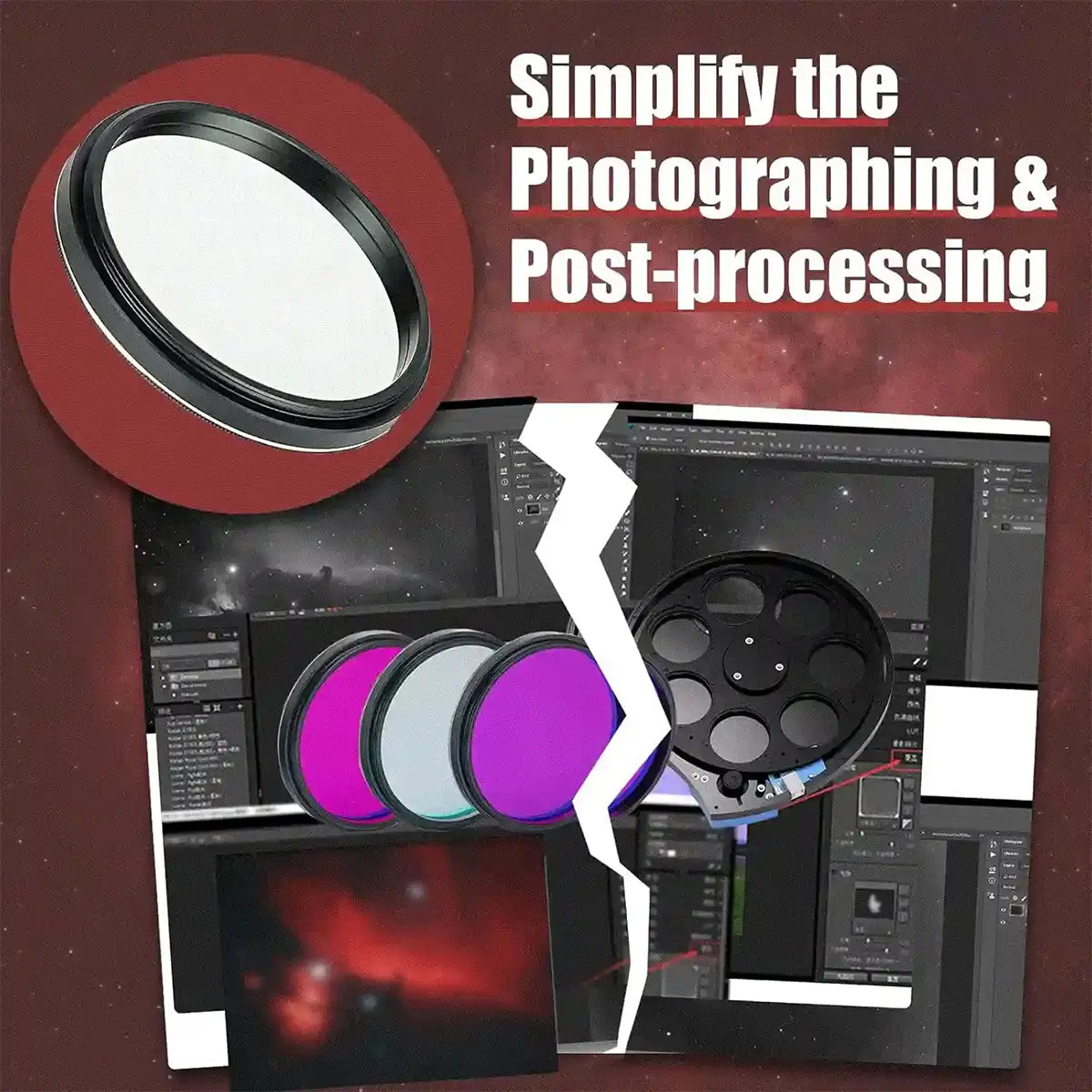
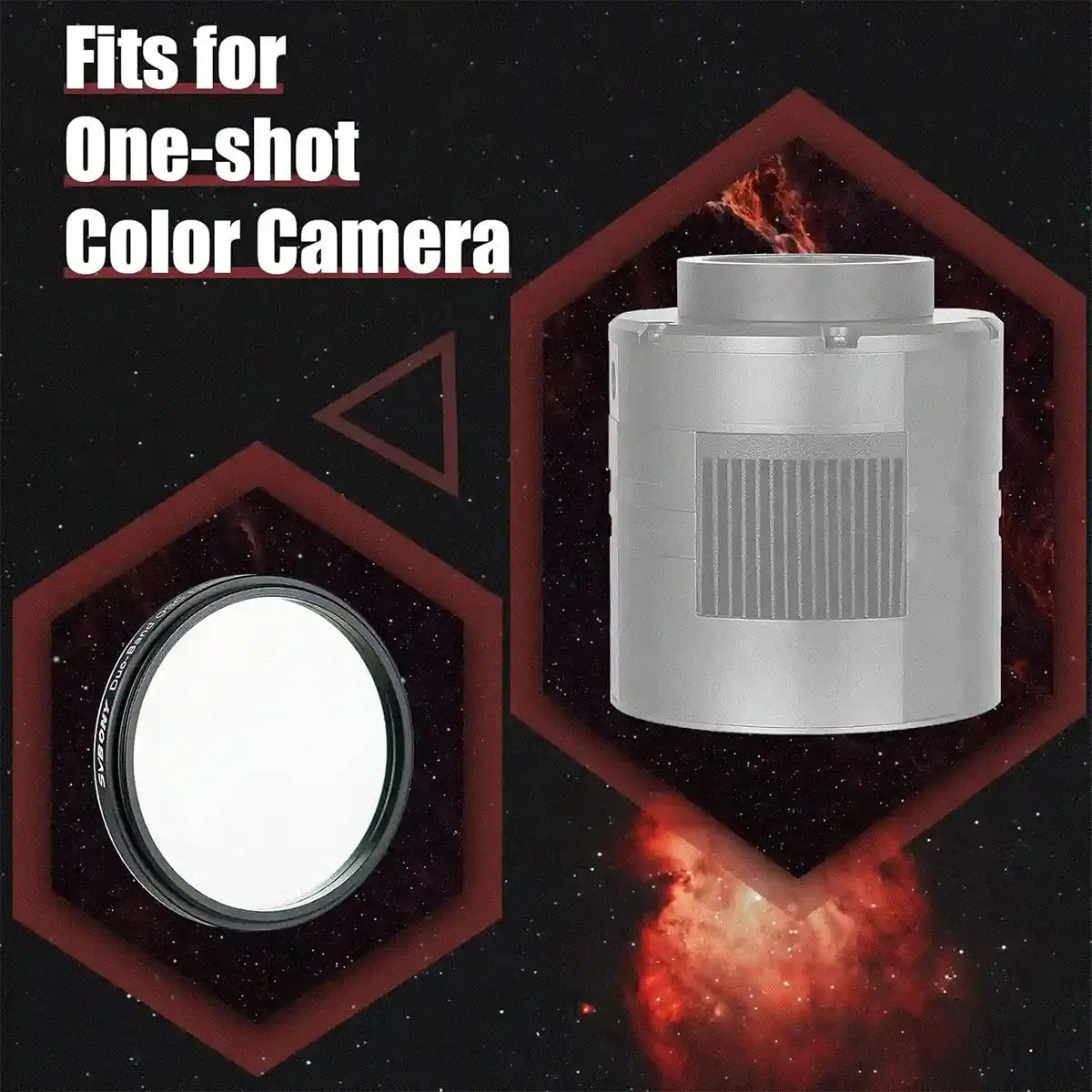
This is a good match if you image emission nebulae with a one-shot-colour camera, especially from a suburban or city backyard, or when the Moon is up. Because both emission lines pass in a single exposure, a colour camera records hydrogen and oxygen detail together without a filter wheel.

Key Features & Design
- Two 7 nm passbands: isolates OIII (500.7 nm) and H-alpha (656.3 nm) emission and rejects most of the spectrum between and around them.
- High line transmission: T>90% at OIII and T>94% at H-alpha.
- OD5 blocking: suppresses mercury-vapour and sodium-vapour street lighting, airglow from atmospheric neutral oxygen, and general sky glow.
- Optical quality: 60/40 surface quality and 1/4λ surface parallelism on a 1.80 mm substrate.
- 2″ M48 x 0.75 cell: 44 mm clear aperture for larger sensors and 2″ imaging trains.


Recommended Uses
- Emission nebulae: hydrogen regions such as the North America, Rosette and Heart nebulae.
- Planetary nebulae and supernova remnants: targets where OIII and H-alpha structure carry the image.
- Light-polluted or moonlit imaging: narrow passbands keep the sky background dark from urban sites.
- Bicolour (HOO) processing: the two lines can be separated from colour-camera data in processing.


Compatibility and Accessory Notes
- Thread: M48 x 0.75, the standard 2″ filter thread, for 2″ filter drawers, filter wheels, camera adapters and 2″ nosepieces with filter threads.
- Cameras: designed as an OSC (one-shot-colour) filter; it also works with mono cameras.
- Focal ratio: SVBONY rates it for telescopes at f/4 and slower.
- SHO colour with a colour camera: SVBONY pairs it with the SV220 2″ 7nm SII & OIII filter, which supplies the sulphur data for a Hubble-palette blend.
- Filter drawers: the SVBONY SV226 filter drawers take 2″ M48 filters for quick swapping without removing the camera.


Good to Know Before You Order
- Imaging only: the filter is designed for cameras and has no application for eyepiece viewing.
- Not a solar filter: it provides no protection for observing or imaging the Sun.
- Fast optics: narrowband passbands shift toward shorter wavelengths in a steep light cone, which can clip the H-alpha line. SVBONY specifies f/4 or slower, which excludes f/2 systems such as RASA-type astrographs.
- Size: this listing is the 2″ M48 version. SVBONY also makes a 1.25″ SV220 with an M28.5 x 0.6 thread.
- Single thread: the cell is threaded on one side.


Frequently Asked Questions
Is it difficult to set up?
No. It threads into any M48 x 0.75 filter thread or drops into a 2″ filter drawer slot, and focus is set as usual with the filter in place.
Can I use it with a DSLR or colour astronomy camera?
Yes. It is designed for one-shot-colour sensors, which record H-alpha in the red channel and OIII in the green and blue channels in a single exposure.
Will it work on my f/2 astrograph?
SVBONY specifies f/4 or slower. Below that, band shift can push the H-alpha line outside the passband. If you are unsure where your system sits, send us the telescope and reducer details and we will check it with you.
How does it compare with a broadband light-pollution filter?
A broadband filter passes several wide windows and suits galaxies and star fields. The SV220's 7 nm passbands pass far less sky glow and suit emission nebulae, at the cost of star colour.
Bottom Line
In short: a 2″ M48 dual-band filter with 7 nm H-alpha and OIII passbands and OD5 blocking, for colour-camera nebula imaging from bright skies on telescopes at f/4 and slower.
| Brand | SVBONY |
|---|---|
| Model | SV220 Duo-Band OSC Filter |
| Size | 2″ |
| Passbands (FWHM) | OIII 7 nm & H-alpha 7 nm |
| Peak transmittance | 500.7 nm @ T>90%; 656.3 nm @ T>94% |
| Blocking | OD5 |
| Wavelength range | 300–1100 nm |
| Substrate thickness | 1.80 mm |
| Clear aperture | 44 mm |
| Surface quality | 60/40 |
| Surface parallelism | 1/4λ |
| Thread | M48 x 0.75 |
| Single thread | Yes |
| Net weight | 12.5 g (0.44 oz) |
| Focal ratio | Not suitable below f/4 (per SVBONY) |
| Use case | Emission nebula, planetary nebula and supernova remnant imaging with colour cameras |
You may also like
Recently viewed
Recent Blog Posts
View all
Your Guide Graph Is Lying to You
Read More

D-Size vs V-Size: A Complete Guide to Telescope Dovetail Systems
Read More

What Is Back Focus in Astrophotography? Telescope Reducers, Flatteners, and Spacing Explained
Read More