


- Description
- Specifications

Product Overview
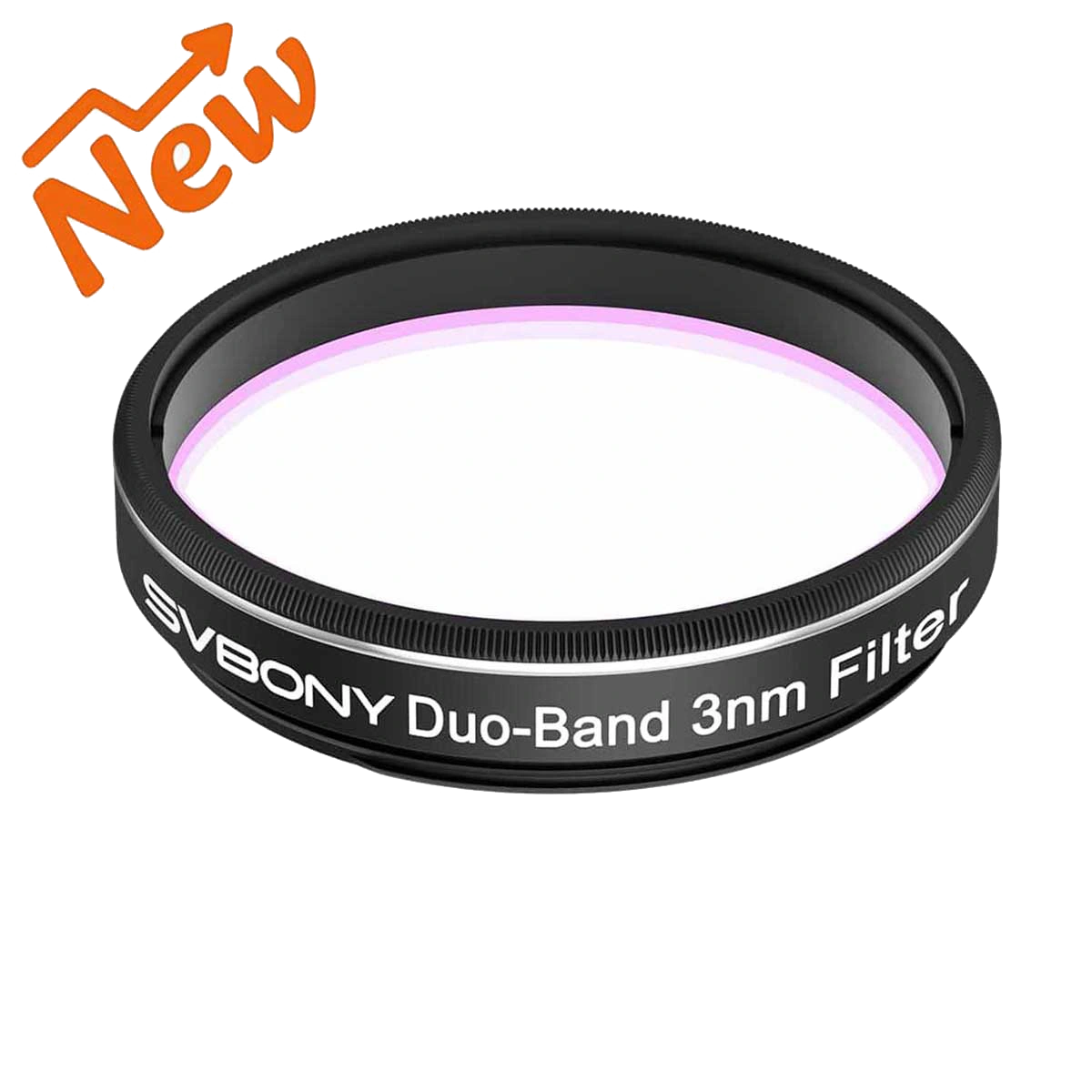
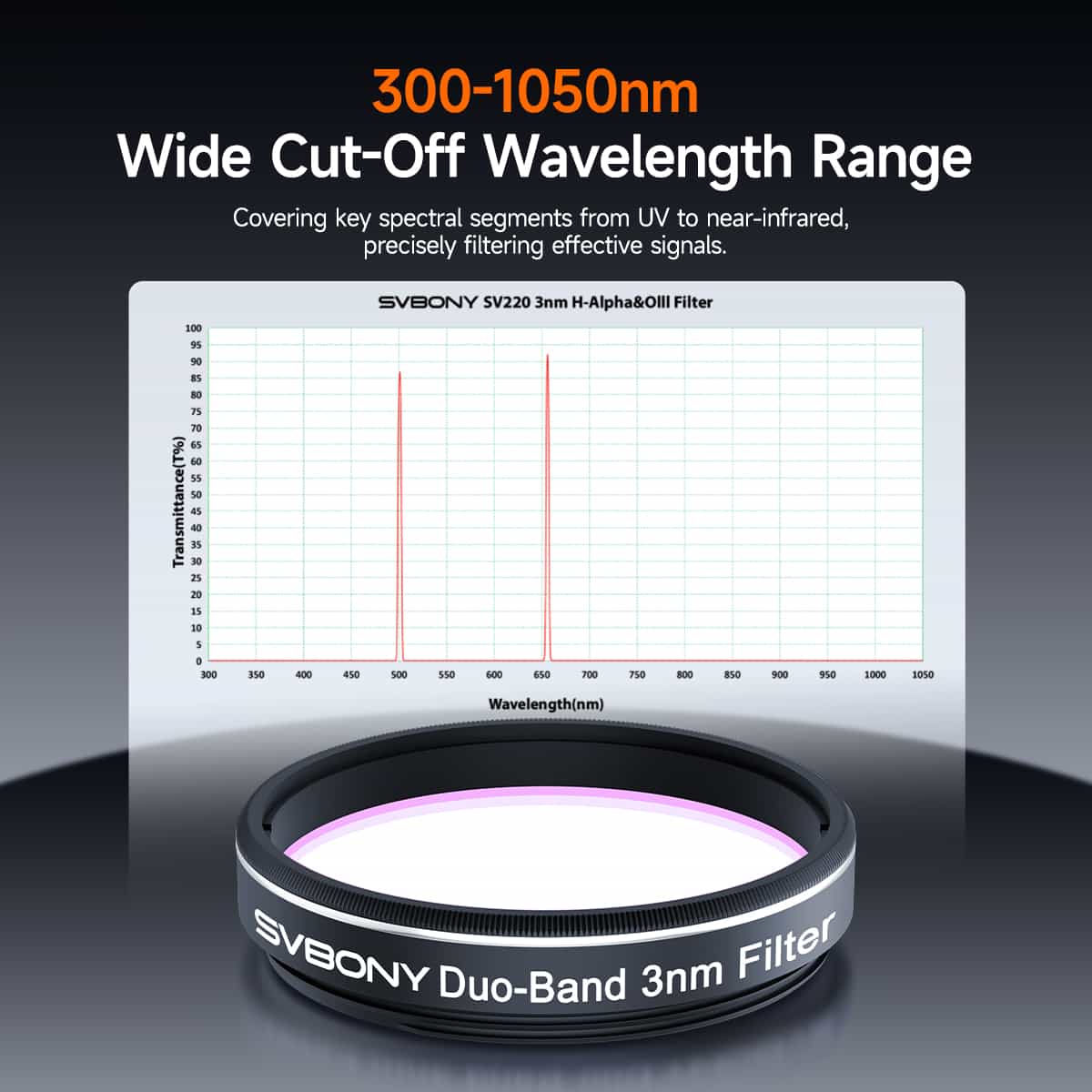
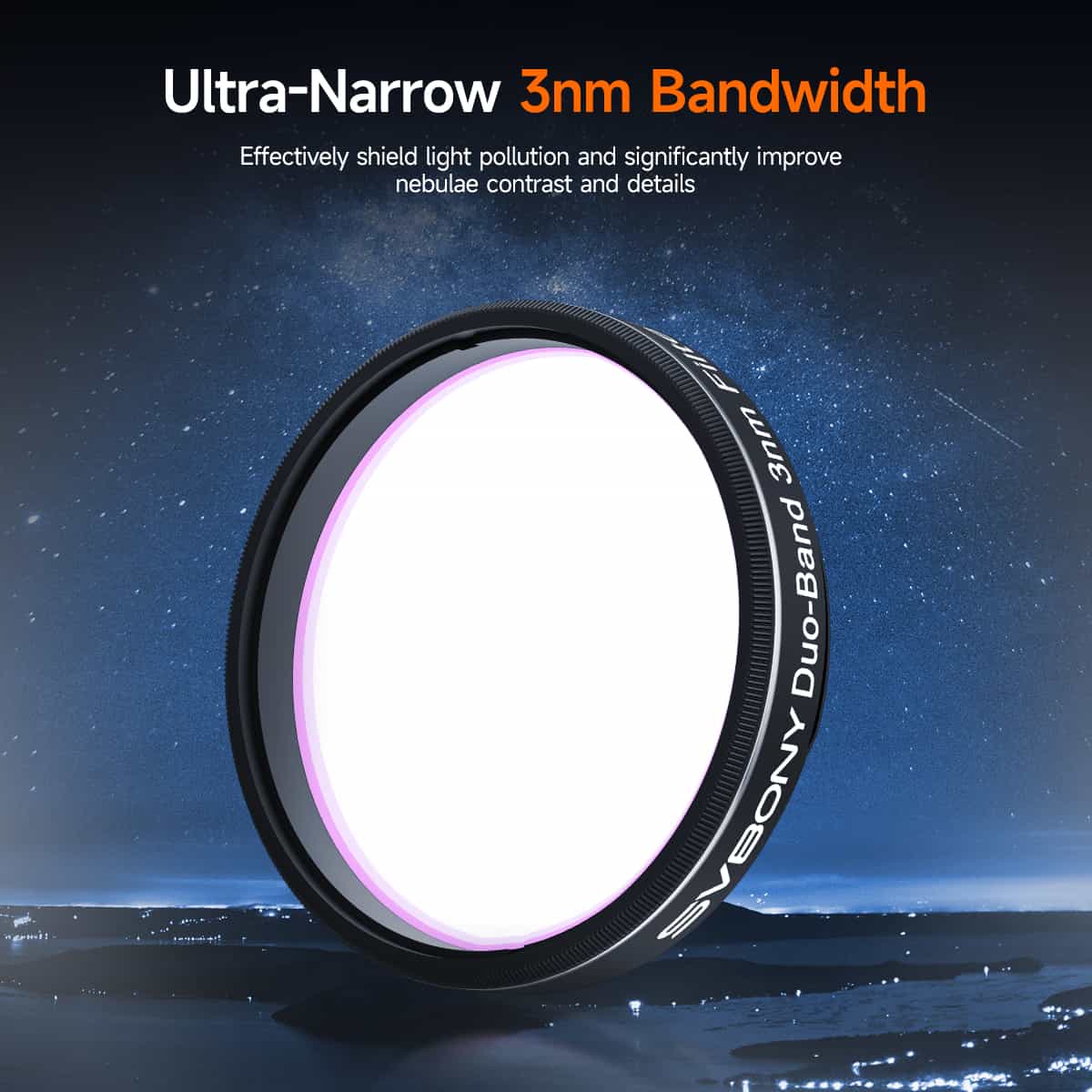
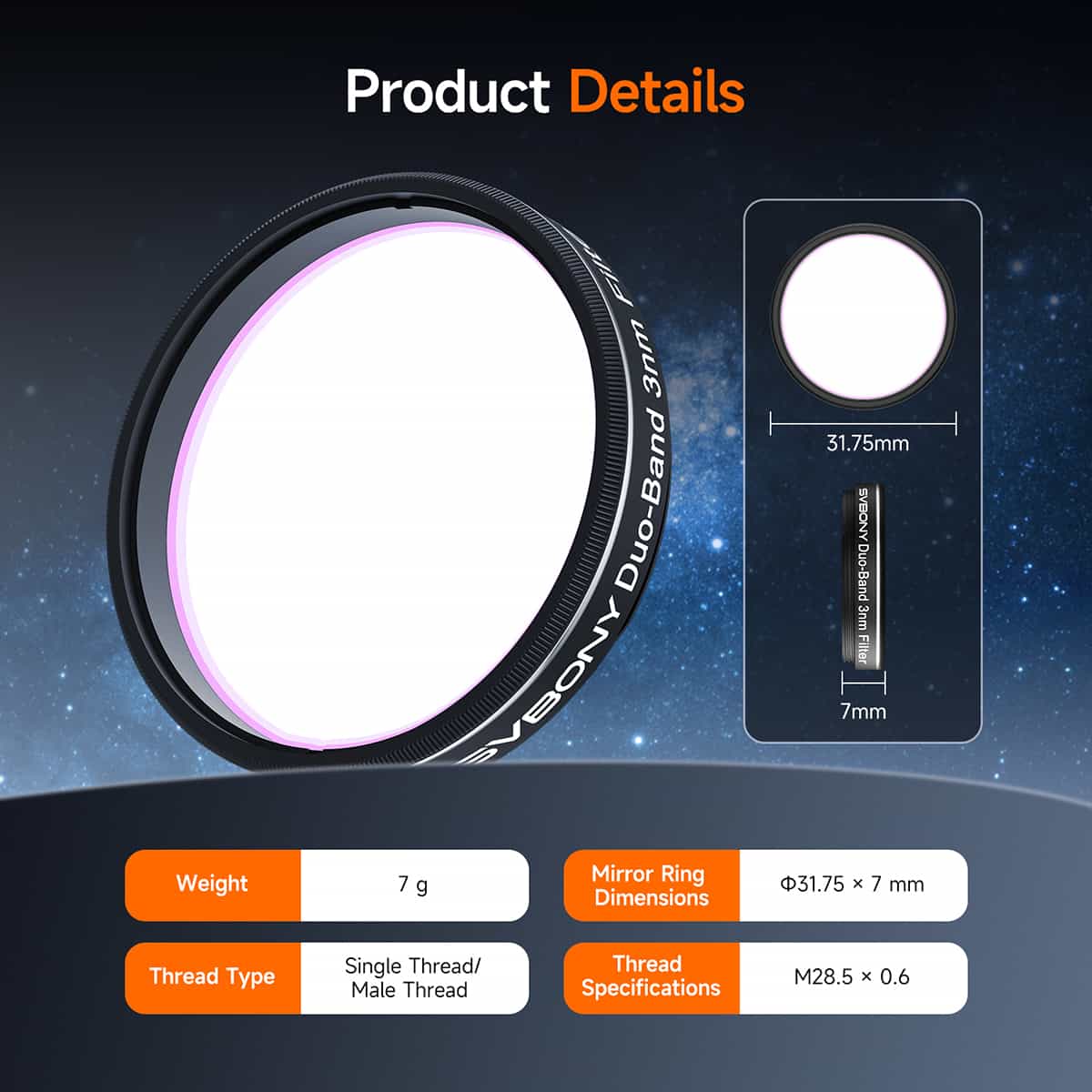
The SVBONY SV220 1.25″ 3nm is a dual narrowband filter with two passbands of 3 ±1 nm FWHM centred on OIII (500.7 nm) and H-alpha (656.3 nm). Out-of-band light from 300 to 1050 nm is blocked to an average of OD5. The 2.0 mm substrate has a 26 mm clear aperture, 60/40 surface quality, transmitted wavefront PV ≤ λ/4 and 30″ parallelism, and is held in a 6061T aluminium cell (Φ31.75 x 7 mm) with a single M28.5 x 0.6 male thread. Net weight is 7 g.
Who It's For
This is a good match if you image emission nebulae with a colour or mono camera from a heavily light-polluted site and want tighter passbands than a 7 nm filter for higher contrast and smaller stars.

Key Features & Design
- 3 nm passbands: isolate the OIII and H-alpha lines more tightly than 7 nm filters, rejecting more sky glow.
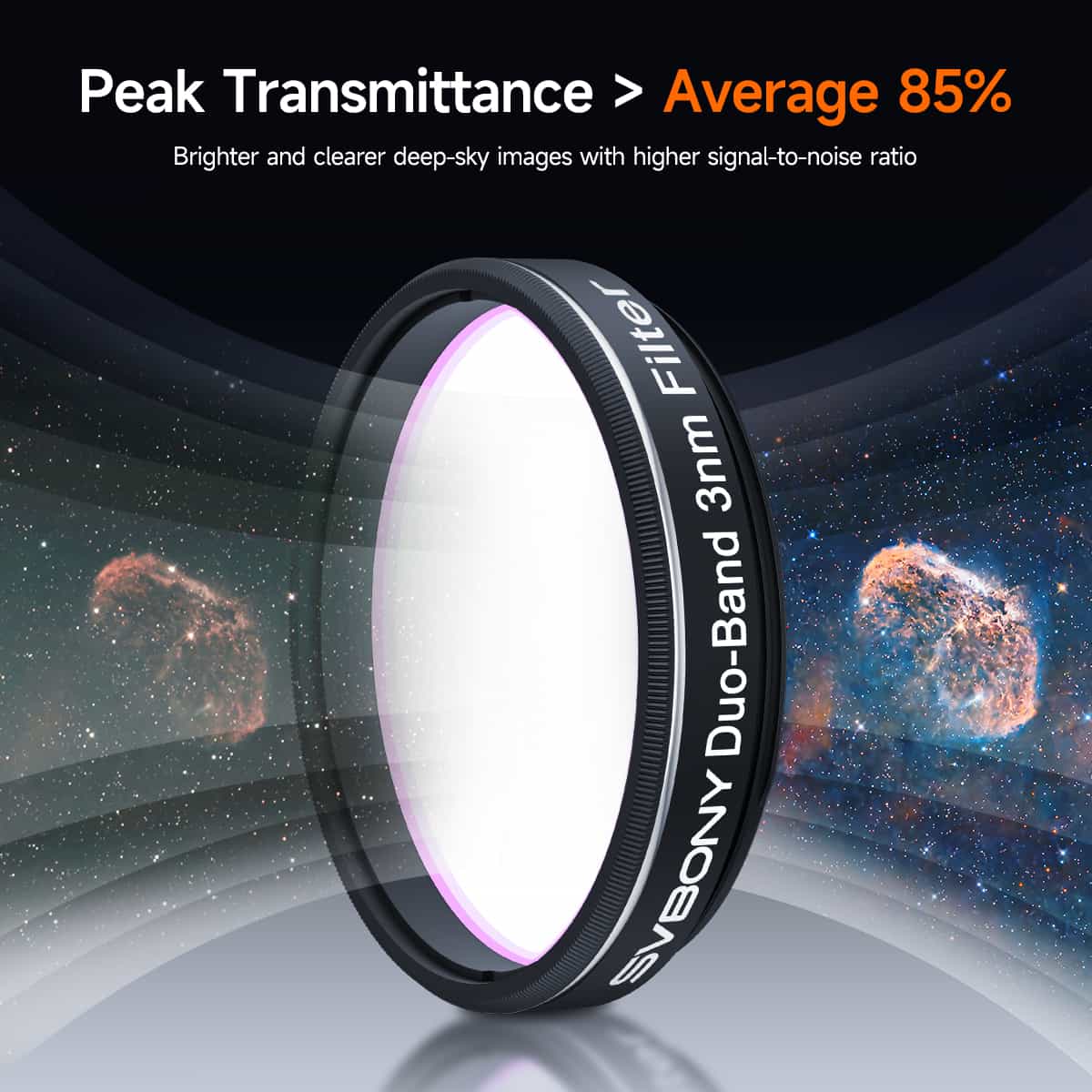
- High transmission: SVBONY specifies above 85% in both bands, which keeps exposure times practical.
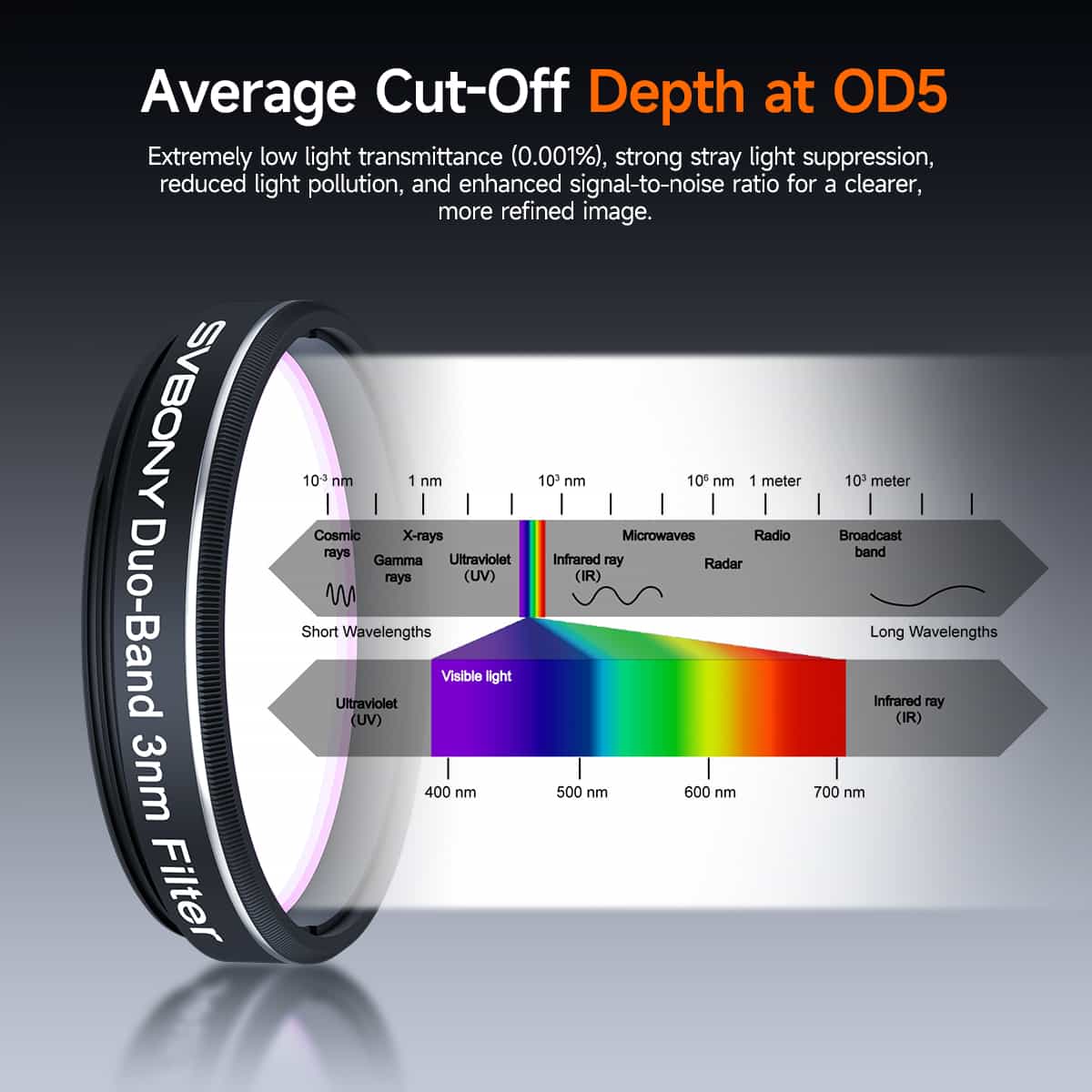
- OD5 average blocking: across 300–1050 nm.
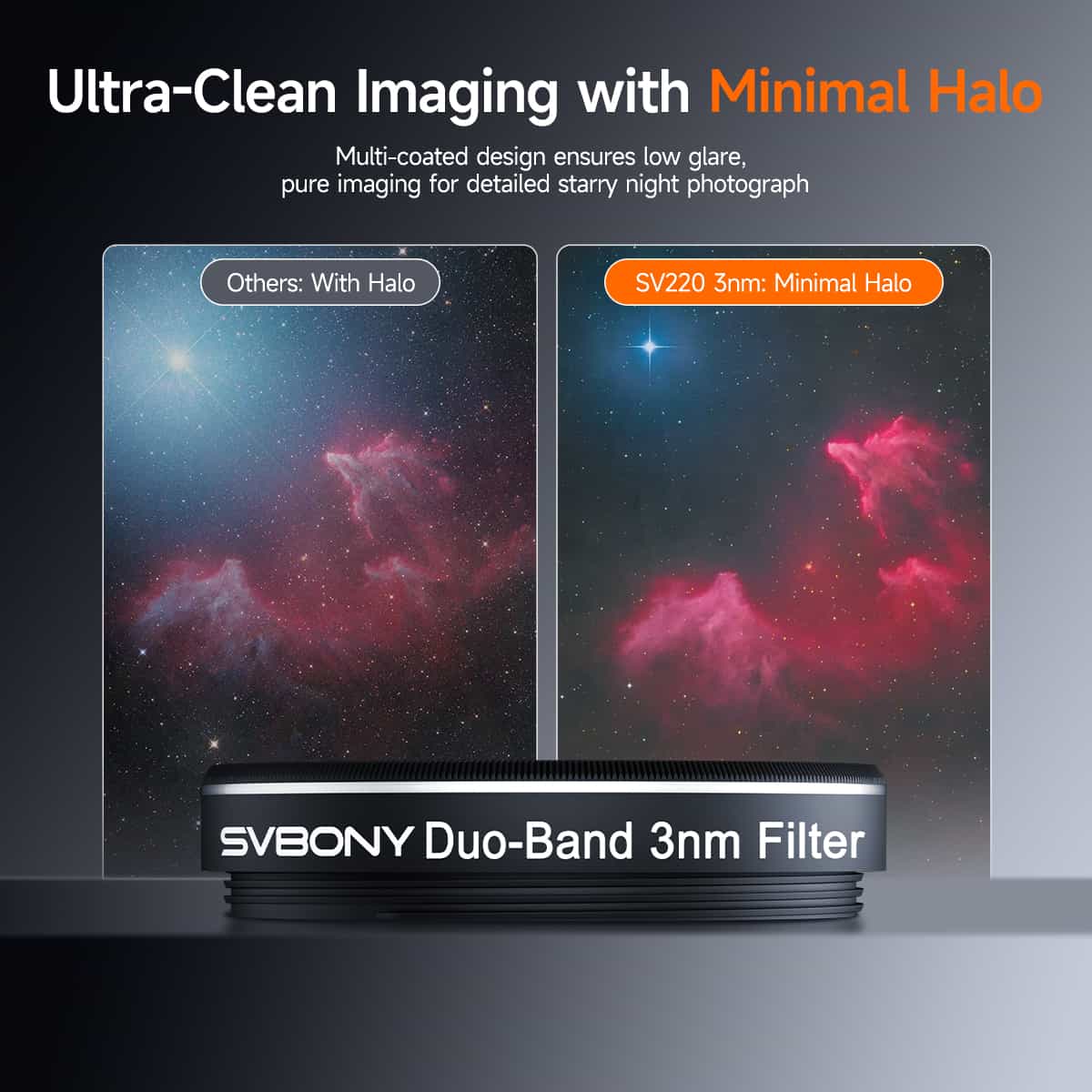
- Minimal-halo multi-layer coating: designed to reduce glare and halos around bright stars.
- 6061T aluminium cell: standard 1.25″ size with M28.5 x 0.6 thread.


Optical Design
Narrowing the passband from 7 nm to 3 nm passes the same emission-line signal from the nebula while admitting less than half the background sky light in each band. The result is a darker background and higher target contrast, at the cost of slightly fainter stars. Because the passbands are tight, the filter performs best on optics that are not extremely fast, where the steep light cone shifts the effective passband. The minimal-halo coating addresses the reflections that narrowband filters can produce around bright stars.


Recommended Uses
- Emission nebulae from urban sites: H II regions, planetary nebulae and supernova remnants.
- Moonlit nights: narrow passbands extend usable time around the full Moon.
- Bicolour imaging with a colour camera, or combined Ha+OIII data with a mono camera.

Compatibility and Accessory Notes
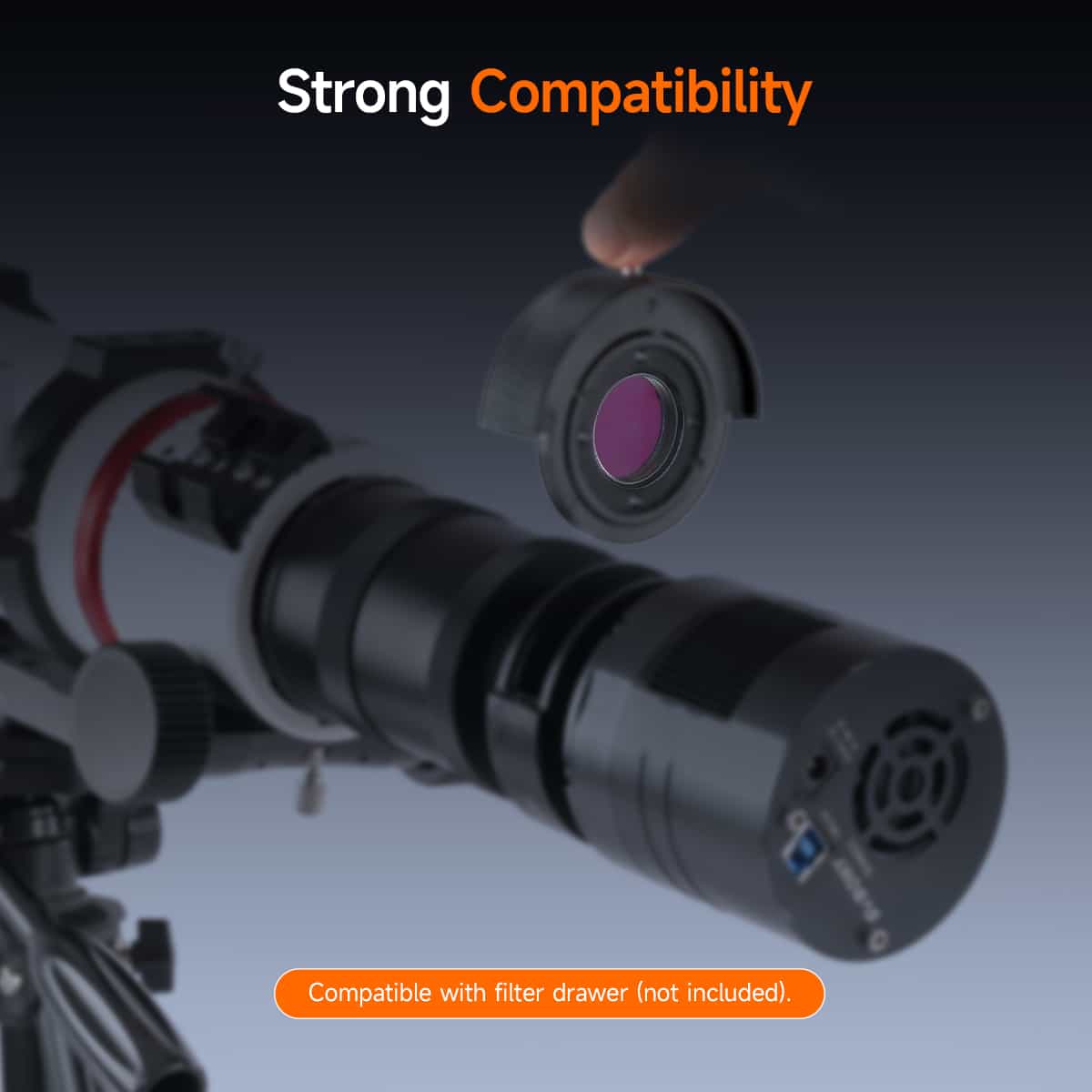
- Mounting: M28.5 x 0.6 male thread for 1.25″ nosepieces, filter wheels and drawers.
- Sensor size: the 26 mm clear aperture suits 1.25″-class sensors; the SV220 2″ 3nm covers larger sensors.
- Optics: narrowband passbands this tight are best matched to moderate focal ratios. Send us your telescope and camera and we will confirm the fit.


Good to Know Before You Order
- Imaging filter: it has no application in visual observing.
- Emission targets: galaxies and reflection nebulae are broadband targets and gain little from it.
- Exposure: tighter passbands mean longer sub-exposures than a 7 nm filter on the same target.
Frequently Asked Questions
Is it difficult to set up?
No. It threads into a 1.25″ nosepiece, filter wheel or drawer like any standard 1.25″ filter.
How does it differ from the SV220 7nm?
The 3 nm passbands reject more sky background, so contrast is higher under bright skies; the 7 nm version collects signal faster and suits darker sites and faster optics.
Does it work with a colour camera?
Yes. On a colour sensor H-alpha records in the red pixels and OIII in the green and blue.
Bottom Line
In short: a 1.25″ 3 nm H-alpha and OIII dual narrowband filter with OD5 blocking and a minimal-halo coating for high-contrast emission-nebula imaging under bright skies.
| Brand | SVBONY |
|---|---|
| Model | SV220 |
| Size | 1.25″ |
| Mirror ring size | Φ31.75 x 7 mm |
| Thread type | Single thread / male thread |
| Thread | M28.5 x 0.6 |
| Material | 6061T aluminium profile |
| Substrate thickness | 2.0 mm |
| Clear aperture | 26 mm |
| Centre wavelength | 500.7 / 656.3 nm |
| Bandwidth (FWHM) | 3 ±1 nm |
| Cutoff wavelength | 300–1050 nm |
| Cut-off depth | Average OD5 |
| Surface quality | 60/40 |
| Surface flatness | Transmitted wavefront PV ≤ λ/4 |
| Parallelism | 30″ |
| Net weight | 7 g |
You may also like
Recently viewed
Recent Blog Posts
View all
Your Guide Graph Is Lying to You
Read More

D-Size vs V-Size: A Complete Guide to Telescope Dovetail Systems
Read More

What Is Back Focus in Astrophotography? Telescope Reducers, Flatteners, and Spacing Explained
Read More