


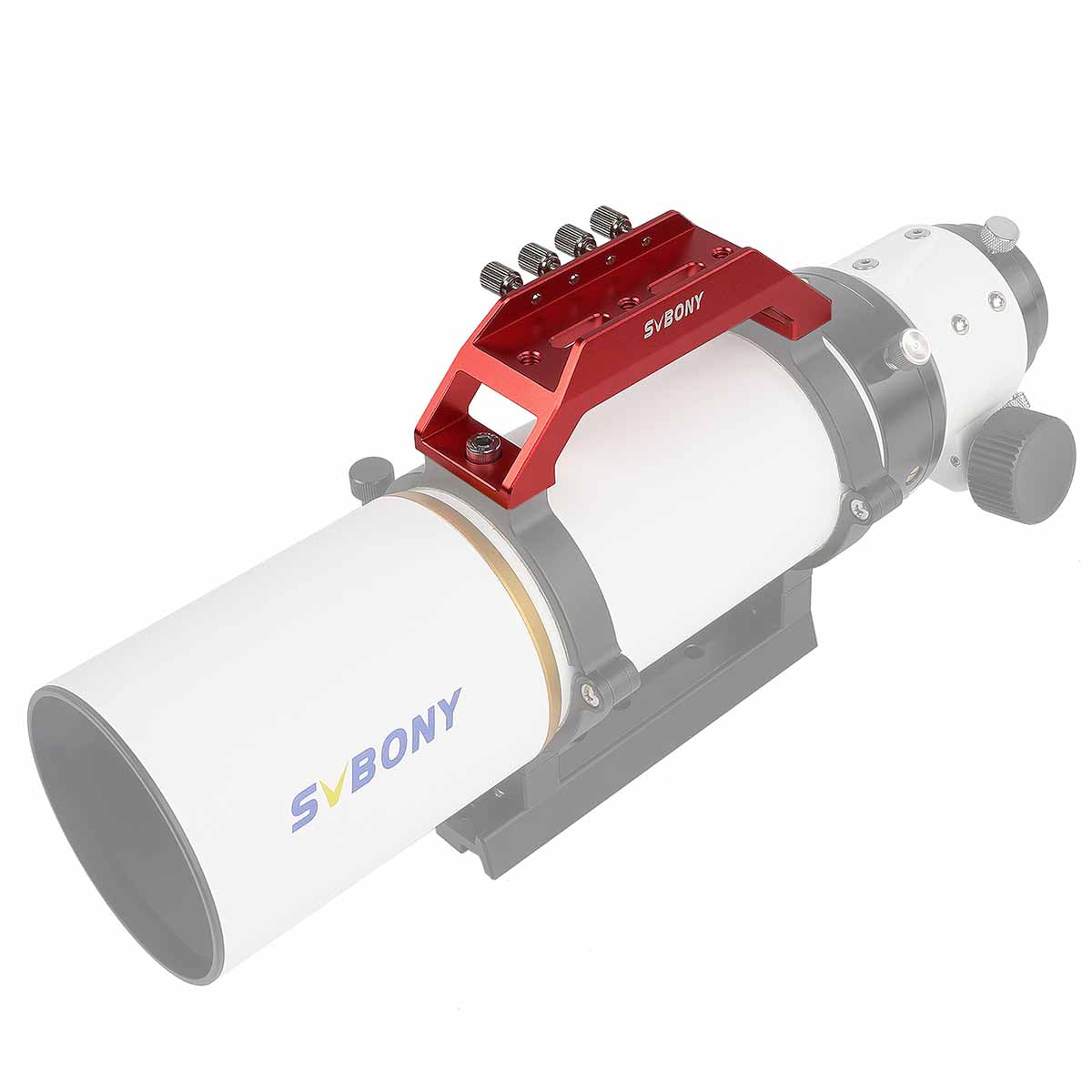


- Description
- Specifications

Product Overview
The SVBONY SV211 is a 135 mm carry handle that mounts across the tube rings of SVBONY's SV550 80 APO and SV503 80ED refractors. Along with giving you a firm grip when lifting the telescope onto the mount, it has an integrated saddle on top for a guide scope or finder scope; SVBONY shows it with the SV198 50 mm guide scope. It is machined from 6061 aluminium in red, measures 135 × 42 × 39 mm and weighs 136 g.

Who It's For
This is a good match if you own an SV550 80 APO or SV503 80ED and want a carry handle plus a place to mount a guide scope or finder without adding a separate dovetail.
Key Features & Design
- 135 mm handle: a carry grip across the tube rings.
- Integrated saddle: holds a guide scope or finder scope on top of the handle.
- 6061 aluminium: red finish, 135 × 42 × 39 mm, 136 g.
- Hardware included: M6 mount screws, M4 set screws and an M5 wrench.


Recommended Uses
- Carrying the telescope to and from the mount.
- Mounting a guide scope such as the SVBONY SV198 for autoguiding.
- Mounting a finder for visual alignment.

Compatibility and Accessory Notes
- Telescopes: SVBONY lists the SV550 80 APO and SV503 80ED; its description also names the SV503 70 f/6 and 80 f/7 and the SV550 80 f/6.
- Fixing: attaches with the two included M6 screws.
- Saddle: secured with the M4 set screws; SVBONY shows the SV198 guide scope on it.


If your telescope is not on SVBONY's list, send us the tube-ring hole spacing and we will check the fit with you.
What's in the Box
- 1 × handle bar
- 2 × M6 mount screws
- 4 × M4 set screws
- 1 × M5 wrench
Good to Know Before You Order
- Made for SVBONY's 70–80 mm refractors: the listed fits are the SV550 80 and SV503 70/80 models.
- Guide scope and finder sold separately.
Frequently Asked Questions
Is it difficult to set up?
No. It bolts across the tube rings with the two M6 screws, and the guide or finder scope is held in the saddle with the M4 set screws.
Can I mount a guide scope on it?
Yes. The integrated saddle is designed for a guide scope or finder; SVBONY shows the SV198.
How long is it?
135 mm, with a width of 42 mm and height of 39 mm.
Bottom Line
In short: a 135 mm red aluminium carry handle for the SV550 80 APO and SV503 80ED, with a built-in saddle that doubles as a guide or finder scope mount.
| Model | SV211 |
|---|---|
| Suitable OTA | SV550 80 APO, SV503 80ED |
| Material | 6061T aluminum |
| Color | Red |
| Length | 135 mm |
| Width | 42 mm |
| Height | 39 mm |
| Included | Handle bar, 2 × M6 mount screws, 4 × M4 set screws, M5 wrench |
| Net weight | 136 g / 4.8 oz |
You may also like
Recently viewed
Recent Blog Posts
View all
Your Guide Graph Is Lying to You
Read More

D-Size vs V-Size: A Complete Guide to Telescope Dovetail Systems
Read More

What Is Back Focus in Astrophotography? Telescope Reducers, Flatteners, and Spacing Explained
Read More