


- Description
- Specifications

Product Overview
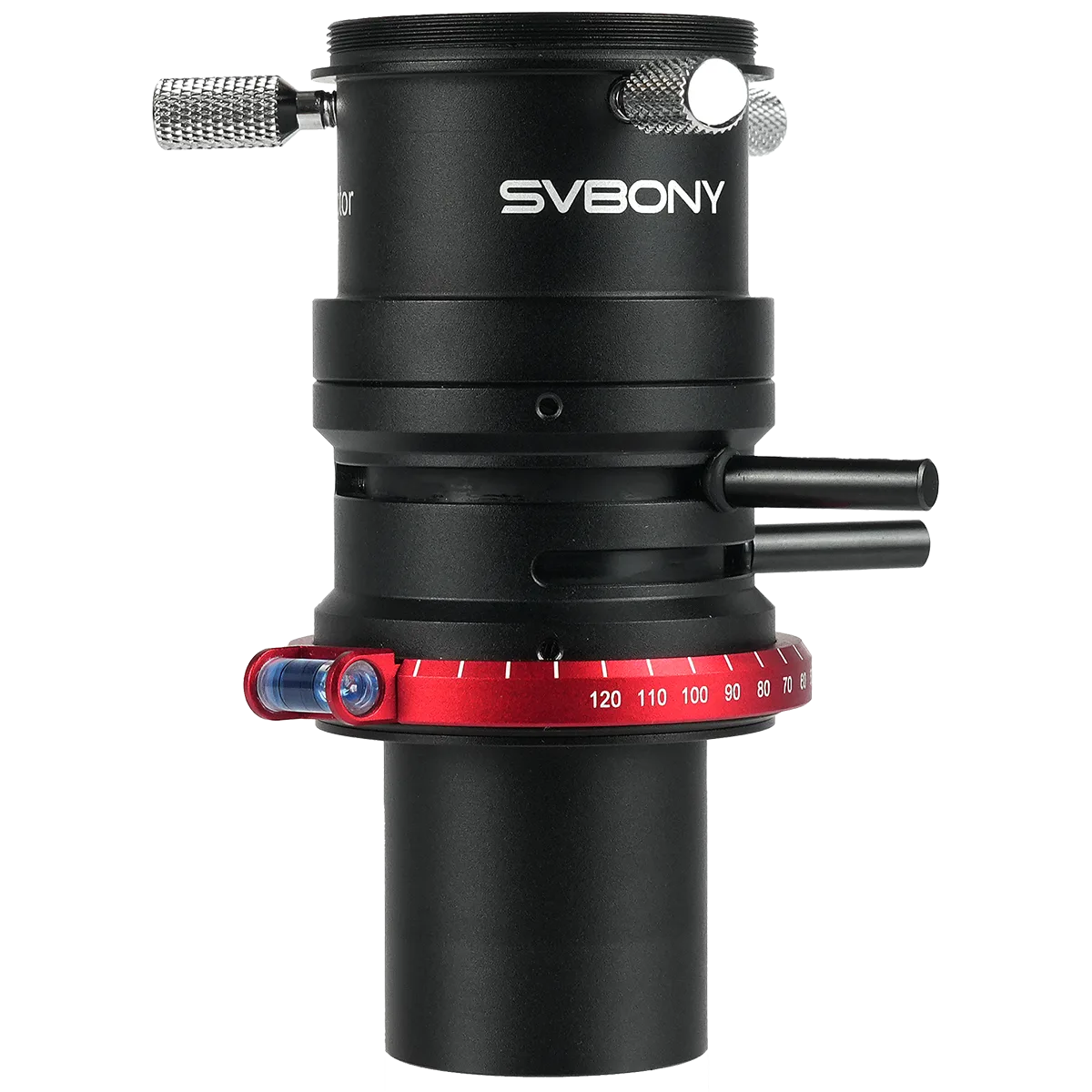
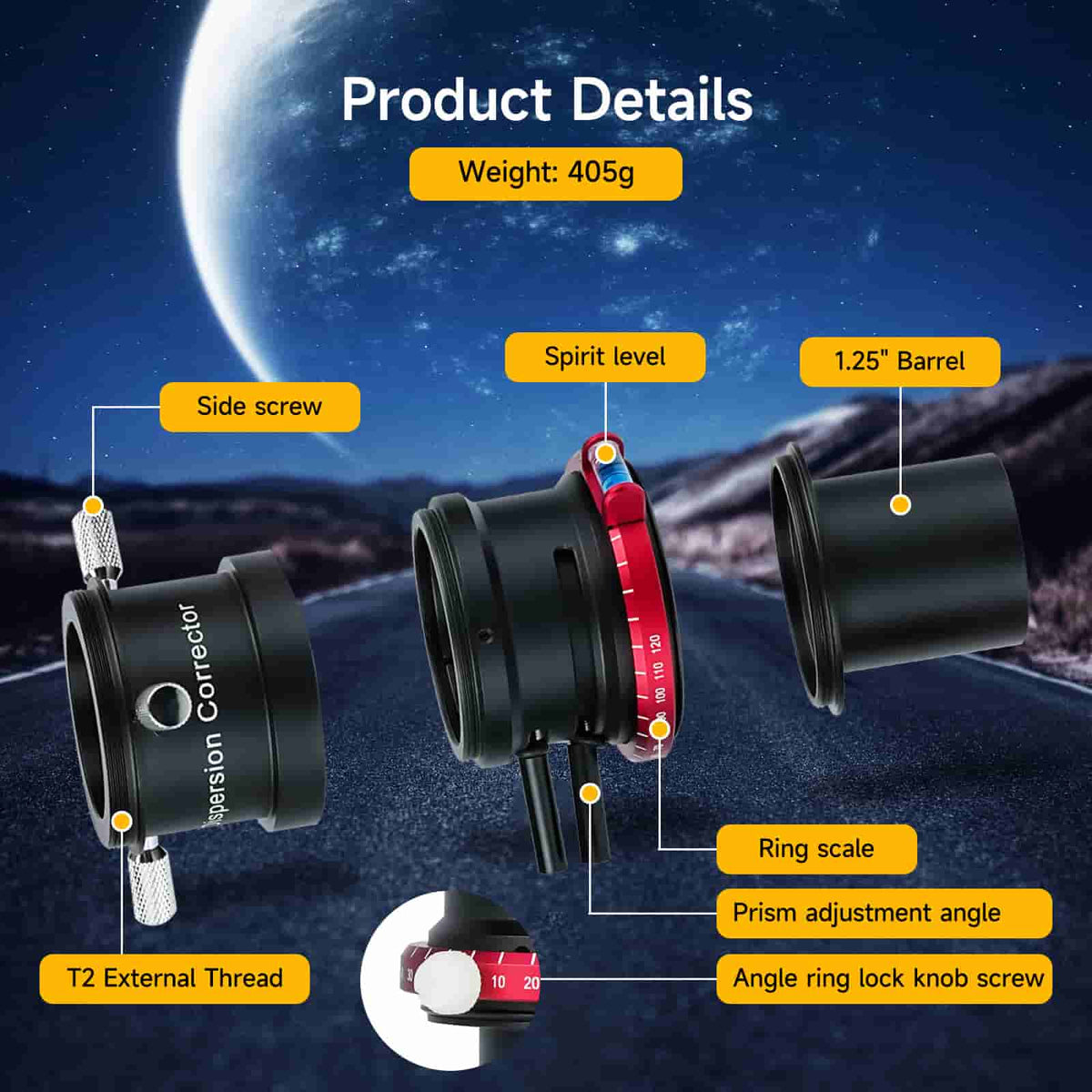
The SVBONY SV199 is a 1.25″ atmospheric dispersion corrector (ADC) for planetary and lunar work. When a planet sits low in the sky, the atmosphere acts like a weak prism and spreads its light into a blue fringe on one side and a red fringe on the other. The SV199 places a pair of adjustable BK7 wedge prisms in the light path to counter that spread. It has a 24 mm effective aperture, a 2°–2.5° deviation angle, a 1.25″ barrel with T2 thread on the telescope side, a T2 male thread on the camera side, and a built-in bubble level. It weighs 405 g.
Who It's For
This is a good match if you image or observe the planets and the Moon, particularly when they sit at modest altitudes where atmospheric dispersion softens detail and adds colour fringes.
Key Features & Design
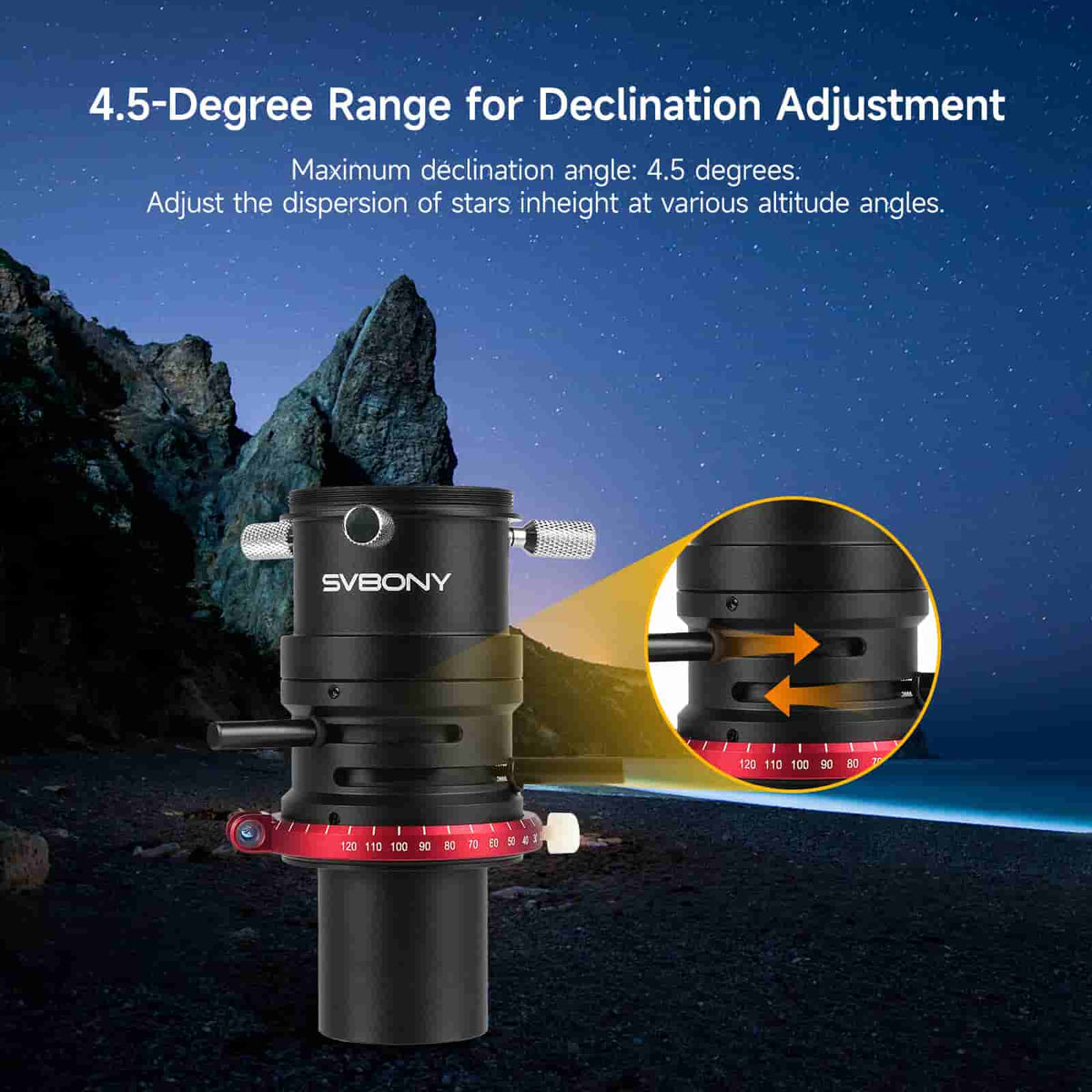
- Twin wedge prisms: one pair of BK7 wedge prisms with 1λ surface accuracy, adjusted with plastic levers against a metal scale dial.
- Double-sided anti-reflection coating: UV-AR coated for 300–700 nm to limit scatter and ghosting.
- Blackened prism edges: matte ink on the prism edges and blackened lateral surfaces for contrast.
- Bubble level: sets the ADC horizontal so the correction direction can be set reliably.
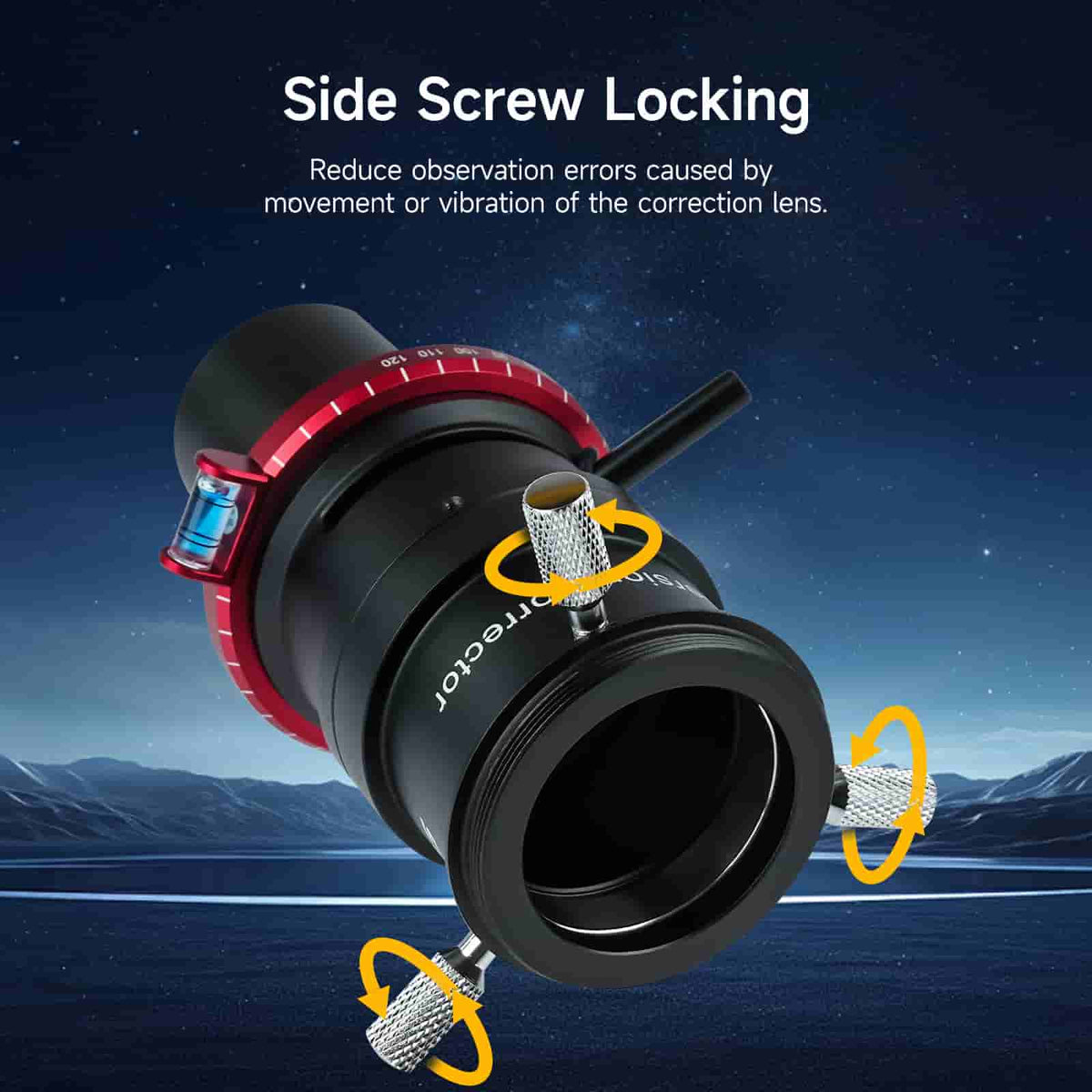
- CNC body: 30 × 48 mm, with a 0.05 mm thread tolerance and side locking screws at the eyepiece end.


Optical Design
The two wedge prisms each deviate light by 2°–2.5° and disperse it slightly. Rotating them relative to each other with the two levers varies the combined dispersion from zero up to its maximum, and you set it so that it cancels the atmospheric dispersion for the planet's altitude. The prisms are BK7 with a 24 mm optical aperture, which suits the narrow light cone of a planetary imaging train. SVBONY notes that the improvement is especially visible in the luminance channel when imaging in LRGB.
Recommended Uses
- Planetary imaging of Jupiter, Saturn, Mars and Venus with a high-frame-rate camera.
- Lunar imaging where fine crater detail is softened by colour spread.
- Visual planetary observing with an eyepiece behind the ADC.
- LRGB planetary work, where SVBONY highlights the gain in the luminance channel.

Compatibility and Accessory Notes
- Telescope side: 1.25″ barrel with T2 male thread.
- Eyepiece / camera side: T2 female thread at the lower end with a 1.25″ eyepiece mount and side locking screws.
- Body interface: T2 male thread.
- Train position: it sits between the telescope (or Barlow) and the camera or eyepiece. The ADC body length is 48 mm.


If you would like help placing it in your planetary train with a Barlow and camera, send us your setup and we will work through it with you.
What's in the Box
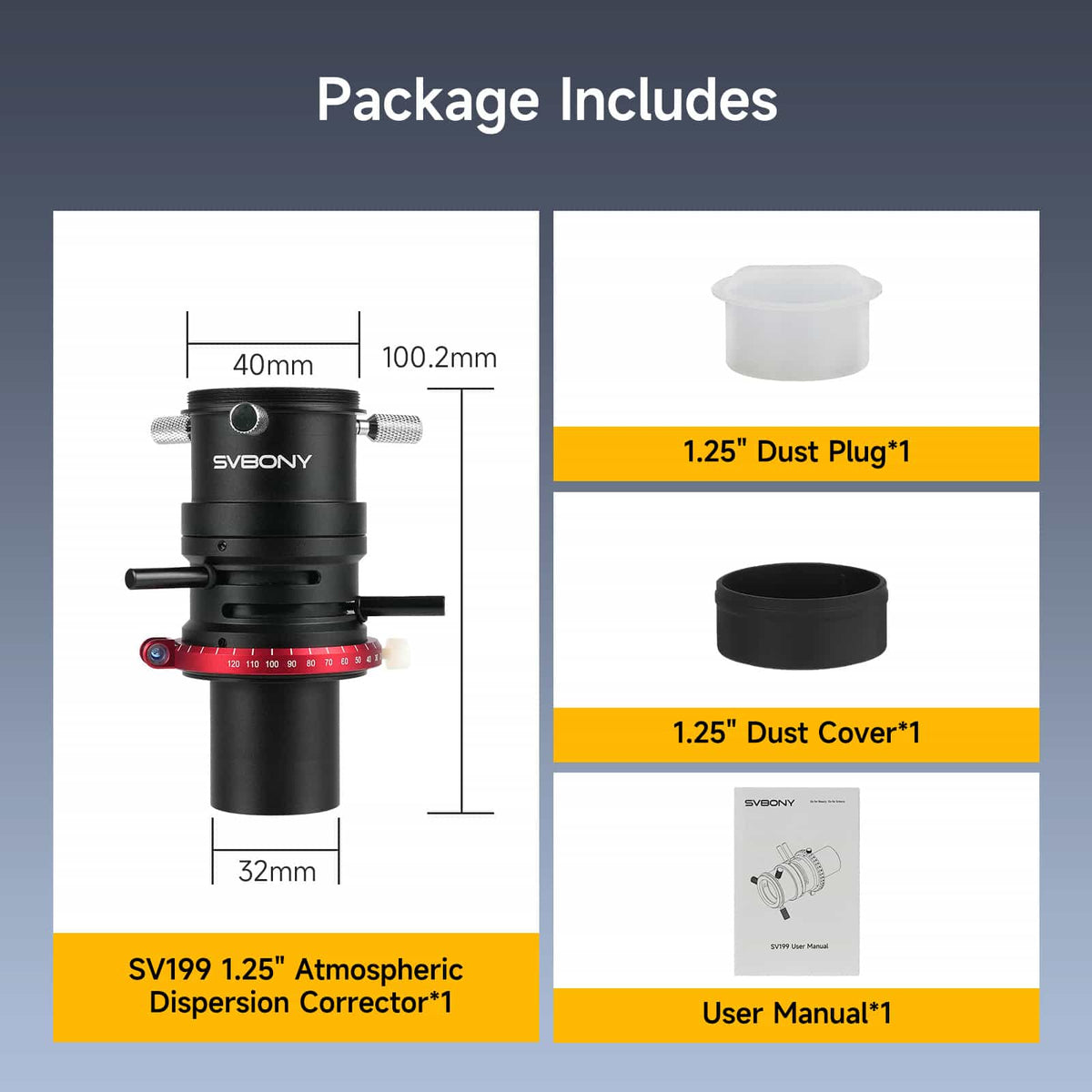
- SV199 1.25″ atmospheric dispersion corrector ×1
- 1.25″ dust plug ×1
- 1.25″ dust cover ×1
- User manual ×1
Good to Know Before You Order
- The correction depends on altitude: the levers are reset as the planet rises or sets, and near the zenith little correction is needed.
- 1.25″ format: the 24 mm aperture is sized for planetary trains rather than wide-field deep-sky imaging.
- Weight 405 g to account for in a focuser carrying a Barlow and camera.
Frequently Asked Questions
Is it difficult to set up?
Setting it up takes a few minutes. Level the body with the bubble level so the levers move horizontally, then adjust the levers while watching a bright star or planet on screen until the red and blue fringes merge.
Can I use it visually?
Yes. SVBONY describes connecting an eyepiece for visual use as well as a camera.
What is the clear aperture?
24 mm.
Does it replace a Barlow?
No. It corrects dispersion only and does not change focal length.
Bottom Line
In short: a 1.25″ ADC with a pair of adjustable BK7 wedge prisms, T2 threads on both sides and a bubble level, for cancelling atmospheric colour spread in planetary and lunar imaging and observing.
| Model | SV199 |
|---|---|
| Name | Atmospheric Dispersion Corrector |
| Prism type | Wedge, one pair |
| Substrate | BK7 |
| Coating | Double-sided antireflection; UV AR 300–700 nm |
| Surface accuracy | 1λ |
| Deviation angle | 2°–2.5° |
| Effective aperture | 24 mm |
| Telescope side | 1.25″ tube / T2 male thread |
| Eyepiece side | T2 female thread (lower end), 1.25″ eyepiece mount, side locking screws |
| ADC body interface | T2 male thread |
| Thread tolerance | 0.05 mm |
| Bubble level | Yes |
| Adjustment | Plastic adjustment levers, metal scale dial |
| Prism edges | Matte ink coating; blackened lateral surfaces |
| Body | CNC, black |
| Dimensions | 30 × 48 mm |
| Package dimensions | 137 × 105 × 97 mm |
| Included | Dust plug, dust cover, user manual |
| Weight | 405 g |
You may also like
Recently viewed
Recent Blog Posts
View all
Your Guide Graph Is Lying to You
Read More

D-Size vs V-Size: A Complete Guide to Telescope Dovetail Systems
Read More

What Is Back Focus in Astrophotography? Telescope Reducers, Flatteners, and Spacing Explained
Read More