





- Description
- Specifications

Product Overview
The SVBONY SV139 is a 1.25″ neutral density filter for lunar observing. A neutral density filter dims the whole image evenly across the spectrum, so the Moon becomes comfortable to look at without taking on a green or yellow cast. This listing is the ND0.6 density (item W9108A), which passes 25% of the incoming light and is the density SVBONY pairs with a waxing crescent Moon. The filter is optical glass in a 2 mm aluminium cell with a standard M28.5 x 0.6 thread.

Who It's For
This is a good match if you observe the Moon visually and find the view glaring, particularly through a larger-aperture telescope, and want to cut the brightness while keeping the Moon's natural grey tones.
Key Features & Design
- Neutral density: reduces brightness evenly without shifting colour balance.
- ND0.6, 25% transmission: a moderate reduction suited to the thinner lunar phases.
- Standard 1.25″ thread: M28.5 x 0.6, so it threads into the barrel of any 1.25″ eyepiece or diagonal nosepiece with filter threads.
- Slim 2 mm cell: aluminium frame with a metal thread and an optical glass element.


Recommended Uses
- Visual lunar observing around crescent phases, where SVBONY matches ND0.6.
- Bright-target viewing where reduced glare makes surface detail easier to follow.
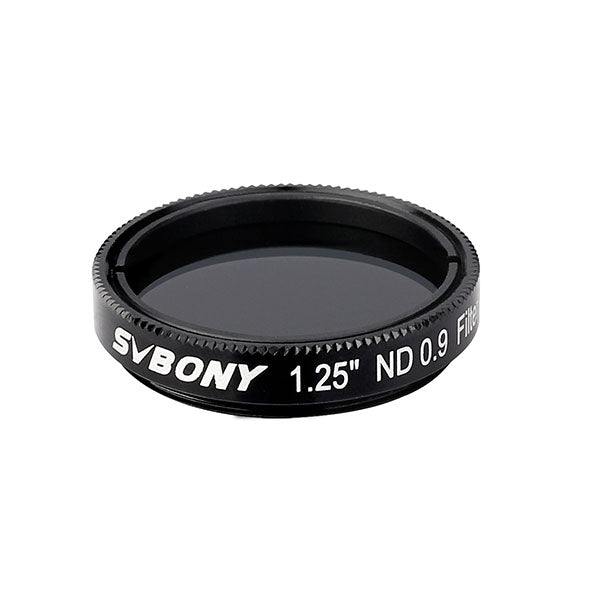
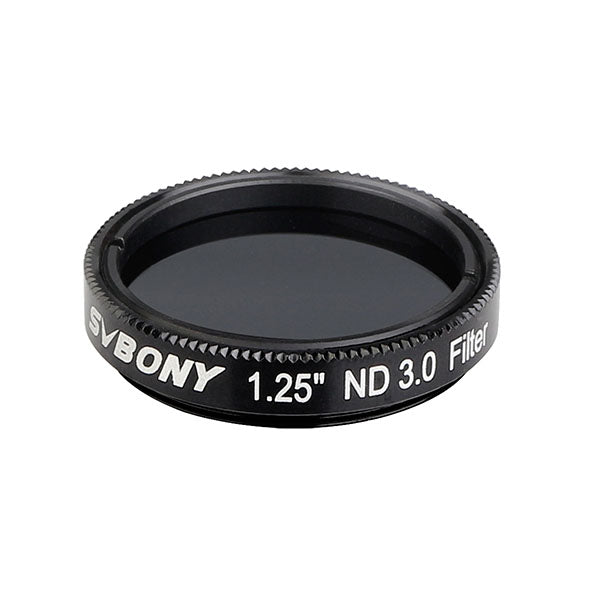
SVBONY makes the SV139 in four densities and matches each to a Moon phase: ND0.6 (25%) for a waxing crescent, ND0.9 (12.5%) for first and last quarter, ND1.2 (6.25%) for waxing and waning gibbous, and ND3.0 (0.1%) for the full Moon.


Compatibility and Accessory Notes
- Fits: any 1.25″ eyepiece or accessory with standard M28.5 x 0.6 filter threads.
- Stacking: the cell is threaded, so it can be combined with other 1.25″ filters.

Good to Know Before You Order
- Density: this listing is ND0.6. The ND0.9, ND1.2 and ND3.0 versions are separate densities; if you would like one of those, get in touch and we will order it for you.
- Not a solar filter: the SV139 is made for the Moon and is not designed for viewing the Sun.
Frequently Asked Questions
Is it difficult to set up?
No. It threads into the bottom of a 1.25″ eyepiece barrel before the eyepiece goes into the diagonal or focuser.
Will it change the colour of the Moon?
No. A neutral density filter reduces brightness evenly, so the Moon keeps its natural tones.
Which density should I choose?
SVBONY's guide is ND0.6 for a crescent, ND0.9 for quarter phases, ND1.2 for gibbous phases and ND3.0 for the full Moon. Larger apertures gather more light, so a denser filter can help at the same phase.
Bottom Line
In short: a 1.25″ ND0.6 moon filter that passes 25% of the light, threads into a standard eyepiece, and takes the glare off the Moon without altering its colour.
| Model | SV139 |
|---|---|
| Item code | W9108A (ND0.6) |
| Type | Neutral density filter |
| Optical density | 0.6 |
| Transmission | 25% |
| Suggested Moon phase | Waxing crescent |
| Other densities in the SV139 series | ND0.9 (W9108B, 12.5%), ND1.2 (W9108C, 6.25%), ND3.0 (W9108D, 0.1%) |
| Barrel diameter | 1.25″ |
| Thread | Standard M28.5 x 0.6 |
| Thickness | 2 mm |
| Material | Aluminium frame, metal thread and optical glass |
| Weight | Not published by vendor |
| Use case | Reducing glare for visual lunar observing |
You may also like
Recently viewed
Recent Blog Posts
View all
Your Guide Graph Is Lying to You
Read More

D-Size vs V-Size: A Complete Guide to Telescope Dovetail Systems
Read More

What Is Back Focus in Astrophotography? Telescope Reducers, Flatteners, and Spacing Explained
Read More