



- Description
- Specifications

Product Overview
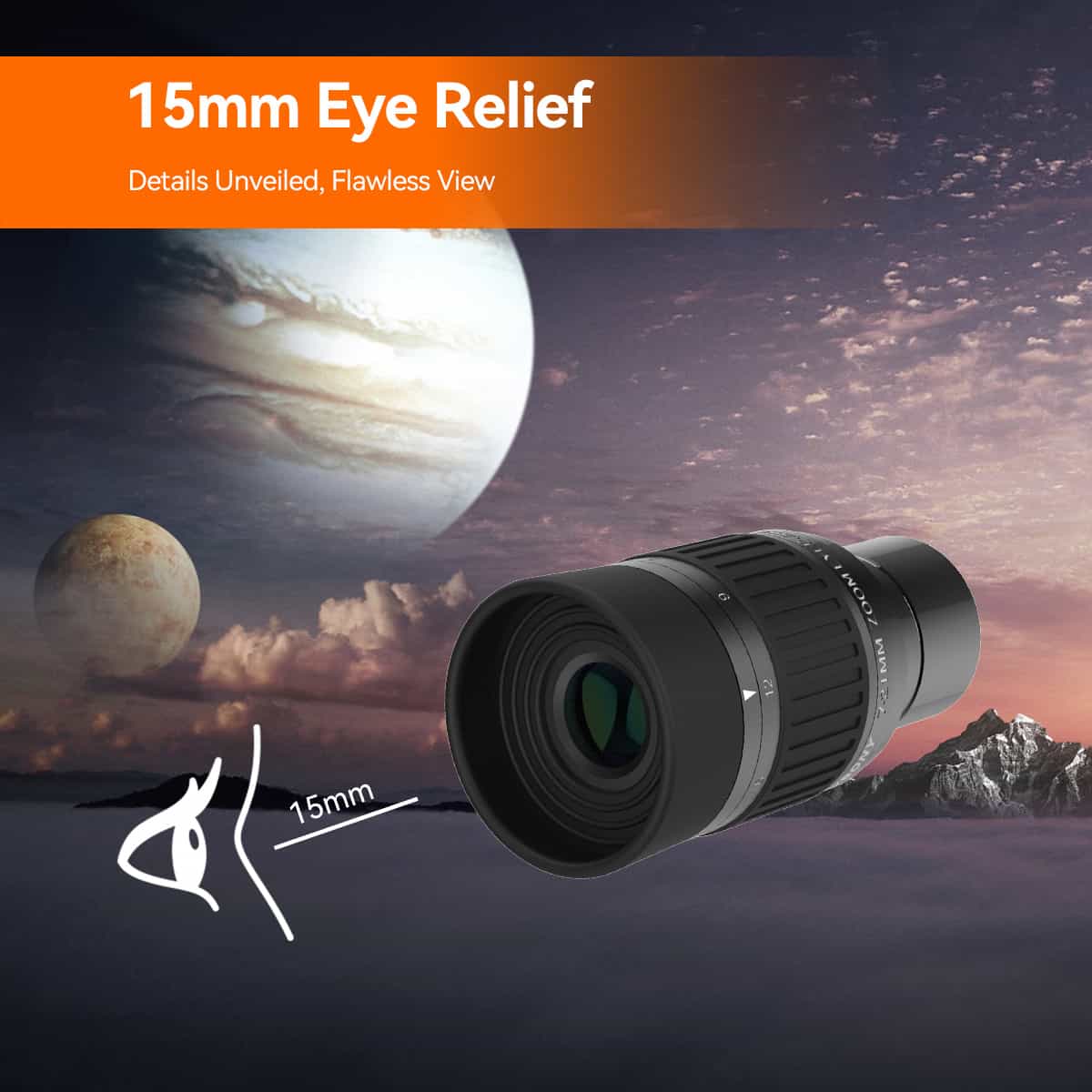
The SVBONY SV135 60°–40° (item W9105D) is a fully multi-coated 1.25″ zoom eyepiece that runs continuously from 7 mm to 21 mm. It is the widest-field SV135, with a 60° apparent field at 7 mm and 40° at 21 mm, from seven elements in four groups of high-index glass. Eye relief is 13–15 mm, the barrel has an M28.5 × 0.6 filter thread, and it weighs 145 g.

Who It's For
This is a good match if you want one eyepiece for the Moon, Jupiter and Saturn, nebulae and star clusters, and you value a wider field at high power — helpful for keeping a planet in view longer on a manual or undriven mount.
Key Features & Design
- 7–21 mm linear zoom with a 60°–40° apparent field.
- 4 groups / 7 elements: fully multi-coated high-index glass.
- 13–15 mm eye relief: rubber eye guard for comfort with glasses and to block stray light.
- Safety undercut barrel: helps keep it seated in the focuser or diagonal.
- Blackened lens edges and anti-reflection threads.
- M28.5 × 0.6 filter thread for 1.25″ accessories.

Optical Design
With seven elements in four groups, this SV135 holds a wider field across the zoom range than the five- and six-element versions: 60° at 7 mm, 40° at 21 mm. The trade is weight — 145 g against 95 g and 133 g for the other two. On a 1000 mm telescope it gives roughly 48× to 143×.

Recommended Uses
- Moon and planets: Jupiter and Saturn at the power the seeing allows.
- Nebulae and star clusters, including diffuse nebulae, at the low-power end.
- Grab-and-go and outreach: one eyepiece in place of several.
Compatibility and Accessory Notes
- Barrel: 1.25″, for standard 1.25″ focusers and diagonals.
- Filters: M28.5 × 0.6 thread, compatible with 1.25″ filters.

Good to Know Before You Order
- Field narrows to 40° at 21 mm, as is typical of zooms.
- Three SV135 versions: 52°–36°, 57°–40° and 60°–40° (this one), each with its own design and weight.
Frequently Asked Questions
Is it difficult to set up?
No. It slides into a 1.25″ focuser or diagonal; twist to zoom and refocus slightly as needed.
Can I use it with glasses?
The 13–15 mm eye relief and rubber eye guard are designed for use with glasses.
Which SV135 has the widest field?
This one: 60° at 7 mm and 40° at 21 mm.
Bottom Line
In short: a 145 g, 4-group/7-element 1.25″ 7–21 mm zoom with a 60°–40° field — the widest-field SV135 for lunar, planetary and cluster observing.
| Model | SV135 (W9105D) |
|---|---|
| Zoom type | Linear |
| Focal length | 7–21 mm |
| Apparent field of view | 60°–40° |
| Eye relief | 13 mm – 15 mm |
| Lens design | 4 groups / 7 elements |
| Barrel size | 1.25″ |
| Lens coating | Fully multi-coated (green) |
| Rubber eye guard | Yes |
| Material | Metal + optical glass |
| Colour | Black |
| Filter thread | M28.5 × 0.6 |
| Net weight | 145 g |
| Package dimensions | 110 × 80 × 70 mm |
| Use case | Visual lunar, planetary and deep-sky observing |
You may also like
Recently viewed
Recent Blog Posts
View all
Your Guide Graph Is Lying to You
Read More

D-Size vs V-Size: A Complete Guide to Telescope Dovetail Systems
Read More

What Is Back Focus in Astrophotography? Telescope Reducers, Flatteners, and Spacing Explained
Read More