




- Description
- Specifications

Product Overview
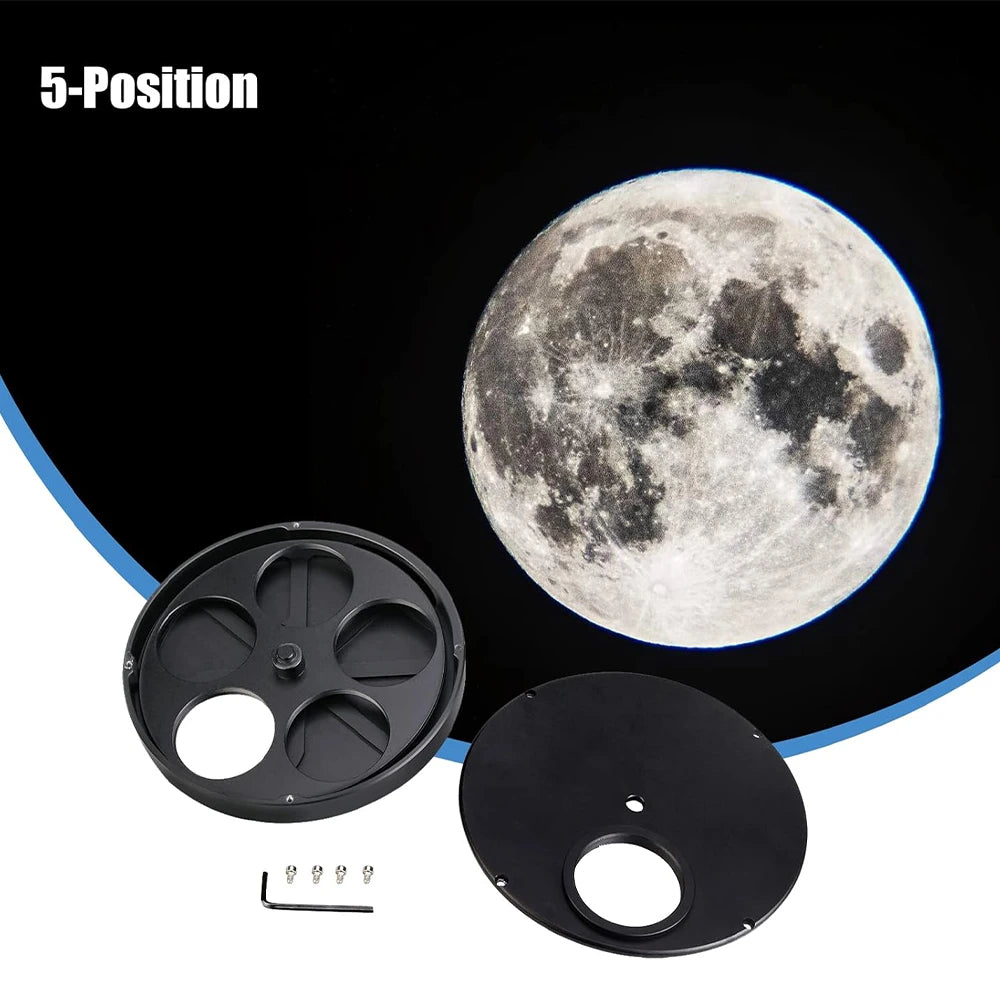
The SVBONY SV133 2″ is a manual filter wheel with five positions for 2″ filters. It lets you switch filters with a camera attached or a 2″ eyepiece in place, so a session is not interrupted by unthreading filters. SVBONY lists it for 2″ eyepieces and for DSLR and CCD cameras, and builds it for frequent, long-term use.
Who It's For
This is a good match if you image or observe with 2″ filters — narrowband, light-pollution or colour — and want to rotate between up to five of them during a session without breaking down your optical train.
Key Features & Design
- Five positions for 2″ filters: organized storage and consistent switching.
- Switch without disassembly: change filters with a camera or eyepiece attached.
- Camera or eyepiece use: SVBONY shows connections for both.
- Sturdy construction for frequent use.

Recommended Uses
- Narrowband and broadband deep-sky imaging with a DSLR or astronomy camera.
- Visual filter comparison with 2″ nebula filters on the same target.

Compatibility and Accessory Notes
SVBONY shows the SV133 2″ in two configurations. With a camera and telescope:

And with an eyepiece and telescope:

- Filters: 2″ filters.
- Eyepieces: 2″ eyepieces.
- Cameras: DSLR and CCD cameras.
- M48-to-M42 adapter: not included.
SVBONY does not publish the wheel's thread sizes or optical path length for this version. Send us your camera, corrector and focuser details and we will confirm the connections and spacing before you order.
Good to Know Before You Order
- Filters sold separately.
- M48-to-M42 adapter not included.
- Manual operation: no motor or computer control.
- Weight: not published by SVBONY.
Frequently Asked Questions
Is it difficult to set up?
No. Thread your filters into the five positions, attach the wheel between telescope and camera or eyepiece, and turn the wheel to select a filter.
Can I use it visually?
Yes. SVBONY shows it connected to an eyepiece and telescope as well as to a camera.
Does it fit 1.25″ filters?
This version is for 2″ filters. SVBONY makes a separate 1.25″ SV133.
Is it motorized?
No, it is a manual wheel.
Bottom Line
In short: a manual five-position wheel for 2″ filters that lets you change filters with a camera or eyepiece attached, for imaging and visual sessions.
| Model | SV133 |
|---|---|
| Filter size | 2″ |
| Positions | 5 |
| Type | Manual |
| Compatibility | 2″ eyepieces, DSLR and CCD cameras |
| Not included | M48-to-M42 adapter |
| Weight | Not published by vendor |
| Use case | Filter changes for deep-sky imaging and visual observing |
You may also like
Recently viewed
Recent Blog Posts
View all
Your Guide Graph Is Lying to You
Read More

D-Size vs V-Size: A Complete Guide to Telescope Dovetail Systems
Read More

What Is Back Focus in Astrophotography? Telescope Reducers, Flatteners, and Spacing Explained
Read More