




- Description
- Specifications

Product Overview
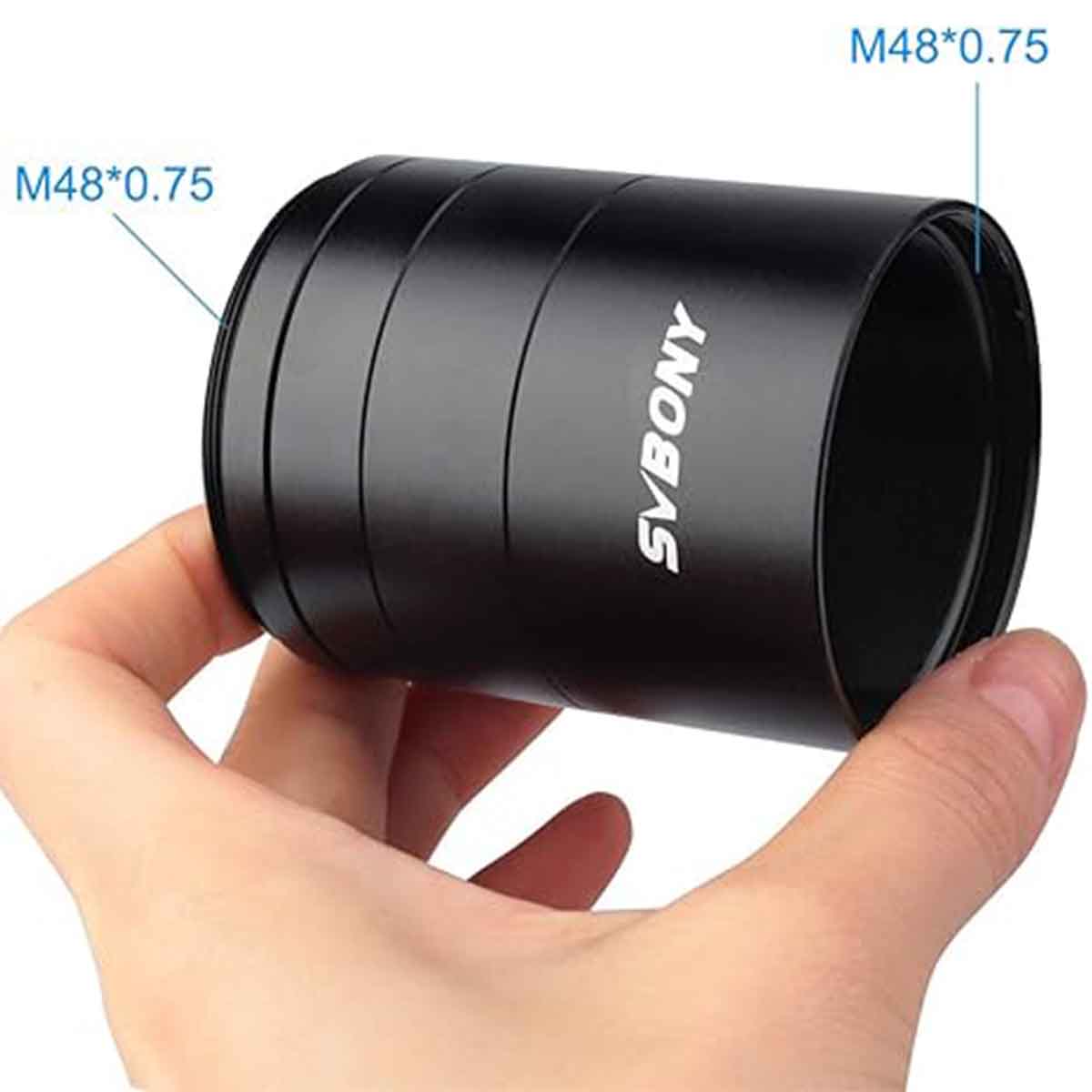
The SVBONY SV119 (item F9190A) is a set of M48×0.75 extension tubes in 5 mm, 10 mm, 15 mm and 30 mm lengths. Each tube has a male thread on one end and a female thread on the other, so they stack in any combination to add the spacing an imaging train needs behind a reducer, field flattener, corrector or Barlow. The tubes are fully anodized aluminium with an internally threaded bore to cut stray reflections, and SVBONY publishes a net weight of 72.9 g (2.57 oz).

Who It's For
This is a good match if you image through an M48 corrector and need to hit its published backfocus, or if you want a few spare lengths on hand to fine-tune focus position and image scale with a camera or eyepiece train.
Key Features & Design
- Four lengths: 5, 10, 15 and 30 mm, giving any combination from 5 mm to 60 mm in 5 mm steps.
- M48×0.75 male and female threads: the tubes stack directly onto each other and onto M48 accessories.
- Inner-threaded bore: reduces stray light and internal reflections.
- Anodized aluminium: light, durable and black throughout.


Recommended Uses
- Backfocus spacing behind M48 field flatteners, reducers and coma correctors.
- Focus reach: extending the train when a camera or eyepiece cannot reach focus.
- Image scale: changing the spacing behind a Barlow to adjust magnification.

Compatibility and Accessory Notes
- Thread: M48×0.75 male and female on every tube.
- Connects: cameras, eyepiece adapters and other accessories with M48×0.75 threads.
- Spacing: add the tube lengths to your camera's sensor-to-flange distance and any filter drawer or wheel to reach your corrector's required backfocus. Send us your setup and we will work the figure out with you.
What's in the Box
- 5 mm M48 extension tube
- 10 mm M48 extension tube
- 15 mm M48 extension tube
- 30 mm M48 extension tube
Good to Know Before You Order
- Mechanical spacers only: they contain no glass and do not change focal length on their own.
- M48 only: an M42 (T2) train needs M42 tubes or an M48-to-M42 adapter.
Frequently Asked Questions
Is it difficult to set up?
No. Choose the lengths that add up to the spacing you need and thread them together between your corrector and camera.
What spacings can I make?
Any 5 mm step from 5 mm to 60 mm using the four tubes.
Do they work with M42 cameras?
Not directly. The tubes are M48×0.75 at both ends, so an M42 camera needs an M48-to-M42 adapter.
Bottom Line
In short: four stackable M48×0.75 anodized aluminium spacers, 5 to 30 mm, for setting backfocus and focus position in an imaging train.
| Model | F9190A (SV119) |
|---|---|
| Type | Astronomical M48×0.75 thread extension tube |
| Male thread | M48×0.75 |
| Female thread | M48×0.75 |
| Lengths | 5 mm, 10 mm, 15 mm, 30 mm |
| Material | Anodized aluminium |
| Net weight | 72.9 g / 2.57 oz |
| Use case | Backfocus and focus spacing in M48 imaging trains |
You may also like
Recently viewed
Recent Blog Posts
View all
Your Guide Graph Is Lying to You
Read More

D-Size vs V-Size: A Complete Guide to Telescope Dovetail Systems
Read More

What Is Back Focus in Astrophotography? Telescope Reducers, Flatteners, and Spacing Explained
Read More