



- Description
- Specifications

Product Overview
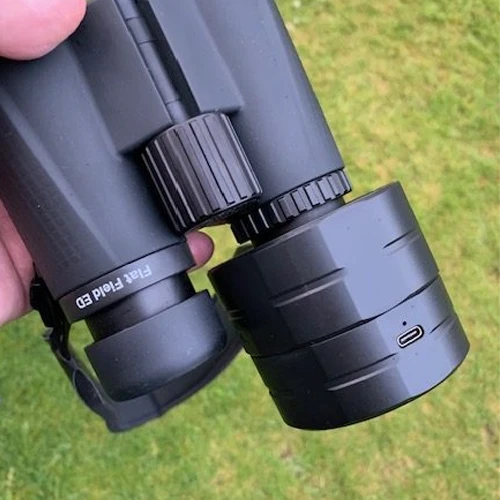
The SVBONY SC002 is a compact WiFi electronic eyepiece camera for spotting scopes and small telescopes. A 2 MP, 1/2.7″ CMOS sensor with 3 µm pixels records 1920 x 1080 JPG photos and H.264 MP4 video at 25–30 fps, and a 2.4 GHz WiFi link (150 Mbps, about 10 m range) sends the live view to SVBONY's free Cam app on your phone. A 1500 mAh polymer lithium battery powers it, files save to the included 32 GB TF card, and charging and data run over USB Type-C.
Who It's For
This is a good match if you digiscope birds and wildlife and want to capture what you see on your phone without holding the phone to the eyepiece, or if you want an easy way to share the view of the Moon or a daytime scene from a small telescope.
Key Features & Design
- 2 MP, 1920 x 1080 capture: JPG photos and MP4 video at 25–30 fps (automatic).
- Four viewing modes: Full, 1x, 2x and 3x digital zoom; the saved image is always the full-resolution original.
- WiFi to your phone: 2.4G, 150 Mbps, with a range of about 10 m / 33 ft.
- Manual brightness: adjustable 0–100 (default 50).
- Built-in battery: 1500 mAh polymer lithium, charged over USB Type-C.
- 32 GB TF card included for on-camera storage.
- Light ABS housing in black.

Camera Design
The SC002 takes the place of an eyepiece, so the scope forms its image directly on the 1/2.7″ sensor. The digital zoom modes crop the live view for framing and focusing; because cropping lowers on-screen clarity, the camera always saves the uncropped original. Video is encoded in H.264 for compact files that share easily from a phone.
Recommended Uses
- Digiscoping: birds and wildlife through a spotting scope, recorded to the TF card and shared from your phone.
- Lunar and daytime viewing through a small telescope.
- Shared viewing: several people can watch the scope's view on a phone screen.


Compatibility and Accessory Notes
- App: SVBONY Cam, free on Google Play and the Apple App Store; the same app runs the SC001. Languages include English, French, German, Italian, Spanish, Russian, Japanese, Portuguese and Korean.
- Scopes: SVBONY shows the SC002 paired with its SV28 and SV28 PLUS spotting scopes and the SV13 telescope. If you are fitting it to a different scope, send us the eyepiece holder size and we will check it with you.


Good to Know Before You Order
- Phone permissions: the app needs camera, storage/photos and location permissions; SVBONY's troubleshooting notes trace most connection issues to one of these being denied.
- Bright targets: the uncooled 2 MP sensor suits wildlife, the Moon and daytime scenes rather than deep-sky imaging.
- Operating range: −10 °C to 50 °C, 20–80% RH.
- Weight and package list: SVBONY does not publish either on the product page.
Frequently Asked Questions
Is it difficult to set up?
No. Fit it in place of the eyepiece, connect your phone to the camera's WiFi, open the SVBONY Cam app and focus the scope until the view is sharp on screen.
The app will not open the camera. What should I check?
SVBONY traces this to blocked app permissions or a temporary glitch: enable the permissions in your phone's settings, then restart the SC002.
Photos or videos will not save. Why?
The app needs storage or photos access. Grant album access in the app settings and reopen the app.
The IP address seems stuck. How do I fix it?
This usually follows denying location access during setup. Enable location for the app and restart the SC002.
Does digital zoom reduce image quality?
On screen, yes, because it crops the view. The saved picture is always the full-resolution original.
Bottom Line
In short: a battery-powered 1080p WiFi eyepiece camera that sends your spotting scope or small telescope view to your phone and records it to an included 32 GB card.
| Model | SC002 |
|---|---|
| Image sensor | CMOS |
| Total pixels | 2 MP |
| Max resolution | 1920 x 1080 |
| Sensor size | 1/2.7″ |
| Pixel size | 3 µm x 3 µm |
| WiFi module | 2.4G, 150 Mbps |
| WiFi range | 10 m / 33 ft |
| Data cable | Type-C charging and data cable |
| Brightness | Manual, 0–100 (initial 50) |
| Battery | Polymer lithium, 1500 mAh |
| Video | MP4, 25–30 fps (auto), H.264 |
| Image format | JPG |
| App languages | English, French, German, Italian, Spanish, Russian, Japanese, Portuguese, Korean |
| Colour / material | Black / ABS plastic |
| Storage card | 32 GB TF card |
| Working humidity | 20%RH–80%RH |
| Storage humidity | 20%RH–95%RH |
| Operating temperature | −10 °C to 50 °C |
| Storage temperature | −20 °C to 60 °C |
| Weight | Not published by vendor |
You may also like
Recently viewed
Recent Blog Posts
View all
Your Guide Graph Is Lying to You
Read More

D-Size vs V-Size: A Complete Guide to Telescope Dovetail Systems
Read More

What Is Back Focus in Astrophotography? Telescope Reducers, Flatteners, and Spacing Explained
Read More