




- Description
- Specifications

Product Overview
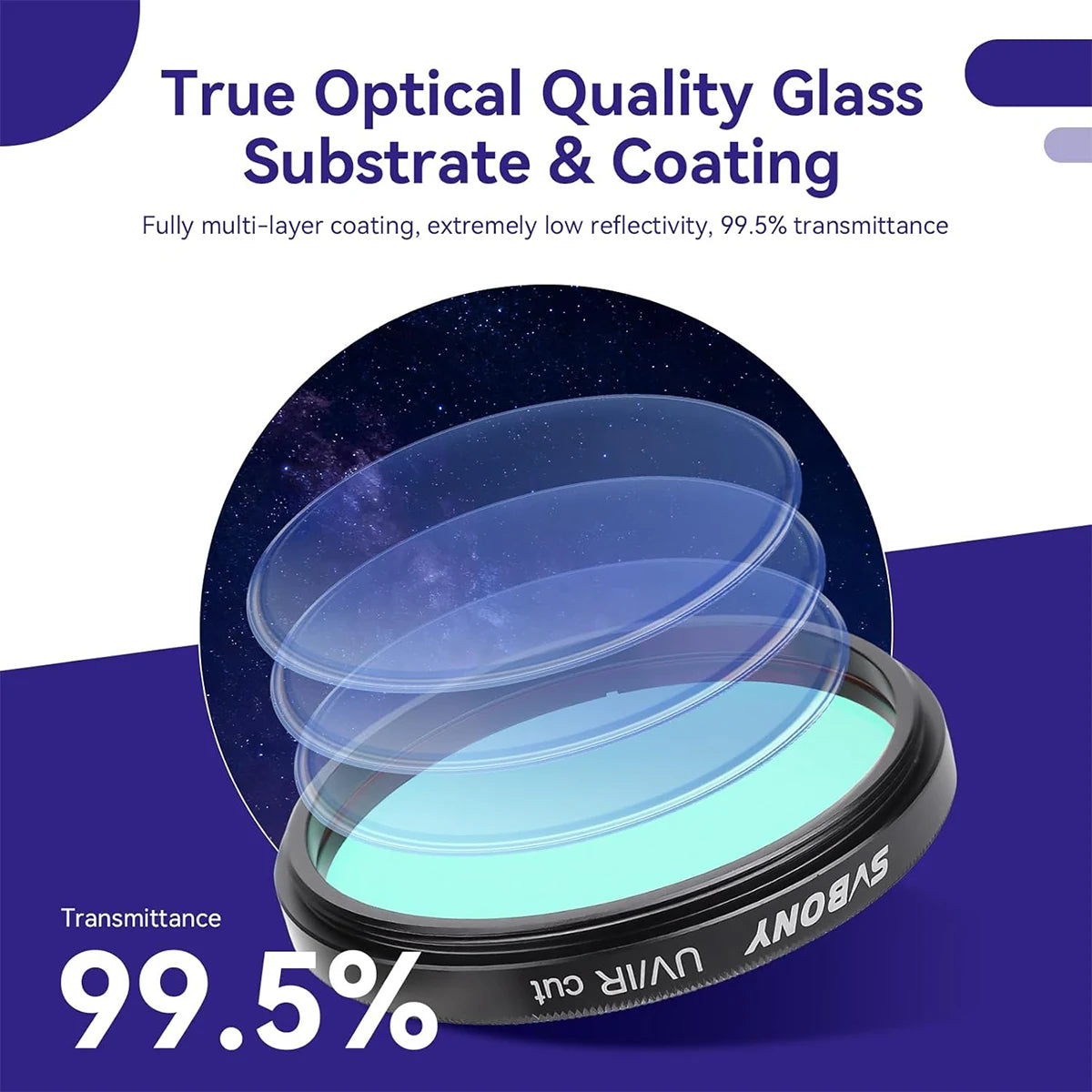
The SVBONY F9127B is a 2″ UV/IR cut filter in a standard M48 x 0.75 cell. It blocks ultraviolet and near-infrared light that colour sensors record but that a telescope does not bring to the same focus as visible light, while passing more than 94% of the visual spectrum according to SVBONY. The coated optical glass is 1.85 mm thick, and the filter ships in a protective plastic box.
Who It's For
This is a good match if you image with a one-shot-colour astronomy camera, an unmodified or modified DSLR, or a modified webcam, and want tighter stars and cleaner colour balance. It also suits a 2″ imaging train where you want a permanent clear window in front of the sensor to keep dust off.

Key Features & Design
- UV and IR blocking: removes the out-of-band light that causes bloated stars and IR-related ghosting in colour images.
- High visible transmission: more than 94% across the visual spectrum (SVBONY figure), so exposure times are essentially unchanged.
- Coated optical glass: 1.85 mm substrate with advanced coatings that SVBONY designs to reduce chromatic aberration and improve colour accuracy.
- Standard 2″ cell: M48 x 0.75 thread, fitting 2″ eyepiece barrels, diagonals, filter drawers and adapters.
- Protective window: works as a permanent cover for a camera sensor or the end of an imaging train.

Recommended Uses
- Colour deep-sky imaging: with OSC astronomy cameras that have a clear (AR-only) sensor window.
- Modified DSLR imaging: restores a natural colour balance when the factory IR filter has been removed.
- Lunar and planetary colour imaging: sharper results through refractors whose focus shifts outside the visible band.
- Imaging-train protection: a clear window that keeps dust away from the sensor.

Compatibility and Accessory Notes
- Thread: M48 x 0.75, the standard 2″ filter thread used on 2″ barrels, diagonals and filter drawers.
- Smaller trains: SVBONY makes the same filter in 1.25″ (F9127A, M28.5 x 0.6), which we also carry.
- Cameras with a built-in UV/IR window: many DSLRs and some astronomy cameras already block UV and IR; on those the filter acts as a protective window only.
If you are not sure whether your camera already has a UV/IR window, send us the model and we will check it with you.
What's in the Box
- 1 x 2″ UV/IR cut filter (F9127B)
- 1 x protective plastic storage box

Good to Know Before You Order
- Colour sensors benefit most: with a mono camera and LRGB filters the colour filters already define the passband, so a UV/IR cut is usually used as the luminance filter instead.
- Not a light pollution filter: it does not reduce skyglow; for that, a CLS or UHC filter is the tool.
- Weight: SVBONY does not publish a weight for this filter.
Frequently Asked Questions
Is it difficult to set up?
No. It threads into the M48 x 0.75 filter thread on a 2″ nosepiece, diagonal or filter drawer by hand.
Does it change my exposure times?
Very little. SVBONY rates transmission above 94% across the visible spectrum.
Can I use it visually?
Yes. Visually it behaves like a clear window, and it can stay in place as protection when you switch between observing and imaging.
Do I need it with a camera that already has an IR filter?
Not for colour correction. In that case its role is a protective window.
Bottom Line
In short: a 2″, M48 UV/IR cut filter with 1.85 mm coated glass that keeps out-of-band light away from colour sensors for tighter stars and cleaner colour, and doubles as a protective window for your imaging train.
| Model | F9127B |
|---|---|
| Type | UV IR cut filter |
| Size | 2″ |
| Thread | M48 x 0.75 |
| Glass thickness | 1.85 mm |
| Visible transmission | More than 94% of the visual spectrum (vendor figure) |
| Included | Protective plastic box |
| Weight | Not published by vendor |
| Use case | UV/IR blocking for colour sensors; protective window for imaging trains |
You may also like
Recently viewed
Recent Blog Posts
View all
Your Guide Graph Is Lying to You
Read More

D-Size vs V-Size: A Complete Guide to Telescope Dovetail Systems
Read More

What Is Back Focus in Astrophotography? Telescope Reducers, Flatteners, and Spacing Explained
Read More