




- Description
- Specifications

Product Overview
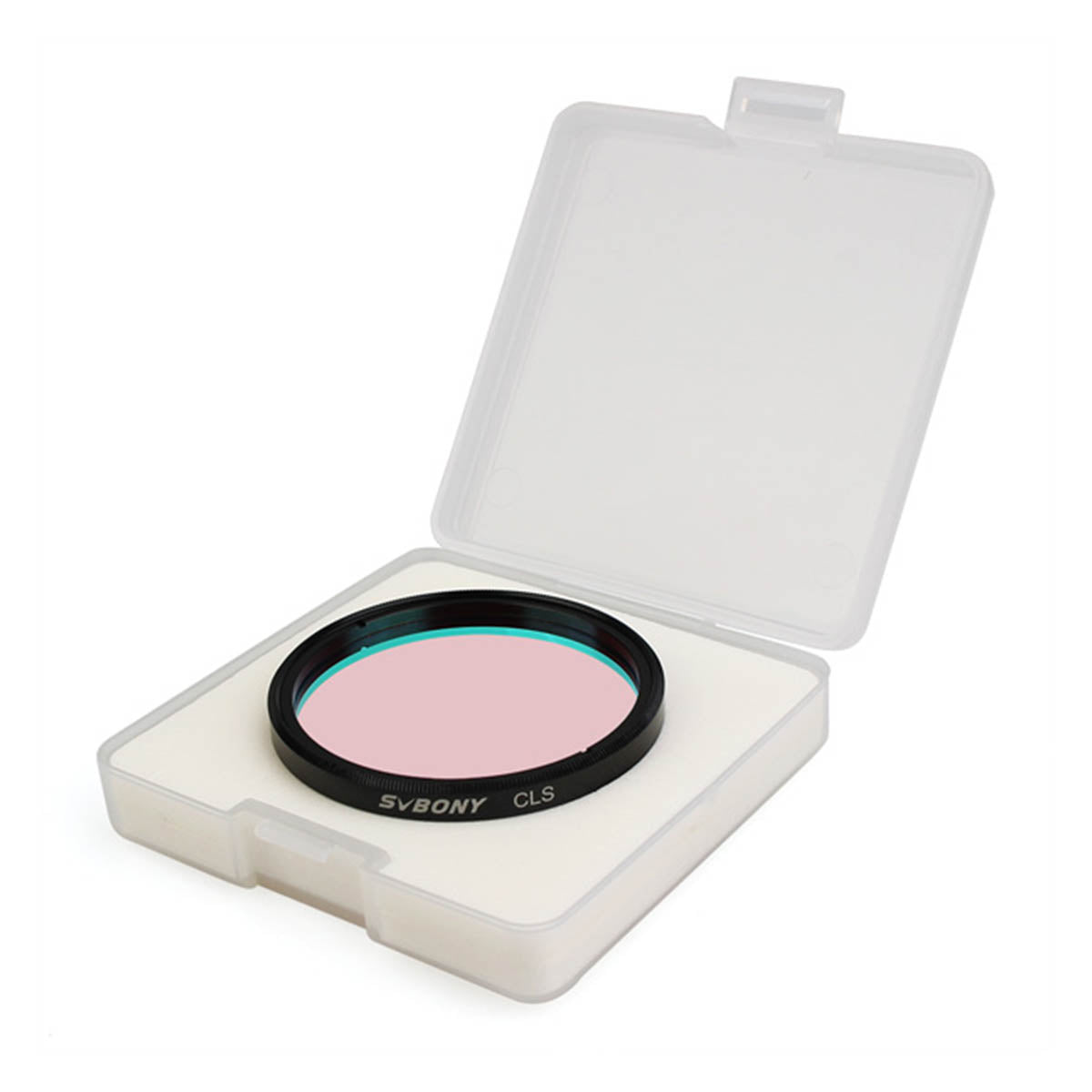
The SVBONY F9155B is a 2″ CLS (City Light Suppression) filter in a standard M48 x 0.75 cell. It is a broadband light pollution filter: SVBONY specifies about 90% transmission at the main nebula emission lines (H-alpha 656 nm, OIII 496 nm, H-beta 486 nm, SII 672 nm) and about 0.1% transmission at the sodium (589 nm) and mercury (435 nm and 578 nm) lines produced by street lighting. The coated glass is 1.85 mm thick.
A CLS filter does not remove light pollution or make an object brighter. It raises the contrast between nebulae and a skyglow-brightened background, which is what makes faint structure easier to see and to stretch in processing.
Who It's For
This is a good match if you image or observe from a suburban or city-edge site with a colour astronomy camera or an unmodified DSLR and want more contrast on emission nebulae. SVBONY designs it with colour CCD/CMOS cameras and unmodified DSLRs in mind.

Key Features & Design
- Emission lines passed: about 90% transmission at H-alpha, OIII, H-beta and SII (SVBONY figures).
- Street-light lines suppressed: about 0.1% transmission at sodium 589 nm and mercury 435/578 nm.
- Hard coatings: electron-beam evaporation with ion-assisted deposition, for scratch resistance and stable performance.
- Even coating: SVBONY uses a planetary rotation system in the coating chamber for consistent passbands across the glass.
- Standard 2″ cell: M48 x 0.75 thread, 1.85 mm glass.

Recommended Uses
- Colour deep-sky imaging from light-polluted sites: emission nebulae such as M42, the Lagoon and North America Nebula.
- DSLR astrophotography: with unmodified cameras through a 2″ nosepiece or filter drawer.
- Visual observing: a darker background and better nebula contrast at sub-rural sites.

Compatibility and Accessory Notes
- Thread: M48 x 0.75, for 2″ barrels, diagonals, filter drawers and 2″ eyepieces.
- Other sizes: SVBONY also makes this filter in 1.25″ (F9155A, M28.5 x 0.6) and as a Canon EOS-C clip-in (F9155D).
- CLS vs UHC: SVBONY notes that the CLS has a wider passband than its UHC filter and suits sites with less light pollution; the UHC is the stronger choice under brighter skies.
If you want help choosing between CLS, UHC and a dual-band filter for your sky and camera, get in touch and we will work through it with you.


Good to Know Before You Order
- Broadband filters favour emission nebulae: galaxies and star clusters emit across the whole spectrum, so their gain from a CLS filter is smaller.
- Colour cast: as with any light pollution filter, images show a colour shift that is corrected in processing with a colour calibration step.
- Weight: SVBONY does not publish a weight for this filter.
Frequently Asked Questions
Is it difficult to set up?
No. It threads into any M48 x 0.75 filter thread on a 2″ nosepiece, diagonal or filter drawer.
Will it work under a dark sky?
It still passes the emission lines, but its benefit is greatest where sodium and mercury lighting brighten the background.
Does it work with a modified DSLR?
SVBONY designs it for colour cameras and unmodified DSLRs. It passes H-alpha, so it also works on a modified camera.
Can I use it for visual observing?
Yes. SVBONY lists both visual and photographic use.
Bottom Line
In short: a 2″ M48 broadband CLS filter that suppresses sodium and mercury street-light lines while passing H-alpha, OIII, H-beta and SII, raising nebula contrast for colour imaging and observing from light-polluted skies.
| Model | F9155B |
|---|---|
| Type | City Light Suppression filter (CLS) |
| Size | 2″ |
| Thread | Standard M48 x 0.75 |
| Glass thickness | 1.85 mm |
| Emission-line transmission | About 90% at H-alpha 656 nm, OIII 496 nm, SII 672 nm, H-beta 486 nm (vendor figure) |
| Off-band transmission | About 0.1%, targeting sodium 589 nm and mercury 435/578 nm (vendor figure) |
| Coating process | Electron-beam evaporation with ion-assisted deposition |
| Other sizes from SVBONY | 1.25″ (F9155A, M28.5 x 0.6), Canon EOS-C clip (F9155D) |
| Weight | Not published by vendor |
| Use case | Light-pollution reduction for colour cameras, unmodified DSLRs and visual observing |
You may also like
Recently viewed
Recent Blog Posts
View all
Your Guide Graph Is Lying to You
Read More

D-Size vs V-Size: A Complete Guide to Telescope Dovetail Systems
Read More

What Is Back Focus in Astrophotography? Telescope Reducers, Flatteners, and Spacing Explained
Read More