

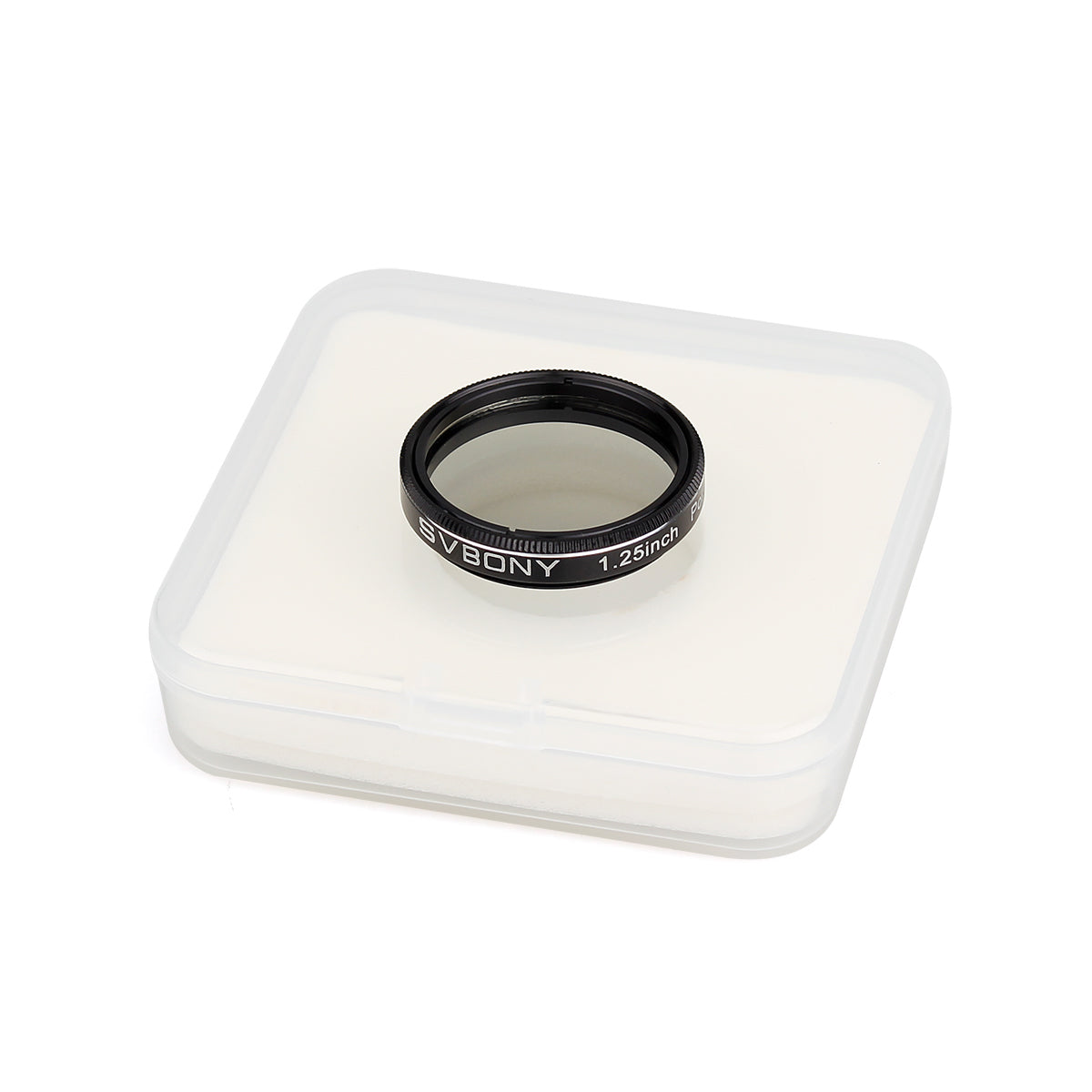


- Description
- Specifications

Product Overview
The SVBONY F9165A is a 1.25″ linear polarizer filter in an aluminium M28.5 x 0.6 cell, 2.4 mm thick. It dims the view of bright objects to increase contrast at the eyepiece, and SVBONY uses neutral-coloured optical glass so the Moon keeps its natural colour. Each filter is individually precision ground and polished.
Who It's For
This is a good match if you observe or photograph the Moon and bright planets through a 1.25″ eyepiece or imaging train and want lower glare without the colour tint of a blue moon filter.

Key Features & Design
- Glare reduction: dims the Moon for more comfortable, longer observing sessions.
- Neutral colour: neutral-coloured optical glass keeps the Moon's natural colour.
- Precision optics: individually ground and highly polished optical glass.
- Aluminium cell: standard M28.5 x 0.6 thread, 2.4 mm thick.
Recommended Uses
- Lunar observing: more contrast on craters and terminator detail.
- Bright planets: lower glare on Venus and Jupiter.
- Lunar and planetary photography: SVBONY notes it enhances lunar and planetary contrast in photographic images.

Compatibility and Accessory Notes
- Thread: M28.5 x 0.6, for 1.25″ eyepieces, diagonals and nosepieces.
- 2″ version: SVBONY also makes it in 2″ (F9165B, M48 x 0.75).
- Variable dimming: a single linear polarizer gives a fixed reduction. Pairing two polarizers and rotating one against the other is the usual way to get adjustable dimming.

Good to Know Before You Order
- Automated cameras: SVBONY notes these filters are generally not suited to highly automated digital cameras, whose metering and autofocus can be affected by polarized light.
- Not a solar filter: it is for the Moon and planets only.
- Weight: SVBONY does not publish a weight for this filter.
Frequently Asked Questions
Is it difficult to set up?
No. It threads by hand into the filter thread of a 1.25″ eyepiece or diagonal.
How is it different from a moon filter?
A blue moon filter adds a colour tint. The polarizer uses neutral glass, so the Moon's colour is unchanged.
Can I use it for imaging?
Yes, for lunar and planetary imaging with astronomy cameras. Highly automated consumer cameras may not meter correctly through it.
Bottom Line
In short: a 1.25″ M28.5 linear polarizer with neutral optical glass in an aluminium cell, for glare-free, natural-colour views of the Moon and bright planets.
| Model | F9165A |
|---|---|
| Type | Linear polarizer filter |
| Size | 1.25″ |
| Thread | M28.5 x 0.6 |
| Cell material | Aluminium |
| Thickness | 2.4 mm |
| Other sizes from SVBONY | 2″ (F9165B, M48 x 0.75) |
| Weight | Not published by vendor |
| Use case | Glare and brightness reduction on the Moon and bright planets |
You may also like
Recently viewed
Recent Blog Posts
View all
Your Guide Graph Is Lying to You
Read More

D-Size vs V-Size: A Complete Guide to Telescope Dovetail Systems
Read More

What Is Back Focus in Astrophotography? Telescope Reducers, Flatteners, and Spacing Explained
Read More