


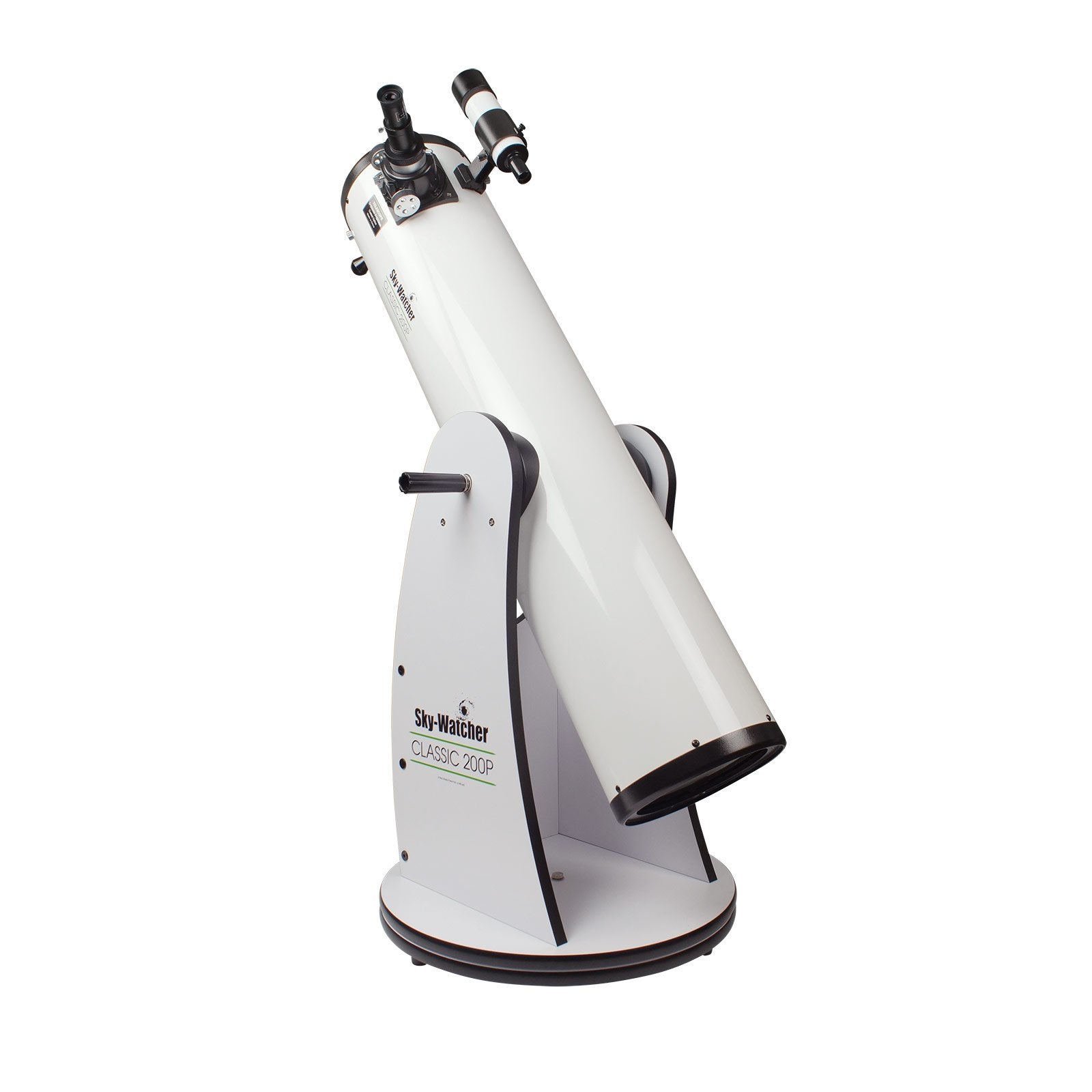


- Description
- Specifications
At a Glance
- Aperture: 200mm (8-inch)
- Optical design: Newtonian reflector, parabolic primary
- Mirror coating: Radiant Aluminum Quartz, 94% reflectivity
- Focuser: 2-inch Crayford-style, 1.25-inch adapter supplied
- Finder: 9x50
- Mount: Manual Dobsonian rocker box, Teflon bearings
Product Overview
The Sky-Watcher Classic 200P is a 200mm (8-inch) Dobsonian reflector for visual astronomy, and the size most observers settle on when they want serious aperture that still fits in a car and a closet. Sky-Watcher publishes its light grasp as 816 times that of the unaided eye — 78% more light than the 150mm model.
It arrives ready to observe with two 1.25-inch eyepieces, a 1.25-inch adapter, a 2-inch eyepiece adapter, dust caps, and a 9x50 finderscope.
Who It Is For
This is a good match if you:
- Observe visually and want real deep-sky reach — 200mm is where galaxy structure and globular cluster resolution start to open up.
- Want maximum aperture without a mount, tripod, or power to manage in the dark.
- Travel to darker skies occasionally — the tube and base separate into two manageable loads.
- Prefer star-hopping and learning the sky by chart rather than driving to targets from a handset.
Key Features and Design
- 78% more light than the 150mm model: light grasp scales with mirror area, and that step is the difference between detecting a galaxy and seeing structure inside it.
- True parabolic figure: stars stay tight to the field edge rather than softening, which is what lets a fast Newtonian hold up under a wide-field eyepiece.
- 94% reflectivity from the RAQ coating: on a two-mirror system the coating quality is paid twice over, with a quartz overcoat protecting the aluminium.
- Crayford-style focuser action: lower backlash than a rack-and-pinion, which is what you feel when fine-focusing a planet at high magnification.
- Patented tension control handle: balances heavier eyepieces by hand so the tube holds its aim instead of drifting downward.
- Teflon azimuth bearings: no stiction to overcome, so small corrections at high power stay small.
Optical and Mechanical Design
This is a Newtonian reflector: light runs down the tube to the parabolic primary, back to a flat secondary, and out to the focuser on the side. Because it works entirely with mirrors, there is no chromatic aberration whatsoever — no false colour on Jupiter, Venus, or the lunar limb regardless of magnification.
At 200mm the aperture is doing real work. Light grasp scales with mirror area, so the step up from 150mm is 78% more photons reaching your eye, which is the difference between seeing a galaxy and seeing structure within it. The rocker box carries that larger tube low and wide, keeping the whole system stable without counterweights or polar alignment. The Crayford-style focuser is the notable mechanical upgrade over the 150P.
Recommended Uses
- Deep-sky observing: globular clusters resolving to stars, galaxy pairs and groups, planetary nebulae with structure.
- Planetary observing: Jupiter cloud belts and festoons, Saturn Cassini division, Martian surface markings at opposition.
- Lunar observing: high-power work along the terminator where 200mm resolves fine rilles and crater chains.
- Club and outreach nights: enough aperture to impress, simple enough to hand over to a stranger.
Compatibility and Accessory Notes
The 2-inch Crayford focuser accepts any standard 2-inch eyepiece, and the supplied adapter steps down to 1.25-inch. A wide-field 2-inch eyepiece is the accessory that most changes what this scope feels like, opening up large clusters and nebulae in a single view.
Filters thread onto eyepiece barrels in both sizes. From suburban skies a UHC or O-III filter meaningfully lifts nebula contrast. A collimation tool — Cheshire or laser — is worth owning, as every Newtonian needs periodic mirror alignment. If you would like help matching eyepieces or filters to this scope and your observing site, get in touch and we will work it out with you.
Good to Know Before You Order
- This is a visual instrument. The alt-azimuth base does not track, so long-exposure deep-sky imaging is outside what this telescope does. Lunar and planetary capture is workable.
- It is a two-part carry. The tube and the base move separately. Worth thinking about if stairs are involved between storage and observing spot.
- Targets drift. At high power you will nudge the tube every 30 to 60 seconds. It becomes automatic quickly.
- Collimation is routine maintenance. Straightforward with the right tool, and it holds well between sessions.
- Cool-down matters more at 200mm. A larger mirror takes longer to reach ambient — set it outside 30 minutes or so before you plan to observe seriously.
Frequently Asked Questions
Is it difficult to set up?
No. Tube into the rocker box, finder on, eyepiece in the focuser. Nothing to align, level, or power. The only real consideration is that the tube and base are carried separately.
What is it best used for?
Visual deep-sky and planetary observing. At 200mm globular clusters resolve into individual stars and brighter galaxies begin showing structure rather than just a smudge.
Can I use it for astrophotography?
Not for deep-sky imaging — there is no tracking. Lunar and planetary imaging with a planetary camera is achievable.
How is it different from the Classic 150P?
78% more light gathering, a Crayford-style focuser in place of rack-and-pinion, and a 9x50 finder rather than a 6x30. It is the larger and heavier of the two to move and store.
How is it different from the Flextube 200P?
Same aperture, different tube. The Flextube collapses on struts to shorten for transport; this solid-tube version is simpler and has no truss to extend or re-collimate after setup.
Does it need anything else to work?
No, it observes as supplied. A collimation tool and a wide-field 2-inch eyepiece are the usual first additions.
Bottom Line
In short: a 200mm parabolic Dobsonian that puts its whole budget into aperture and optical quality rather than electronics. It resolves globulars, shows galaxy structure, and takes high magnification on the planets, with a Crayford focuser to place that focus precisely.
| Product Type | Manual Dobsonian reflector telescope |
|---|---|
| Item Number | S11610 |
| Aperture | 200mm (8-inch) |
| Optical Design | Newtonian reflector with parabolic primary mirror |
| Mirror Substrate | Borosilicate glass |
| Mirror Coatings | Radiant Aluminum Quartz (RAQ), 94% reflectivity |
| Focuser | 2-inch Crayford-style with 1.25-inch adapter |
| Mount Type | Dobsonian rocker box with Teflon bearings |
| Altitude Control | Patented tension control handle |
| Finderscope | 9x50 |
| Light Grasp | 816x the unaided eye; 78% brighter than the 150mm model |
| Included Accessories | Two 1.25-inch eyepieces, 1.25-inch adapter, 2-inch eyepiece adapter, dust caps, 9x50 finderscope |
| Primary Use | Visual observing of the Moon, planets, star clusters, nebulae, and galaxies |
You may also like
Recently viewed
Recent Blog Posts
View all
Your Guide Graph Is Lying to You
Read More
D-Size vs V-Size: A Complete Guide to Telescope Dovetail Systems
Read More
What Is Back Focus in Astrophotography? Telescope Reducers, Flatteners, and Spacing Explained
Read More