

- Description
Shipping regulations require that any flammable liquid ships as "Dangerous Goods" (DG) or "Hazardous Materials" (HM) when shipped in quantities greater than 500ml. This DG or HM classification adds a FedEx-mandated fee ranging from $32 to $142 to the shipping cost. So, why not provide a product just below the 500ml limit? Good question! That's why the First Contact InterMax Kits were created. This kit ships with 479ml of Red Spray First Contact Polymer ready to clean the most sensitive surfaces on the planet AND avoids the FedEx DG or HM shipping fee.
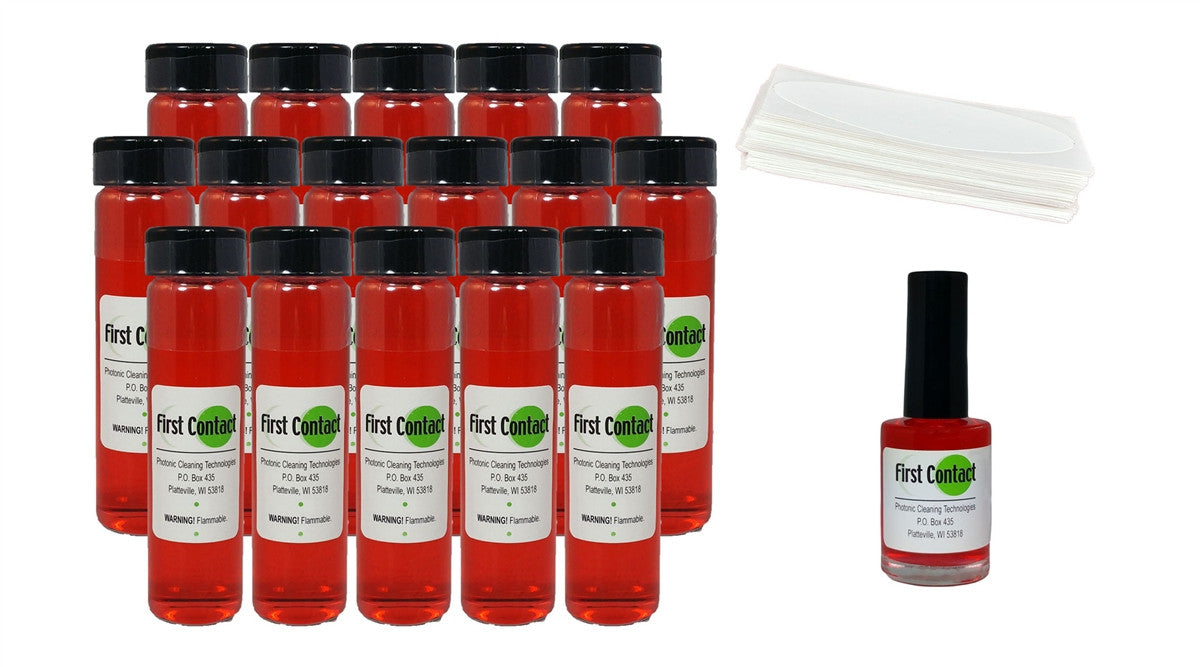
The RFCIM includes:
- 16 x 29 ml bottles of Red First Contact Polymer
- 1 x 15 ml Applicator bottle
- 50 First Contact Polymer peel tabs
- Sample of FCUF (floss) and FCNet (chemically inert mesh)
This kit contains sufficient polymer to clean approximately 1900 square inches (12,250 cm2) of surface area.
For mounted mirrors, refractor objectives, and corrector plates we suggest purchasing our chemically inert mesh (FCNet) for easier film removal. Eyepieces and objectives demand FCNet or FCUF unwaxed dental floss.
You may also like
Recently viewed
Recent Blog Posts
View all
Your Guide Graph Is Lying to You
You drove ninety minutes to dark sky, PHD2 held 0.4 arcseconds all night, and half your subs still have eggs for stars. Here are the three things your
Read More
Read More

D-Size vs V-Size: A Complete Guide to Telescope Dovetail Systems
What's the difference between D-size and V-size telescope dovetails? Here's everything you need to know.
Read More
Read More

What Is Back Focus in Astrophotography? Telescope Reducers, Flatteners, and Spacing Explained
What Is Back Focus in Astrophotography? Telescope Reducers, Flatteners, and Spacing Explained
Back focus is one of those astrophotography terms that c
Read More
Read More