

- Description
- Specifications
Product Overview
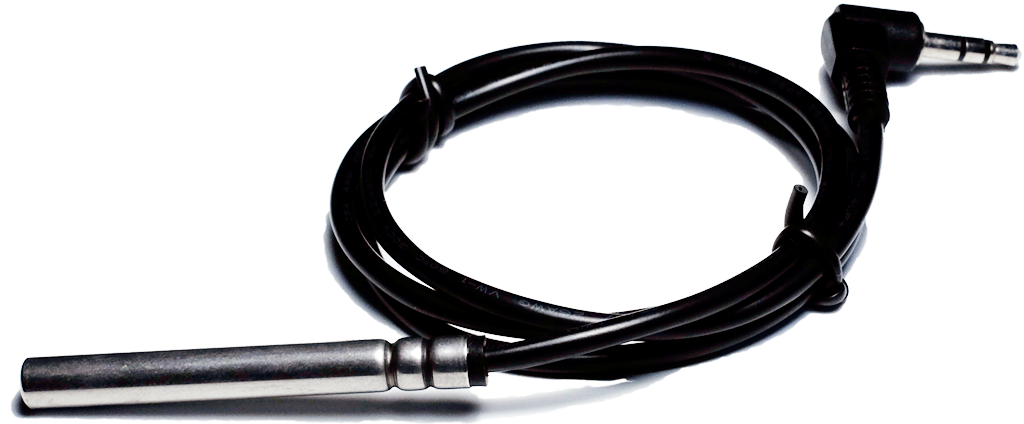
This is the Pegasus Astro digital temperature probe with a 3.5 mm jack, for the Dual Motor Focus Controller, the Prodigy Microfocuser and the FocusCube 3. It is the part that makes temperature-compensated focusing possible: the controller reads the probe, notices the night cooling, and moves the focuser to match.
It is also the replacement part if the original probe has been damaged or lost.
Who It's For
This is a good match if you:
- Run a DMFC, Prodigy Microfocuser or FocusCube 3 and want the controller to track focus drift as the temperature falls through the night.
- Image long sessions where focus at 10 pm and focus at 3 am are not the same number.
- Have lost or damaged the original probe and need the matching replacement.
- Operate remotely and want focus to follow temperature without anyone intervening.
Key Features & Design
- Digital temperature probe: a digital sensor rather than an analogue thermistor, so the reading arrives at the controller already converted.
- 3.5 mm jack termination: matches the sensor input on the DMFC, Prodigy Microfocuser and FocusCube 3.
- Enables temperature compensation: the controller's software and ASCOM driver use the reading to offset focus position automatically.
- Mounts at the focuser: the probe reads the temperature where focus actually shifts, rather than ambient air some distance away.
Recommended Uses
- Temperature-compensated focusing across a long imaging session.
- Logging focuser temperature alongside your imaging data.
- Replacing a damaged or missing DMFC, Prodigy or FocusCube 3 probe.
- Unattended remote operation where nobody is present to refocus.
Compatibility and Accessory Notes
- Dual Motor Focus Controller, Prodigy Microfocuser and FocusCube 3, using the 3.5 mm jack sensor input.
- Not the probe for the FocusCube 1 or 2 — those use the RJ45 version, which we stock as a separate part.
- Not the environmental sensor for the powerboxes — the Ultimate Powerbox and Pocket Powerbox range use the RJ12 environmental sensor, also a separate part we carry.
- For reference: Pegasus Astro describes the probe supplied with the Dual Motor Focus Controller as a one-metre digital probe giving 9-bit Celsius measurements, mounted at the focuser and read by the supplied software or the ASCOM driver.
- Unsure which probe your controller takes? Look at the socket, or send us a photo and we will identify it with you before you order.
Good to Know Before You Order
- Connector type is the thing to get right. Pegasus uses 3.5 mm jack, RJ45 and RJ12 sensors across the range, and they are not interchangeable. This one is the 3.5 mm jack.
- Temperature compensation needs a coefficient. The probe supplies the temperature; how far the focuser moves per degree is something you establish for your own telescope, and the controller software walks you through it.
- Pegasus Astro publishes no separate length or accuracy figure for this SKU sold on its own. The figures above are the ones Pegasus publishes for the probe supplied with the DMFC, quoted as such rather than presented as this part's own specification.
- Pegasus Astro publishes no weight for this part. Our declared shipping weight of 1 lb is a carrier minimum, not the probe's true mass — worth knowing if you are ordering several small items together.
Frequently Asked Questions
Is it difficult to set up?
No. It plugs into the sensor input and the controller software picks it up. The only setup step worth doing is establishing the temperature-compensation coefficient for your telescope, which is a one-off.
Will it fit my FocusCube 2?
No — the FocusCube 1 and 2 use the RJ45 probe, which we stock separately.
Do I need it, or does the controller work without one?
The focuser works without it. The probe is what adds temperature compensation and temperature logging.
Does one probe cover all three controllers?
Yes — the DMFC, Prodigy Microfocuser and FocusCube 3 all take the 3.5 mm jack sensor.
Where should the probe sit?
At the focuser, so it reads the temperature of the part that is actually moving, rather than air some distance from the telescope.
Bottom Line
In short: the 3.5 mm jack digital temperature probe that gives a DMFC, Prodigy Microfocuser or FocusCube 3 temperature-compensated focusing — and the right replacement if the original has gone missing.
| Product type | Digital temperature probe |
|---|---|
| Connector | 3.5 mm jack |
| Compatibility | Pegasus Astro Dual Motor Focus Controller, Prodigy Microfocuser, FocusCube 3 |
| Function | Temperature-compensated focusing and temperature logging |
| Not compatible with | FocusCube 1 and 2 (RJ45) or powerbox environmental sensors (RJ12) |
| Probe length | Not published by vendor for this SKU (1 m for the probe supplied with the DMFC) |
| Resolution | Not published by vendor for this SKU (9-bit Celsius for the probe supplied with the DMFC) |
| Product weight | Not published by vendor |
| Shipping weight | 1 lb declared (carrier minimum) |
You may also like
Recently viewed
Recent Blog Posts
View all
Your Guide Graph Is Lying to You
Read More

D-Size vs V-Size: A Complete Guide to Telescope Dovetail Systems
Read More
What Is Back Focus in Astrophotography? Telescope Reducers, Flatteners, and Spacing Explained
Read More