

- Description
- Specifications
Product Overview
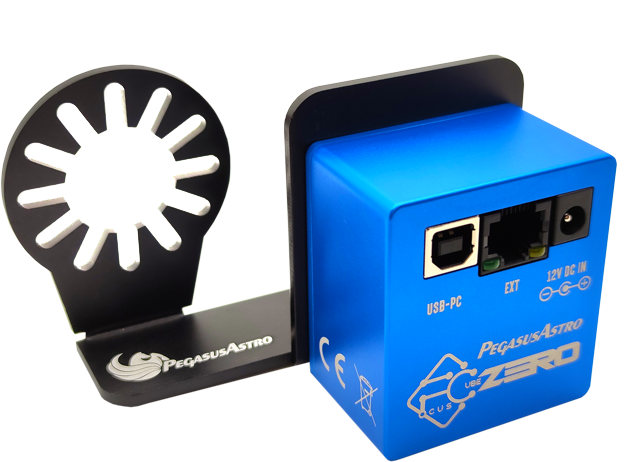
The FocusCube Zero is Pegasus Astro's self-contained motorised focuser for Celestron SCTs — motor, controller and driver electronics in one 52 x 58 x 35 mm enclosure that bolts to the focus knob. This is the C14 version, cut for the Celestron C14 Classic, EdgeHD 14 and RASA 14.
It connects to your computer over USB 2.0 Type-B and runs on 12–13.8 V DC through a 2.1 mm centre-positive socket. Because the controller is built in, it needs no separate motor controller — unlike the Motor Focus Kit Zero, which is the motor-only version of the same mechanics.
Who It's For
This is a good match if you:
- Image with a C14, EdgeHD 14 or RASA 14 and want repeatable, absolute-position focus from the computer rather than by hand at the knob.
- Run autofocus routines and need a focuser that returns to the same position after a filter change or a temperature shift.
- Want temperature compensation: the included probe reads focuser and ambient temperature so focus can track the night's drift.
- Would rather not add a separate controller — the FocusCube Zero is the all-in-one option.
Key Features & Design
- Bipolar stepper with zero backlash: 1.8° step angle, 0.8 kg/cm hold torque and 0.18 kg/cm detent torque — enough to turn a C14 focus knob under a loaded imaging train.
- Absolute positioning: the stepper reports a real position number, so autofocus routines and saved presets return to the same point every time.
- 1:5 pulley ratio on the 11" and 14" versions: gearing chosen for the heavier focus mechanism, using two aluminium pulleys (60 and 40 teeth) and a timing belt.
- Built-in controller: USB 2.0 Type-B to the computer, 12–13.8 V DC power in — no external motor controller required.
- Temperature probe included: a 0.6 m digital sensor on an RJ45 expansion port giving 9-bit Celsius readings.
- Wide operating range: rated −40 °C to +80 °C.
- Compact and light: 52 x 58 x 35 mm and 280 g including the bracket.
Optical / Mechanical Design
A Schmidt-Cassegrain focuses by moving the primary mirror along the baffle tube, and the whole imaging train's focus position depends on turning that knob by a precise, repeatable amount. The FocusCube Zero replaces your fingers with a bipolar stepper geared through a toothed belt and two aluminium pulleys. The 1.8° step angle divided through the 1:5 ratio used on the 11" and 14" brackets is what produces steps fine enough to land inside the critical focus zone of an f/11 SCT or an f/2.2 RASA.
Zero backlash is the part that matters for automated focusing. A focuser that lags on reversal reports a position it is not actually at, and every autofocus curve built from those points is skewed. The belt-and-pulley drive on a bipolar stepper removes the lash that a gear train introduces, so a move to position 14,200 lands at 14,200 whether you arrived from above or below — which is what makes V-curve autofocus and saved filter offsets trustworthy.
The 0.8 kg/cm hold torque is the other half of it. A 14-inch SCT carrying a camera, filter wheel and off-axis guider puts real load on the mirror-shift mechanism, and a motor that stalls or slips at the end of a slew loses its position reference.
Recommended Uses
- Automated autofocus runs on a C14, EdgeHD 14 or RASA 14 imaging rig.
- Temperature-compensated focus across a long night, using the included probe.
- Per-filter focus offsets in a filter-wheel imaging train.
- Remote and observatory operation where nobody is at the telescope to touch the knob.
Compatibility and Accessory Notes
- This is the 14" bracket. It fits the Celestron C14 Classic, EdgeHD 14 and RASA 14. The 11"/RASA 11 v2 and the 6"/8"/9.25"/RASA 8 versions are separate products, both of which we stock.
- Meade SCTs with the round focus knob are listed by Pegasus Astro as compatible.
- Power: 12–13.8 V DC on a 2.1 mm centre-positive plug — a Pegasus powerbox output, or any regulated 12 V supply.
- Software: the Unity platform, ASCOM 6, INDI (driver in stable libindi), and TheSkyX via X2 drivers.
- Hand controller: available separately if you want to focus at the telescope without a computer.
- Not sure which bracket your scope takes? Send us the exact model and we will confirm it with you before you order.
Good to Know Before You Order
- Aperture-specific bracket. The FocusCube Zero is sold per telescope size because the bracket and pulley ratio differ — this one is the 14" fit, and we carry the other two.
- It needs 12 V. USB carries data only; the motor runs from the DC socket. If you already have a Pegasus powerbox on the mount, that is the tidiest source.
- Everything needed to fit it is in the box: the SCT bracket, both pulleys and the belt, the temperature probe, the 1.8 m USB cable and the screws and washers.
- Pegasus Astro publishes 280 g including the bracket. That is well under a pound, so our declared shipping weight of 1 lb is the carrier minimum rather than the true mass — worth knowing if you are ordering several small items together.
Frequently Asked Questions
Is it difficult to set up?
It is a mechanical fit followed by a driver install. The bracket, pulleys, belt and screws all come in the box, and Pegasus publishes fitting instructions. Once mounted, it appears as a standard ASCOM or INDI focuser, so N.I.N.A, SGP, Ekos and TheSkyX drive it without special handling.
What is the difference between this and the Motor Focus Kit Zero?
The FocusCube Zero has the controller built in and plugs straight into a computer over USB. The Motor Focus Kit Zero is the same motor and mechanics without the controller — it needs a Dual Motor Focus Controller, an Ultimate Powerbox v2, or an eXternal Motor Controller to drive it.
Will it hold focus on a heavy imaging train?
The stepper gives 0.8 kg/cm hold torque and the drive is zero backlash, so position is held and reversals do not lose steps.
Does it do temperature compensation?
Yes. The 0.6 m digital probe is included and reports 9-bit Celsius readings for the focuser or ambient air.
Can I focus without a computer?
Yes, with the hand controller, which is sold separately.
Will it fit my C11?
No — the C11 and RASA 11 v2 take the 11" version, which is a different bracket and pulley ratio. We stock it.
Bottom Line
In short: an all-in-one motorised focuser for the C14, EdgeHD 14 and RASA 14 — zero-backlash bipolar stepper, absolute positioning, a temperature probe in the box, and USB straight to the computer with no separate controller in the chain.
| Product type | All-in-one motorised focuser (motor + controller) |
|---|---|
| Telescope fit | Celestron C14 Classic, EdgeHD 14, RASA 14; Meade SCT with round focus knob |
| Motor | Bipolar stepper, zero backlash |
| Step angle | 1.8 deg |
| Hold torque | 0.8 Kg/cm |
| Detent torque | 0.18 Kg/cm |
| Pulley ratio | 1:5 (11" and 14" versions) |
| Computer connection | USB 2.0 Type-B (1.8 m cable included) |
| Power input | 12V - 13.8V DC, 2.1 mm centre positive |
| Temperature sensor | Included, 0.6 m probe, 9-bit Celsius, RJ45 expansion port |
| Dimensions | 52 x 58 x 35 mm |
| Weight | 280 g (including bracket) |
| Operating temperature | -40 C to +80 C |
| Software | Unity platform, ASCOM 6, INDI (libindi), TheSkyX (X2 drivers) |
| In the box | FocusCube Zero, SCT bracket, temperature sensor, USB cable, 2 aluminium pulleys (60 and 40 teeth) and belt, 4 x M3x6mm screws, metric screws and washers |
You may also like
Recently viewed
Recent Blog Posts
View all
Your Guide Graph Is Lying to You
Read More

D-Size vs V-Size: A Complete Guide to Telescope Dovetail Systems
Read More

What Is Back Focus in Astrophotography? Telescope Reducers, Flatteners, and Spacing Explained
Read More