
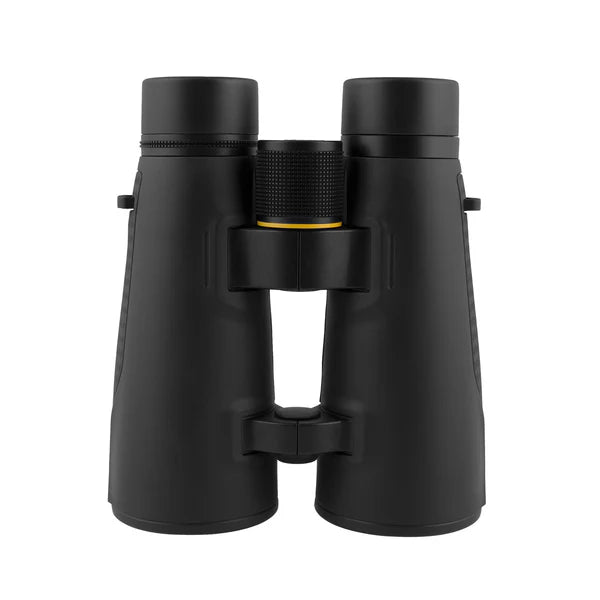
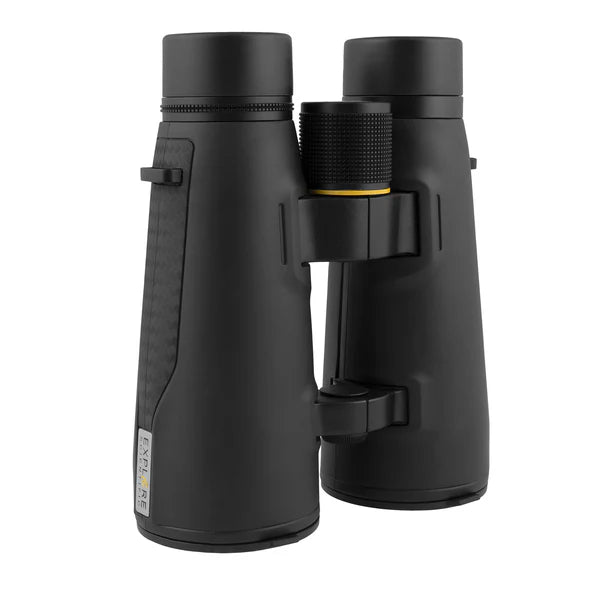


- Description
- Specifications
Product Overview
The Explore Scientific G600 ED Series 8x56 is a roof-prism binocular built around 56mm objectives and 8x magnification, using ED glass and BaK4 prisms. The pairing of those two numbers is the whole design brief: 56 divided by 8 gives a 7mm exit pupil, which is as much light as a fully dark-adapted human eye can accept. That is why 8x56 is the classic low-light and astronomy format rather than a general daytime one.
Explore Scientific publishes a 6.4° field of view, equivalent to 335ft at 1,000 yards, with 19.3mm of eye relief and a 3m close focus. The body is waterproof to IPX7 and nitrogen-purged against internal fogging, with twist-up eyecups and a black finish. Coatings are fully multi-coated on the lenses, with dielectric prism coating and correction coating applied to the roof prisms.
Supplied with a protective carrying case, neck strap, lens covers and a cleaning cloth.
Who It's For
- Astronomy observers: a 6.4° field at 8x takes in whole constellation regions, the Hyades, the Coathanger and the Milky Way star clouds in a single, two-eyed view.
- Twilight and dawn nature watchers: the 7mm exit pupil is what keeps the image bright when the light is going, which is when most mammals are active.
- Eyeglass wearers: 19.3mm of eye relief with twist-up eyecups is enough to see the full 6.4° field with spectacles on.
- Anyone who wants a binocular that lives outdoors: IPX7 waterproofing and a nitrogen fill mean rain and temperature swings are not events.
Key Features & Design
- 56mm objective lenses at 8x: a 7mm exit pupil, matched to a fully dark-adapted eye.
- ED glass: extra-low-dispersion elements, used to bring wavelengths closer to a common focus and reduce the colour fringing that shows on high-contrast edges.
- Roof prism with BaK4 glass: a straight-through body shape, with BaK4's higher refractive index preserving a round, fully illuminated exit pupil.
- Dielectric prism coating and correction coating: dielectric mirrors return more light than aluminised or silvered ones, and phase-correction coating restores the coherence a roof prism otherwise disturbs.
- 6.4° field of view, published as 335ft at 1,000 yards.
- 19.3mm eye relief with twist-up eyecups, which set eye position for use with or without glasses.
- Waterproof to IPX7 and nitrogen-purged, so the interior stays dry and clear through rain and temperature changes.
- Black body, supplied with carrying case, neck strap, lens covers and cleaning cloth.
Optical Design
A roof-prism binocular folds the light path inside a straight barrel by reflecting it off surfaces that sit at a shallow angle to each other, which is what allows the compact, in-line shape rather than the stepped body of a Porro design. That folding comes with two costs, and this design addresses both. The first is reflectivity: one of the roof surfaces reflects at less than the total-internal-reflection angle, so it needs a mirror coating. A dielectric coating, which is what Explore Scientific specifies here, is a multilayer stack that returns a higher percentage of light than metallic silver or aluminium does. The second cost is phase: light reflecting off the two halves of the roof arrives slightly out of step, which softens fine detail. A correction coating puts the two halves back in phase, and Explore Scientific lists that coating on this model.
The ED glass works on a different problem. Ordinary glass disperses wavelengths by slightly different amounts, so a lens that focuses green sharply leaves blue and red marginally out of focus, which shows as a coloured edge on bright, high-contrast subjects — a branch against a bright sky, or a star against black. Extra-low-dispersion glass brings those wavelengths closer together, so the edges are cleaner and contrast holds up.
Recommended Uses
- Astronomical sweeping — star fields, large open clusters, the Andromeda Galaxy, comets and the Milky Way.
- Low-light nature observation at dawn and dusk.
- Birding where a wide, bright field matters more than the highest magnification.
- Aurora, meteor shower and general sky watching, where two-eyed viewing at low power is the most comfortable way to observe.
Compatibility and Accessory Notes
- Handheld or supported: 8x is low enough to hold steady by hand for short spells. For longer astronomical sessions a tripod or a monopod removes the last of the shake and shows more.
- Tripod adapters: Explore Scientific does not publish a tripod socket specification for this model, so we are not quoting one. Send us a note and we will confirm whether a standard L-adapter fits before you order.
- Eyeglasses: the twist-up eyecups retract for spectacle wearers and extend for use without, and 19.3mm of eye relief supports both.
- Close focus: 3m, which suits garden and feeder distances as well as long range.
- Weather: IPX7 and nitrogen purging cover rain, spray and moving between a warm room and a cold garden without the interior fogging.
- Included: carrying case, neck strap, lens covers and cleaning cloth, so nothing else is needed to start using them.
Good to Know Before You Order
- 56mm objectives make for a substantial binocular. That aperture is exactly what delivers the low-light performance, and a wide neoprene strap or a harness makes longer sessions comfortable. We stock both.
- Explore Scientific does not publish a weight for this model, so that row is absent from the table below rather than estimated. If the figure is important to your decision, ask us and we will put the question to our Explore Scientific contact.
- The 7mm exit pupil is fully usable by a young, fully dark-adapted eye. Pupil size tends to reduce with age, so some observers will not use the entire 7mm — the image stays bright and sharp regardless, and the wide exit pupil also makes eye placement far more forgiving.
- 8x is a wide-field magnification rather than a detail one. For lunar craters or planetary detail a telescope is the right tool; for star fields, comets and sweeping, the binocular usually wins.
- The vendor specification table prints magnification as “8mm”. That is reproduced verbatim in the table below as Explore Scientific publishes it; the figure is 8x magnification paired with the 56mm objectives.
Frequently Asked Questions
Is it difficult to set up?
No — there is nothing to assemble. The barrels hinge to match the spacing of your eyes, the centre wheel focuses both sides together and the dioptre ring on one eyepiece corrects for the difference between your two eyes. That takes about a minute the first time and holds afterwards.
Why 8x56 rather than 10x50?
The 7mm exit pupil. 56mm of aperture at 8x delivers the brightest image a dark-adapted eye can accept, while 10x50 gives 5mm and asks more of your hand-holding. For astronomy and for low light, 8x56 is the format built for the job.
Can I use them with glasses?
Yes. 19.3mm of eye relief is generous, and the twist-up eyecups retract so spectacles can sit close enough to take in the full 6.4° field.
Do they need a tripod?
Not for casual use — 8x is comfortably hand-holdable. For extended astronomy a support makes a visible difference, because steadying the image reveals fainter stars than a hand-held view does.
What does the ED glass change?
It reduces colour fringing on high-contrast edges by bringing wavelengths closer to a common focus. On a bright star or a dark branch against a pale sky, the edge reads clean rather than tinted.
Bottom Line
In short: an 8x56 ED roof-prism binocular with BaK4 prisms, dielectric and correction coatings, a 6.4° field, 19.3mm of eye relief and IPX7 waterproofing — a 7mm exit pupil built for the hour after sunset and the hours after that. If you would like a harness, a tripod adapter or a comparison against another format we carry, tell us how you plan to use them and we will help you choose.
| Item Number | ES-20856 |
|---|---|
| Magnification | 8mm |
| Lens Diameter | 56mm |
| ED Glass | Yes |
| Optical Type | Roof; Bak4 |
| Coating | Fully Multi-coated |
| Prism Coating | Dielectric Prism Coating / Correction Coating |
| Body Color | Black |
| FOV degrees | 6.4 |
| FOV | 335ft (@ 1,000 yards) |
| Close Focus | 3m |
| Eye relief | 19.3mm |
| Waterproof | Yes / IPX7 |
| Fogproof/Nitrogen Purged | Yes |
| Eyecups | Twist-up |
| Included | Carrying case, neck strap, lens covers, cleaning cloth |
| Weight | Not published by vendor |
| Tripod Socket | Not published by vendor |
You may also like
Recently viewed
Recent Blog Posts
View all
Your Guide Graph Is Lying to You
Read More

D-Size vs V-Size: A Complete Guide to Telescope Dovetail Systems
Read More

What Is Back Focus in Astrophotography? Telescope Reducers, Flatteners, and Spacing Explained
Read More