
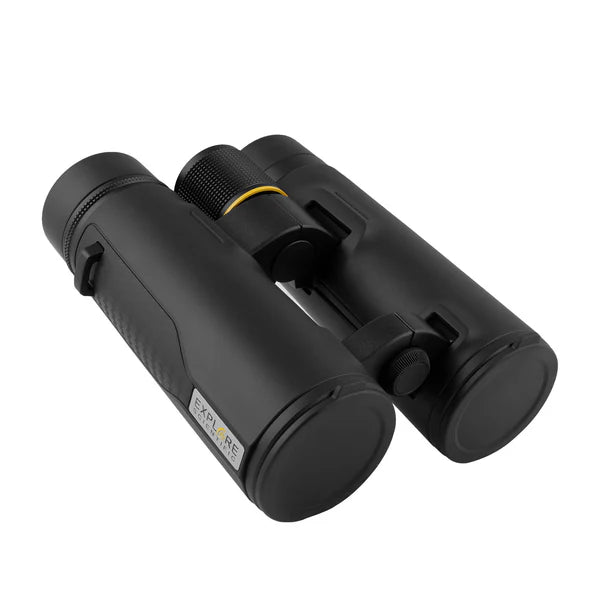
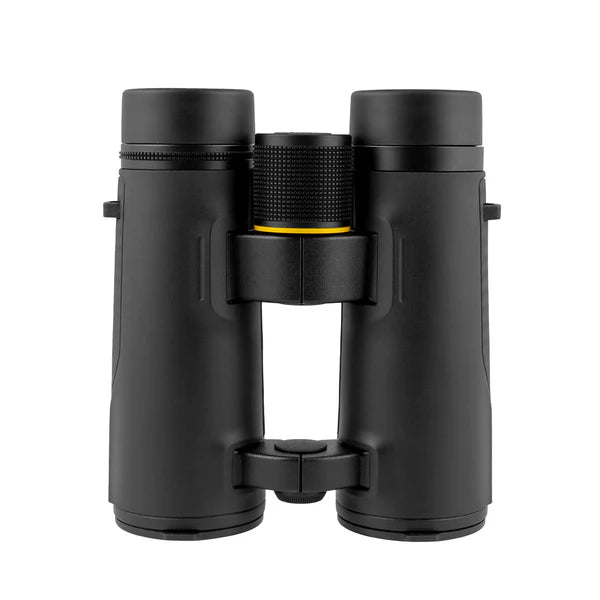


- Description
- Specifications
Product Overview
The Explore Scientific G600 ED Series 10x42 is a roof-prism binocular built around ED glass objectives, BaK-4 prisms, dielectric prism coatings and phase-correction coatings, in a nitrogen-purged body rated IPX7 for waterproofing.
10x42 is one of the most useful formats there is. Ten times magnification is enough to resolve plumage detail, read distant markings and pick out lunar craters, while 42mm objectives give a 4.2mm exit pupil — bright enough to stay usable at dusk and dawn, when a large proportion of interesting wildlife activity happens. The published field of view is 6.1°, which Explore Scientific also gives as 319 feet at 1,000 yards, and close focus is 3 metres.
Eye relief is published at 16.1mm with twist-up eyecups, which is the combination that lets spectacle wearers see the full field. The package includes a protective case, a strap, lens covers and a cleaning cloth.
Who It's For
- Birdwatchers: 10x resolves the field marks that 8x leaves ambiguous, and a 6.1° field is wide enough to pick a moving bird up and hold it.
- Wildlife and hunting observers working at longer ranges, where the extra magnification over an 8x is what separates identification from a guess.
- Dawn and dusk observers: a 4.2mm exit pupil and fully multi-coated ED optics keep the image bright when the light is going.
- Anyone observing in weather: an IPX7 rating and a nitrogen-purged body mean rain, spray and rapid temperature changes are not a problem.
- Casual astronomy users: 10x42 shows the larger open clusters, the Pleiades, the Andromeda Galaxy and lunar detail comfortably from a garden.
Key Features & Design
- 10x magnification with 42mm objectives: the exit pupil works out at 4.2mm, which is the figure that governs brightness in low light.
- ED glass objectives: extra-low-dispersion elements pull the different wavelengths closer to a common focus, which is what removes the colour fringe from a dark branch against a bright sky.
- Roof prisms in BaK-4 glass: BaK-4 has a high enough refractive index to keep total internal reflection working across the full prism face, so the exit pupil stays round rather than squared off at the edges.
- Dielectric prism coating with correction coating: dielectric mirror coatings reflect a higher percentage of light than aluminium or silver coatings, and phase-correction coating restores the phase relationship a roof prism otherwise disturbs.
- 6.1° field of view, published equivalently as 319 feet at 1,000 yards.
- 16.1mm eye relief with twist-up eyecups: eyecups down for glasses, up for the unaided eye, with detents to hold the setting.
- 3 metre close focus, which is short enough for insects and garden-distance subjects.
- IPX7 waterproof and nitrogen purged: sealed against water ingress and filled with dry nitrogen so the internal surfaces stay clear of fogging when the temperature changes.
- Black body finish, supplied with a protective case, strap, lens covers and cleaning cloth.
Optical Design
A roof-prism binocular folds the light path inside a straight barrel, which is why roof designs are narrower and easier to hold than the stepped porro shape. The folding is done by a prism pair whose surfaces split the wavefront and recombine it, and that split introduces a phase shift that softens contrast unless it is corrected. Phase-correction coating is what puts the two halves of the wavefront back in step, and it is one of the clearest dividing lines between binoculars that resolve fine detail and ones that merely magnify. Explore Scientific specifies it here alongside a dielectric prism coating, which uses a stack of thin dielectric layers as a mirror rather than a metal film — a higher reflectivity across the visible spectrum, and no metallic colour cast.
The ED glass sits in the objectives. A conventional two-element objective brings two wavelengths to a common focus and leaves the rest slightly apart, which appears as a coloured fringe on high-contrast edges. Extra-low-dispersion glass reduces the spread, and at 10x that improvement is visible on exactly the subjects where identification matters: a dark bird against bright sky, a white gull on grey water, the limb of the Moon.
Recommended Uses
- Birdwatching at medium and long range, where 10x resolves identifying detail.
- Dawn and dusk observation, where the 4.2mm exit pupil is working hardest.
- Casual astronomy — the Moon, bright open clusters, comets and large star fields.
- Marine and wet-weather use, where the IPX7 rating and nitrogen purging are the relevant specifications.
Compatibility and Accessory Notes
- In the box: a protective case, a strap, lens covers and a cleaning cloth, so it is ready to use on arrival.
- Eyeglass wearers: 16.1mm of eye relief with twist-up eyecups is the specification that matters. Eyecups twist down for glasses and up for the unaided eye.
- Tripod use: at 10x, a tripod noticeably steadies the view for long observation. Explore Scientific does not publish whether this model carries a tripod adapter socket, so we would rather confirm that with them than assume — ask us and we will find out before you order.
- Close focus: 3 metres is the published minimum, which is short for a 42mm binocular and worth having for butterflies and garden birds.
Good to Know Before You Order
- 10x magnifies hand shake as well as the subject. Most people hold a 10x42 steadily enough for identification; for extended watching, bracing against a fence or using a tripod makes a visible difference. An 8x42 is the steadier hand-held format if that is your priority, and we stock those too.
- Explore Scientific does not publish a weight or physical dimensions for this model, so those rows read as not published in the table below rather than being estimated. If carrying weight is the deciding factor for you, ask us and we will confirm it with our Explore Scientific representative.
- The vendor's specification table lists magnification in millimetres rather than as a power. The model is a 10x42, which is a 10x magnification with 42mm objectives, and that is how it is recorded below.
- IPX7 covers immersion, not use underwater. The rating means rain, spray and a drop into a puddle are not events, which is what field use actually asks for.
Frequently Asked Questions
Is it difficult to set up?
No. Binoculars come ready to use: set the barrel spacing to match your eyes, twist the eyecups up or down depending on whether you wear glasses, then set the dioptre adjustment once so both eyes focus together. That takes a couple of minutes on the first outing and holds afterwards.
10x42 or 8x42?
10x resolves more detail at distance and is the better choice for open country, shorelines and raptors. 8x is steadier in the hand, gives a wider field and a larger exit pupil, and suits woodland and fast-moving subjects. This one is the 10x. If you would like to compare, tell us where you do most of your watching.
Can I use them with glasses on?
Yes. The 16.1mm eye relief with the eyecups twisted down is enough for most spectacle wearers to take in the full 6.1° field.
What does ED glass do that ordinary glass does not?
It reduces the spread between wavelengths at focus, which is what colour fringing on high-contrast edges actually is. The visible result is a cleaner outline on a dark bird against a bright sky and better fine contrast overall.
Bottom Line
In short: a 10x42 ED-glass roof-prism binocular with dielectric and phase-corrected BaK-4 prisms, a 6.1° field, 16.1mm of eye relief, 3 metre close focus and an IPX7 nitrogen-purged body, supplied with case, strap, covers and cloth — a format that covers birding, wildlife and casual astronomy without specialising away from any of them. If you are weighing this against an 8x42 or wondering about tripod mounting, tell us how you plan to use them and we will help you choose.
| Item Number | ES-21043 |
|---|---|
| Magnification | 10x |
| Lens Diameter | 42mm |
| ED Glass | Yes |
| Optical Type | Roof; Bak4 |
| Coating | Fully Multi-coated |
| Prism Coating | Dielectric Prism Coating / Correction Coating |
| Body Color | Black |
| FOV (degrees) | 6.1 |
| FOV (feet @ 1,000 yards) | 319ft |
| Close Focus | 3m |
| Eye Relief | 16.1mm |
| Waterproof | Yes / IPX7 |
| Fogproof/Nitrogen Purged | Yes |
| Eyecups | Twist-up |
| In the Box | Protective Case; Strap; Lens Covers; Cleaning Cloth |
| Weight | Not published by vendor |
| Dimensions | Not published by vendor |
| Tripod Adapter Socket | Not published by vendor |
| UPC | 811803034990 |
You may also like
Recently viewed
Recent Blog Posts
View all
Your Guide Graph Is Lying to You
Read More

D-Size vs V-Size: A Complete Guide to Telescope Dovetail Systems
Read More

What Is Back Focus in Astrophotography? Telescope Reducers, Flatteners, and Spacing Explained
Read More