
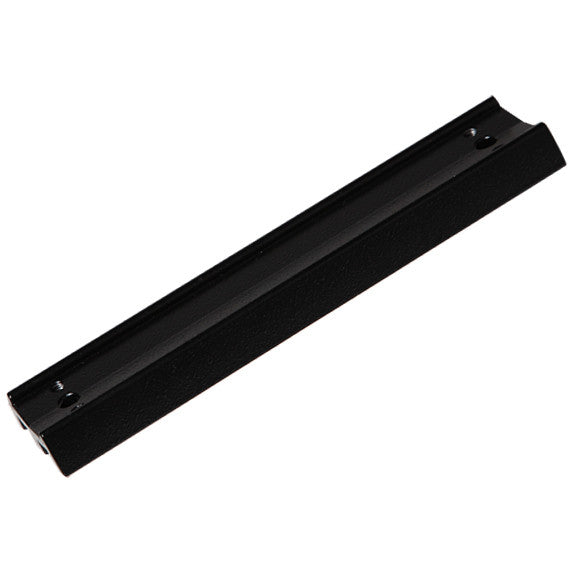

- Description
Product Overview
The Explore Scientific Medium Vixen-Style Saddle Plate (item VXNMD) is the hardware that stands between your optical tube and the mount head. Explore Scientific machines it from one solid piece of extruded aluminium, 190 mm (7.5 inches) long, and finishes it in black anodising for longevity. It attaches to the bottom of your optical tube assembly and then locates into the saddle of a wide range of popular Vixen-style mounts, giving you the industry-standard dovetail profile that most small and medium mounts are built to accept.
Who It's For
This is the part nobody thinks about until something goes wrong. If you have an optical tube with no dovetail on it at all, a set of tube rings waiting for a bar, or a plate that has started to flex and let the tube shift under load, this is the fix. Explore Scientific puts it plainly on their own page: a saddle plate is not the most exciting accessory in the world, but it is one of the most important when it comes to the stability and safety of your telescope system. It is very often the only piece of hardware holding your optics to the mount.
The medium length is the useful middle ground. A short plate gives you very little travel for balancing, which becomes a problem the moment you hang a heavy diagonal, a camera, or a guide package off the back end. A very long plate is more bar than a small refractor or a compact reflector needs and adds mass where you do not want it. At 190 mm you have enough length to slide the tube fore and aft and find balance in declination or altitude without running out of clamp, while keeping the plate light enough that it does not eat into the payload budget of a modest mount.
Key Features & Design
- Vixen-style dovetail profile, the most widely supported small and medium mount standard.
- 190 mm (7.5 inch) length, sized for small to medium optical tubes and tube ring sets.
- Machined from one solid piece of extruded aluminium rather than assembled from sections.
- Black anodised finish for corrosion resistance and a non-reflective surface at the eyepiece end of the night.
- Lightweight but rigid, so it adds minimal mass to the payload while resisting flexure.
- Attaches to the underside of the optical tube assembly, then drops into any Vixen-compatible saddle.
- Explore Scientific item number VXNMD, part of their industry-standard saddle plate range.
Mechanical Design
The reason Explore Scientific specifies a single extruded piece matters more than it sounds. A dovetail plate carries its load in bending and in torsion at the same time: the weight of the tube tries to bow the plate along its length, and any imbalance in the rings tries to twist it about its long axis. An extrusion has a continuous cross-section with no joints or fasteners partway along it, so there is nothing in the middle of the span to work loose or introduce a soft spot. The dovetail flanks themselves do the clamping work, and because they are part of the same extrusion as the flat mounting face, load transfers straight from the tube to the saddle jaws without passing through an intermediate bolted interface. The anodised layer is thin and hard, which helps the plate slide cleanly in a saddle without galling while giving the aluminium a surface that will not corrode from dew exposure over years of use.
Recommended Uses
- Fitting a Vixen-style dovetail to an optical tube or tube ring set that does not have one.
- Replacing a short or flexing plate that is not giving you enough balance travel.
- Moving a small refractor or reflector between different Vixen-compatible mounts.
- Adding a second, dedicated plate so a tube can stay ready to mount without swapping hardware.
Compatibility and Accessory Notes
The plate is cut to the Vixen-style profile, which is accepted by the great majority of small and medium equatorial and alt-azimuth mount saddles, including most Explore Scientific saddles, Losmandy-style dual saddles running in their narrow slot, and the common third-party clamps. On the tube side it needs matching mounting holes in your tube rings or in the tube itself, and hole patterns vary between manufacturers, so this is worth checking before you order. Explore Scientific does not publish the hole spacing or fastener size for this plate on their product page. If you tell our team in Bolton what tube or rings you are fitting it to, we will confirm whether the pattern lines up before anything ships.
Good to Know Before You Order
This is the plate on its own. Mounting bolts, washers, and tube rings are not included, and Explore Scientific does not list a fastener size or hole layout for it, so plan on sourcing hardware to suit your rings. It is also a plate, not a saddle: it goes on the tube and into a mount's saddle, so if what you actually need is the clamp that sits on top of the mount head, this is not that part. Explore Scientific publishes no shipping weight for this item, so we are confirming it on our own scales before the listing goes live. That is why it is currently unpublished. Contact us and we will give you a shipping figure for your address.
Frequently Asked Questions
Will this fit my mount? If your mount takes a Vixen-style dovetail, which most small and medium mounts do, yes. Losmandy-style dual saddles will also take it in their narrow channel. If you are not sure which standard your saddle uses, send us a photograph and we will tell you.
Does it come with the screws to bolt it to my telescope? No. Explore Scientific supplies the plate alone and does not publish a hole pattern or fastener size for it, so you will need hardware that matches your tube rings.
How much weight will it carry? Explore Scientific does not publish a load rating for this plate. In practice the limiting factor is almost always the mount's own capacity and the clamping force of its saddle rather than the extrusion itself, but for a heavy tube we would point you at a longer or wider plate.
Is the medium length right for a small refractor? Usually, yes. At 190 mm it gives a short refractor plenty of fore-and-aft travel for balancing once a diagonal and eyepiece are on the back, which is where short plates tend to run out of room.
Bottom Line
A dovetail plate is cheap insurance for an expensive optical tube, and this one is a straightforward, rigid, single-piece Vixen-style bar in the length most small and medium tubes actually want. If you are unsure whether the hole pattern suits your rings or whether your saddle takes the Vixen profile, contact us and we will confirm it for you before you order.
You may also like
Recently viewed
Recent Blog Posts
View all
Your Guide Graph Is Lying to You
Read More

D-Size vs V-Size: A Complete Guide to Telescope Dovetail Systems
Read More

What Is Back Focus in Astrophotography? Telescope Reducers, Flatteners, and Spacing Explained
Read More