


- Description
Product Overview
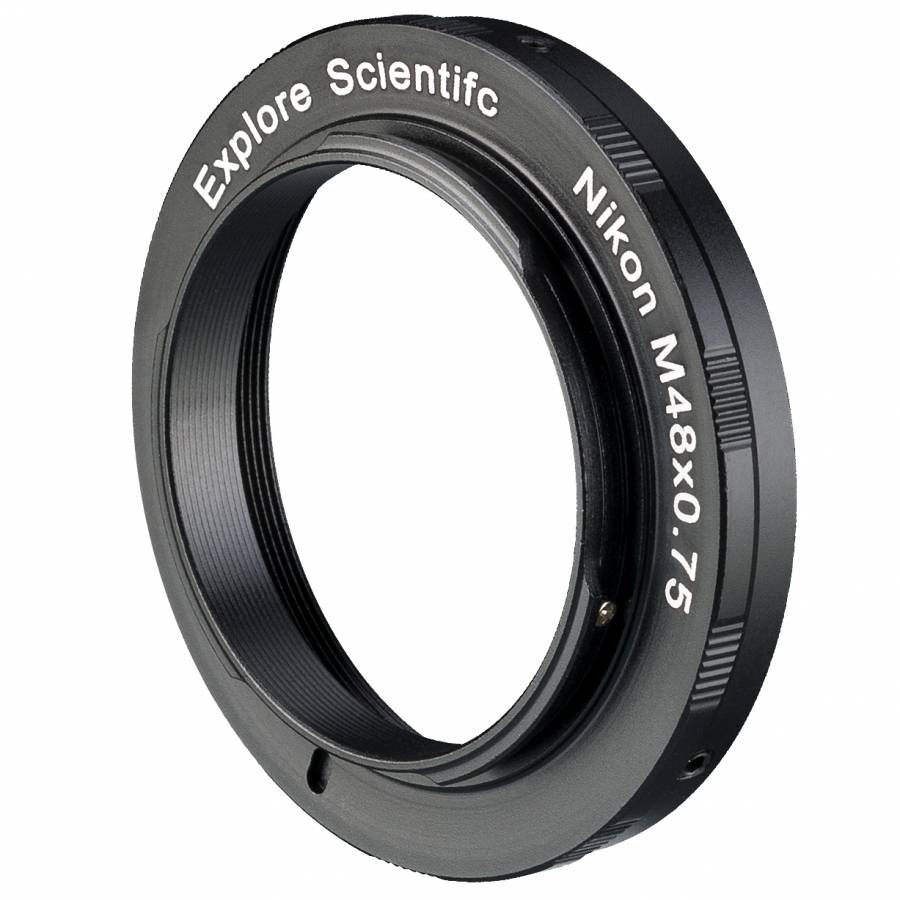
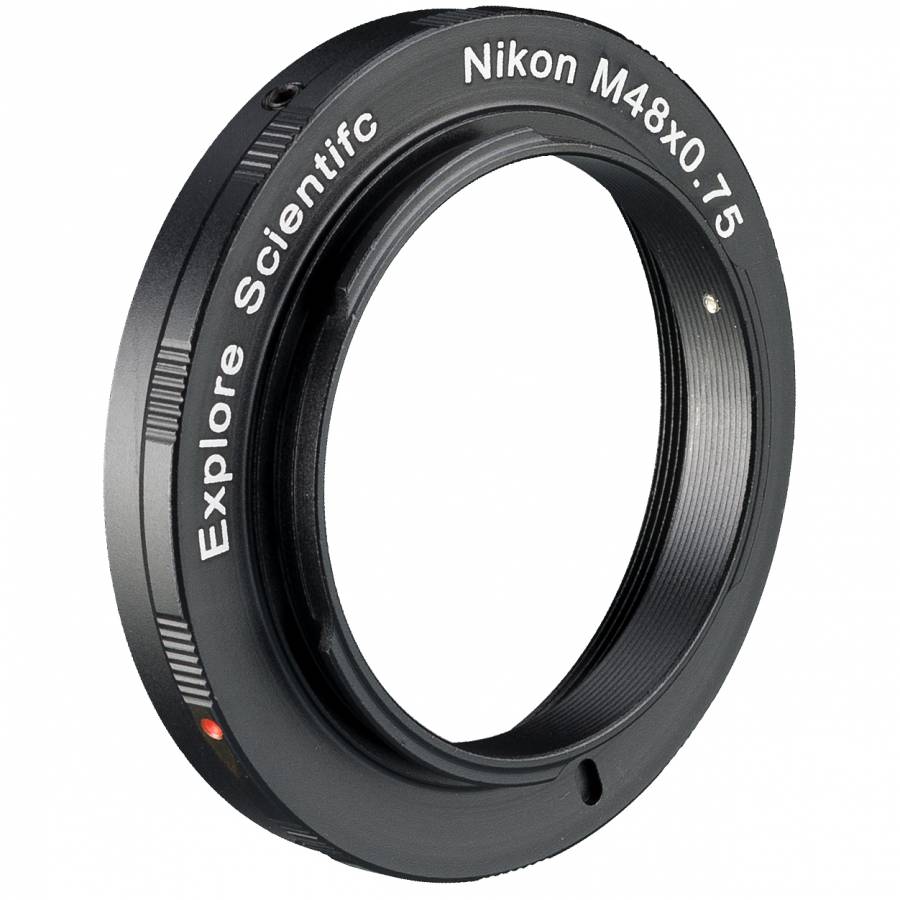
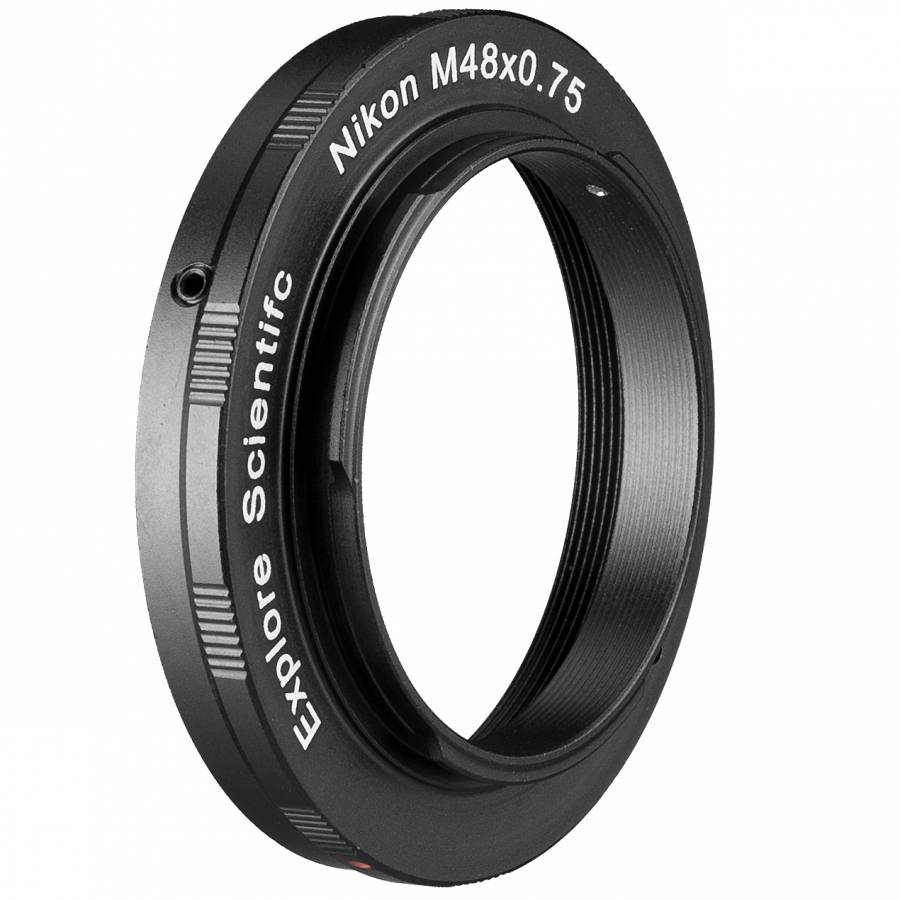
This is Explore Scientific's Nikon camera ring, the part that converts a Nikon F bayonet body into a threaded link in an M48 imaging train. The camera side is a Nikon F bayonet; the telescope side is a female M48 x 0.75 thread. Explore Scientific publishes a clear inner diameter of 41.2 mm, a light path length of 8.0 mm, matte black anodised aluminium construction, and a weight of 30 grams (about 0.07 lb). Vendor item number 510384 / 05-10384.
Who It's For
This is for the Nikon shooter who wants the widest light path the F mount will actually allow. In a conventional T2 imaging train the narrowest point is the M42 x 0.75 thread, which leaves roughly 38 mm of clear aperture and clips the corners of any sensor larger than APS-C. Moving to the M48 x 0.75 standard opens that bottleneck, and on a Nikon body this ring takes it out to a published 41.2 mm. If you have been looking at darkened corners on a D750, a D800-series body or a Df and blaming your flattener, the adapter in front of the camera is the more likely cause, and this is the part that addresses it.
It is also the ring to buy if the rest of your imaging train is already M48. Explore Scientific's field flatteners and focal reducers are built around M48 x 0.75, and threading a Nikon body straight onto that standard removes a step ring from the chain. Every junction you delete is one fewer place for tilt and flexure to appear, and on a Nikon, where the F mount's long 46.5 mm register already eats into your spacing budget, keeping the train short and rigid is worth real effort.
Key Features & Design
- Native Nikon F bayonet on the camera side, locking onto F-mount DSLR bodies the same way a Nikkor lens does
- Female M48 x 0.75 thread on the telescope side, matching Explore Scientific's flatteners, reducers and M48 accessories
- Published clear inner diameter of 41.2 mm, substantially wider than the roughly 38 mm a T2 thread allows
- Published light path length of only 8.0 mm, the shortest practical contribution on a Nikon and a figure you need for back focus arithmetic
- Machined from aluminium with a matte black anodised finish to keep internal reflections and stray light down
- Published weight of 30 grams, which is negligible against any focuser or corrector it hangs from
- Rigid threaded connection at the telescope end, so the camera cannot rotate or droop part way through a sub-exposure
Mechanical Design
Two published numbers define this ring, and both are shaped by the Nikon F mount itself. The first is spacing. A Nikon F body registers at 46.5 mm, meaning the sensor sits 46.5 mm behind the bayonet face — two and a half millimetres further back than a Canon EOS body, because the F mount had to clear a larger mirror box. Explore Scientific compensates by keeping this ring thin: at 8.0 mm of light path, the sensor lands about 54.5 mm behind the M48 thread face. That is close to the 55 mm back focus that most field flatteners and reducers are designed around, so on a Nikon you are typically within half a millimetre of the target with no shims at all. The second number is aperture. The F bayonet's throat is roughly 44 mm across, noticeably narrower than the Canon EF equivalent, and that physical opening caps how wide any Nikon adapter can be made. Hence 41.2 mm rather than the 47.5 mm of the Canon version of this ring. It is a constraint of the mount, not a shortcut by the manufacturer, and no F-mount adapter from any maker gets around it.
Recommended Uses
- Prime focus deep-sky imaging with a Nikon FX or DX body where corner illumination matters
- Building an M48 imaging train around an Explore Scientific field flattener or focal reducer without step rings
- Lunar and planetary work at native focal length with a Nikon DSLR
- Replacing a T2 ring whose M42 thread is visibly clipping the corners of a full-frame Nikon sensor
Compatibility and Accessory Notes
The camera side fits Nikon F bayonet bodies, which covers the DX line from the D3000 and D5000 series up through the D7500, and the FX line including the D610, D750, D780, D800 and D850. Nikon's Z mirrorless bodies use a completely different bayonet with a 16 mm flange, so a Z camera needs Nikon's FTZ adapter in the chain; the FTZ is designed to restore the F-mount register, so the 54.5 mm figure above still applies once it is fitted. On the telescope side you need a male M48 x 0.75 thread to screw into, which Explore Scientific's correctors and many modern 2-inch imaging accessories already provide. This ring will not thread straight onto a T2 fitting — T2 is M42 x 0.75 and this is M48 x 0.75, so a bridging ring is required between the two standards. Explore Scientific's M48 to M42 reduction adapter is the usual candidate, but the vendor does not publish which of its ends is male and which is female, and a ring sold as an M48-to-M42 reduction can be the very same object as one sold as an M42-to-M48 step-up, viewed from the other end. Tell us what is on each of your two fittings and we will confirm the correct bridging part rather than have you order on a guess. Spacing is genuinely model-dependent once a corrector joins the train, so let our team in Bolton know which scope, corrector and Nikon body you are using and we will confirm the arithmetic before you order.
Good to Know Before You Order
This is a mount ring and nothing more: no glass, no correction, and neither camera nor telescope-side adapter is included. It is Nikon F specific, so if you shoot Canon you want the Canon EOS version rather than this one, since both the bayonet and the flange distance differ. The honest caveat on this particular ring is the aperture. Explore Scientific describes 41.2 mm as preventing vignetting on full-frame sensors, and it is a large improvement over a T2 train, but a full-frame sensor has a 43.3 mm diagonal, so the very extreme corners can still show a little falloff on a heavily illuminated field. That is the F mount's throat imposing its limit rather than a defect in this part, and it is a limit every F-mount adapter shares. Note too that an M48 ring only helps if everything ahead of it is at least as wide; a narrow nosepiece further up the train will still vignette regardless of what is bolted to the camera.
Frequently Asked Questions
Where does this put my sensor relative to the M48 thread? About 54.5 mm behind it — Nikon's 46.5 mm flange distance plus the 8.0 mm light path Explore Scientific publishes. That is close enough to the usual 55 mm corrector spacing that most Nikon users need no shims.
Why is the opening 41.2 mm when the Canon version is 47.5 mm? Because the Nikon F bayonet throat is physically narrower than Canon's EF throat. No adapter can be made wider than the mount it fits, so this is a property of the F mount rather than of Explore Scientific's machining.
Will this work on a Nikon Z body? Not on its own. Z bodies use a different bayonet with a 16 mm flange. Fit Nikon's FTZ adapter between this ring and the camera and the train behaves like an F-mount setup, with the same effective spacing.
Can I use it with a T2 adapter I already own? Not directly, since T2 is M42 x 0.75 and this ring is M48 x 0.75. You need a bridging ring between the standards, and Explore Scientific's M48 to M42 reduction adapter is normally that part. Because thread gender is not published, send us both fittings and we will confirm before you order.
Bottom Line
For a Nikon shooter this is the sensible way onto the M48 standard: thin enough that the F mount's long register still lands near 55 mm of back focus, and as wide as the F bayonet physically permits. If you are running an Explore Scientific flattener or reducer it is the ring that train is designed for. Send our team in Bolton your scope, corrector and camera model and we will check the spacing with you before you order.
You may also like
Recently viewed
Recent Blog Posts
View all
Your Guide Graph Is Lying to You
Read More

D-Size vs V-Size: A Complete Guide to Telescope Dovetail Systems
Read More

What Is Back Focus in Astrophotography? Telescope Reducers, Flatteners, and Spacing Explained
Read More