


- Description
Product Overview
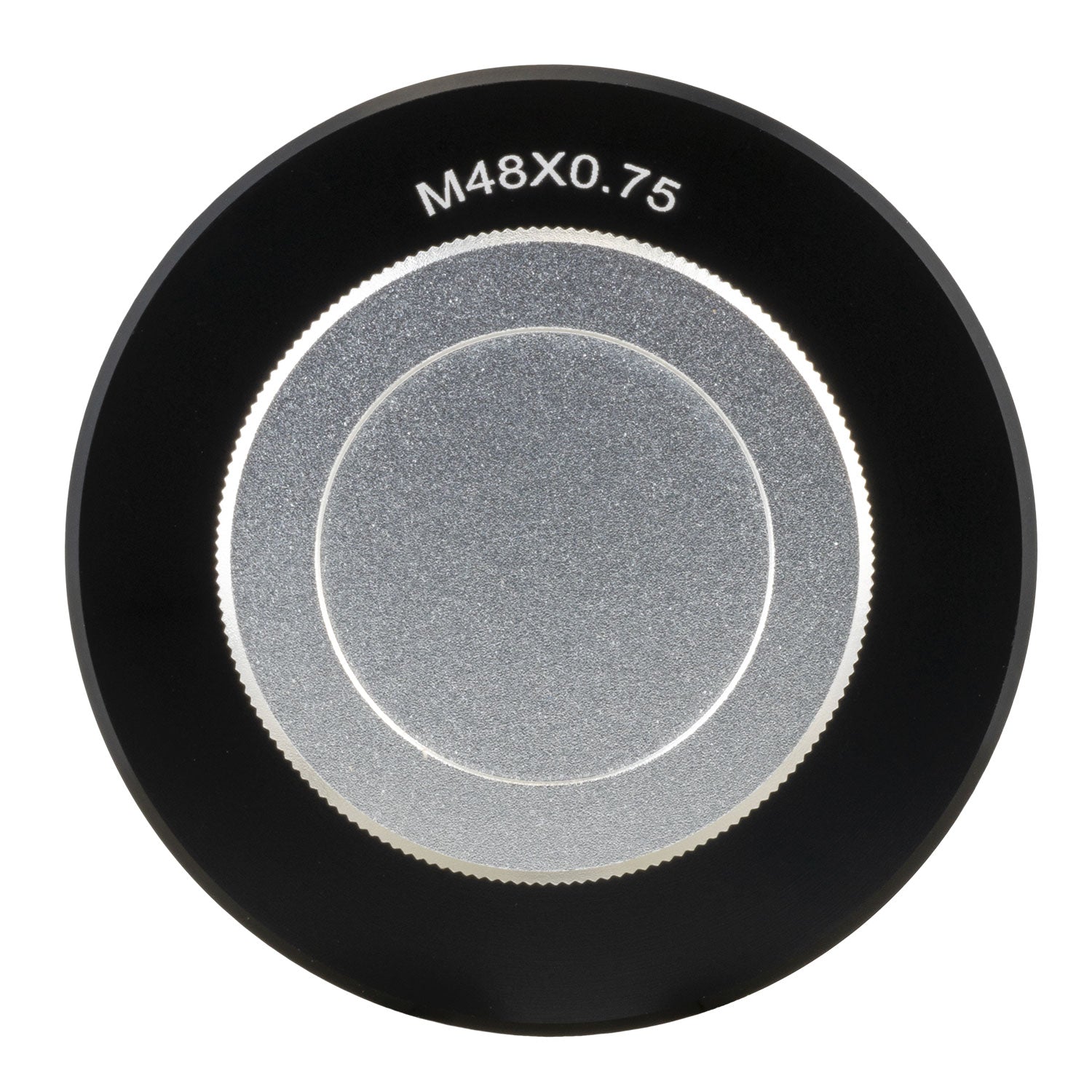
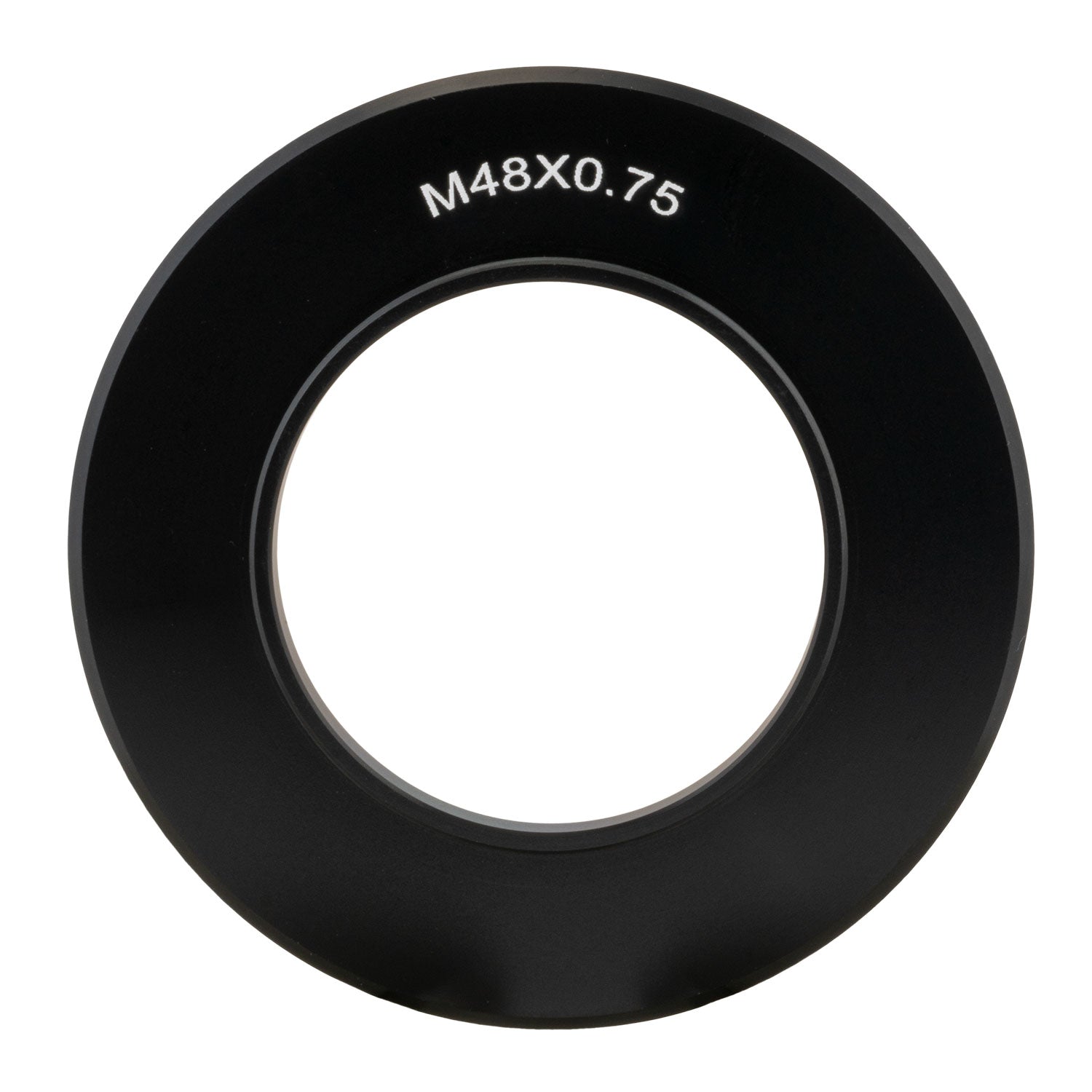
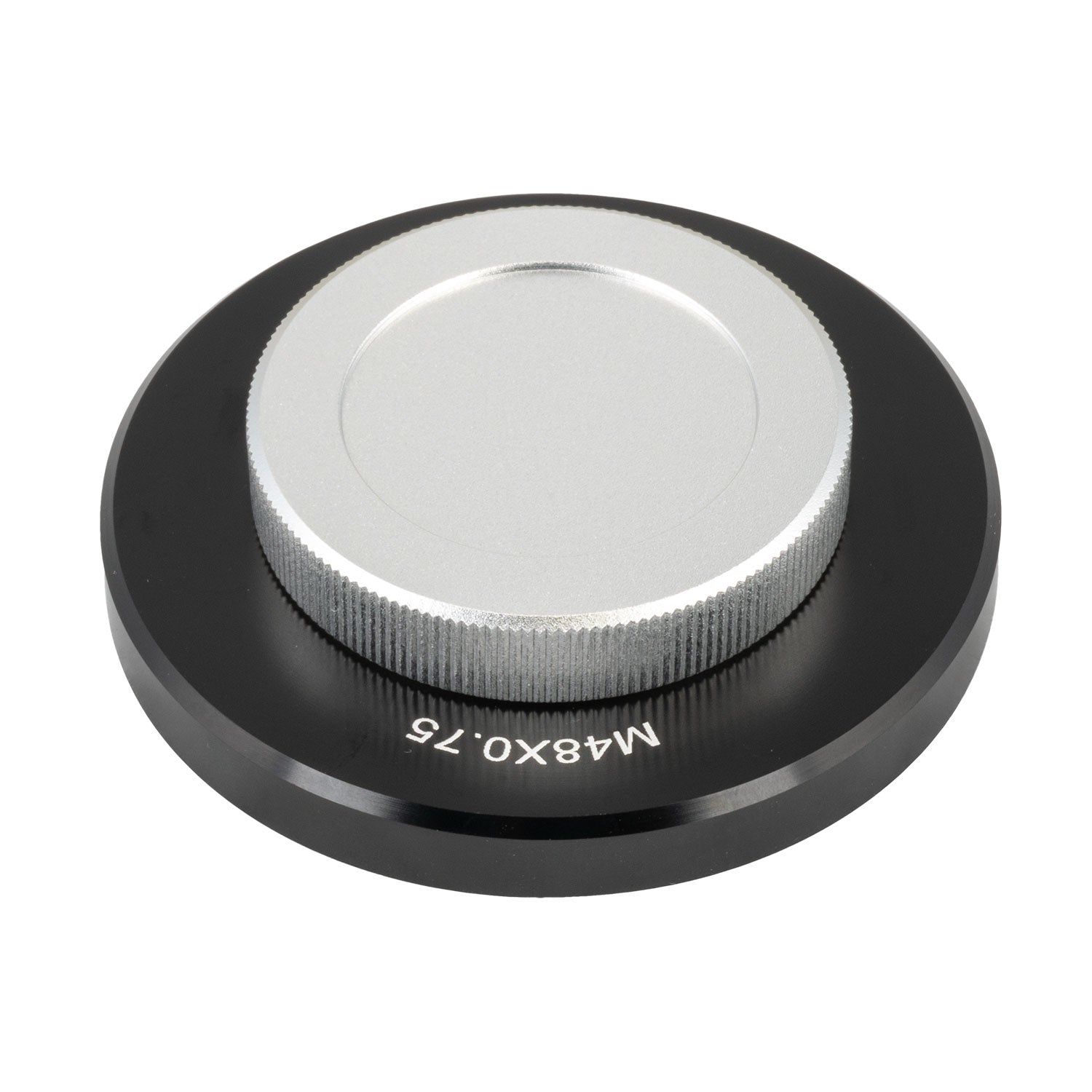
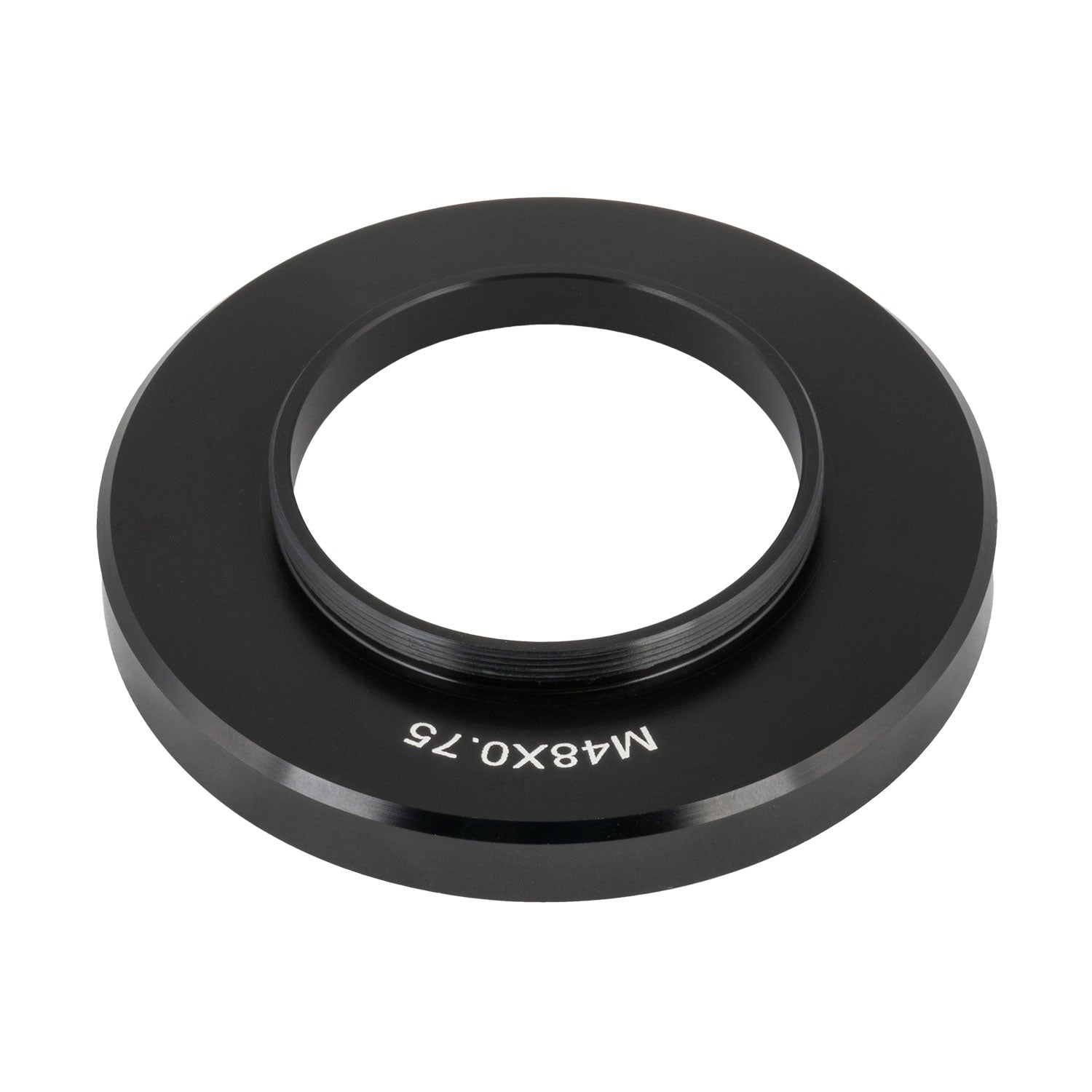
This is the wide-thread camera adapter for Explore Scientific's 3-inch Field Flattener and 0.7x Focal Reducer, the corrector usually shortened to FFFR (item FFFR507X-00). The FFFR ships with an M42 x 0.75 adapter for CCD and DSLR cameras; this part replaces it with an M48 x 0.75 thread, opening up the camera end of the corrector. Explore Scientific states plainly that it must be purchased separately from the FFFR, and publishes a weight of 0.15 lb (0.08 kg). Vendor item number M48-0750.7x.
Who It's For
This exists to solve one specific and frustrating problem: you bought a focal reducer to get a wider, faster field, and then discovered the corners of that wider field were dim. The 0.7x FFFR does its job well, compressing the image circle and dropping the focal ratio so that a given exposure goes further, but the standard M42 adapter that comes in the box presents a throat of only about 39 mm to the camera. A full-frame sensor measures 43.3 mm across the diagonal. The reducer is delivering a field the adapter behind it cannot pass, and the result is corner falloff that no amount of flat framing fully rescues.
Swapping in this M48 x 0.75 adapter widens that final aperture so the corrector can actually deliver what it was designed to deliver. If you are running an APS-C or smaller sensor you may never need it, since a 28 mm diagonal fits through an M42 throat without complaint. If you have moved to a full-frame body, or you are running the FFFR on a fast scope where corner illumination is already working hard, this is the part that stops the adapter from being the limiting element in your imaging train. It is also the right choice if the rest of your train is already standardised on M48 and you would rather not stack step rings behind an expensive corrector.
Key Features & Design
- M48 x 0.75 camera thread, the wide standard used by Explore Scientific's M48 camera rings and 2-inch filters
- Direct replacement for the M42 x 0.75 CCD camera adapter supplied as standard with the 3-inch Field Flattener and 0.7x Focal Reducer
- Purpose-made for the FFFR507X-00, so it mates with the corrector's own fitting rather than relying on a stack of generic step rings
- Removes the narrow M42 throat as the bottleneck in a reduced, wide-field imaging train
- Published weight of 0.15 lb (0.08 kg), adding nothing meaningful to the load behind the focuser
- All-threaded connection at both ends, so there is no compression ring to slip and no camera rotation mid-sequence
Optical and Mechanical Design
A focal reducer works by shortening the effective focal length, which shrinks the image scale and simultaneously widens the illuminated circle projected onto the sensor. The 0.7x factor means a scope at f/7 becomes roughly f/4.9, and the field being poured onto the sensor grows accordingly. That is precisely why the camera-side aperture matters more after a reducer than before one: you have deliberately made the light cone wider and shallower, and the last mechanical opening it passes through now sets your corner illumination. An M42 x 0.75 thread caps that opening at roughly 39 mm; M48 x 0.75 raises it well past the 43.3 mm full-frame diagonal. The second half of the design question is spacing. Every corrector has a designed distance from its rear element to the sensor, and missing it produces elongated or misshapen stars in the corners — the same symptom people often misread as collimation or tracking error. Because Explore Scientific presents this as a swap for the adapter the FFFR already ships with, it is intended to sit in the same place in the train rather than to change the corrector's spacing. Explore Scientific does not publish a light path length for it, so if you are working to an exact back focus figure, treat that number as something to confirm rather than assume.
Recommended Uses
- Full-frame DSLR, mirrorless or CCD imaging behind the Explore Scientific 3-inch Field Flattener and 0.7x Focal Reducer
- Wide-field deep-sky work where corner illumination and flat field both matter
- Standardising an existing imaging train on M48 x 0.75 to remove step rings from behind the corrector
- Replacing the supplied M42 adapter after upgrading from a crop-sensor body to full frame
Compatibility and Accessory Notes
This is a dedicated part for the Explore Scientific 3-inch Field Flattener and 0.7x Focal Reducer, FFFR507X-00. It is not a general-purpose thread ring, and that distinction is worth holding onto, because Explore Scientific also sells a general M48-to-M42 reduction adapter that sounds similar and does something quite different — that one bridges the two standards anywhere in a train, while this one is the camera-side fitting for one particular corrector. If you do not own the FFFR, this is almost certainly not the part you want. On the camera side you will need something with an M48 x 0.75 thread: Explore Scientific's M48 camera rings for Canon EOS and Nikon are the natural partners, and the M48 junction will also accept a 2-inch filter, since 2-inch astrophotography filters are cut to M48 x 0.75. Bear in mind that the ring only helps if it is the narrowest point you have fixed; a T2 ring left further down the chain will reimpose the same bottleneck. Spacing and fit behind a corrector are genuinely model-dependent, so tell our team in Bolton which camera and which scope you are running the FFFR on and we will confirm the combination before you order.
Good to Know Before You Order
The most important thing to understand is that this is sold separately from the FFFR and is not an upgrade you receive with it — Explore Scientific says so directly on their own page. Buying the corrector does not get you this adapter. The camera ring is not included either, nor is any filter. Explore Scientific does not publish dimensions or a light path length for this item, only the 0.15 lb weight, so if your imaging train is tuned to a specific back focus we would rather measure it here than have you discover a discrepancy under clear skies; contact us and we will do that. Finally, this widens the camera end of the corrector only. It cannot improve illumination that was already lost further up the optical train, and it does not change the FFFR's optical performance in any way — it simply stops the mechanics from throwing away the field the glass is producing.
Frequently Asked Questions
Does the 3-inch Field Flattener and 0.7x Focal Reducer already come with this? No. The FFFR ships with an M42 x 0.75 adapter for CCD cameras. This M48 version replaces it and must be bought separately, which Explore Scientific states explicitly.
Do I need it if I shoot an APS-C camera? Probably not. A crop sensor has a diagonal of around 28 mm, comfortably inside what the standard M42 adapter passes. The M48 upgrade earns its place with full-frame sensors, or if you want the whole train on one thread standard.
Is this the same as the M48 to M42 reduction adapter? No. That is a general-purpose ring for joining the two thread standards anywhere in an imaging train. This is the camera-side adapter made specifically for the FFFR507X-00 corrector.
What do I screw onto the M48 end? An M48 x 0.75 camera ring for your body — Explore Scientific makes them for Canon EOS and Nikon — or a 2-inch filter, since 2-inch filters share the M48 x 0.75 thread.
Bottom Line
If you own the Explore Scientific 3-inch Field Flattener and 0.7x Focal Reducer and a full-frame camera, this is the adapter that lets the corrector finish the job it started, by taking the narrow M42 throat out of the light path. It is a small, purpose-built part and not a general thread ring, so make sure the FFFR is what you are fitting it to. Our team in Bolton will confirm the spacing and the camera-side parts with you before you order.
You may also like
Recently viewed
Recent Blog Posts
View all
Your Guide Graph Is Lying to You
Read More

D-Size vs V-Size: A Complete Guide to Telescope Dovetail Systems
Read More

What Is Back Focus in Astrophotography? Telescope Reducers, Flatteners, and Spacing Explained
Read More