


- Description
Product Overview
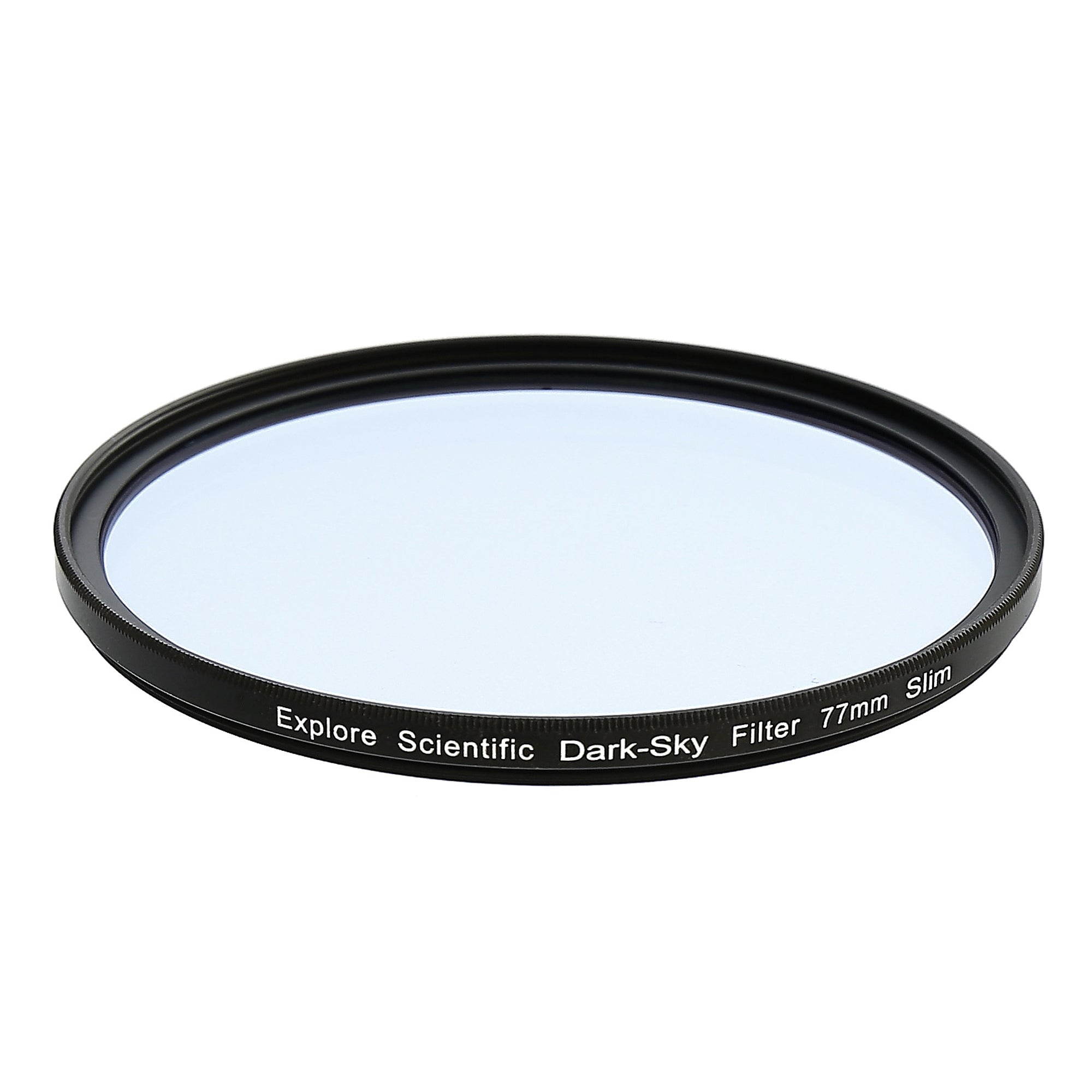
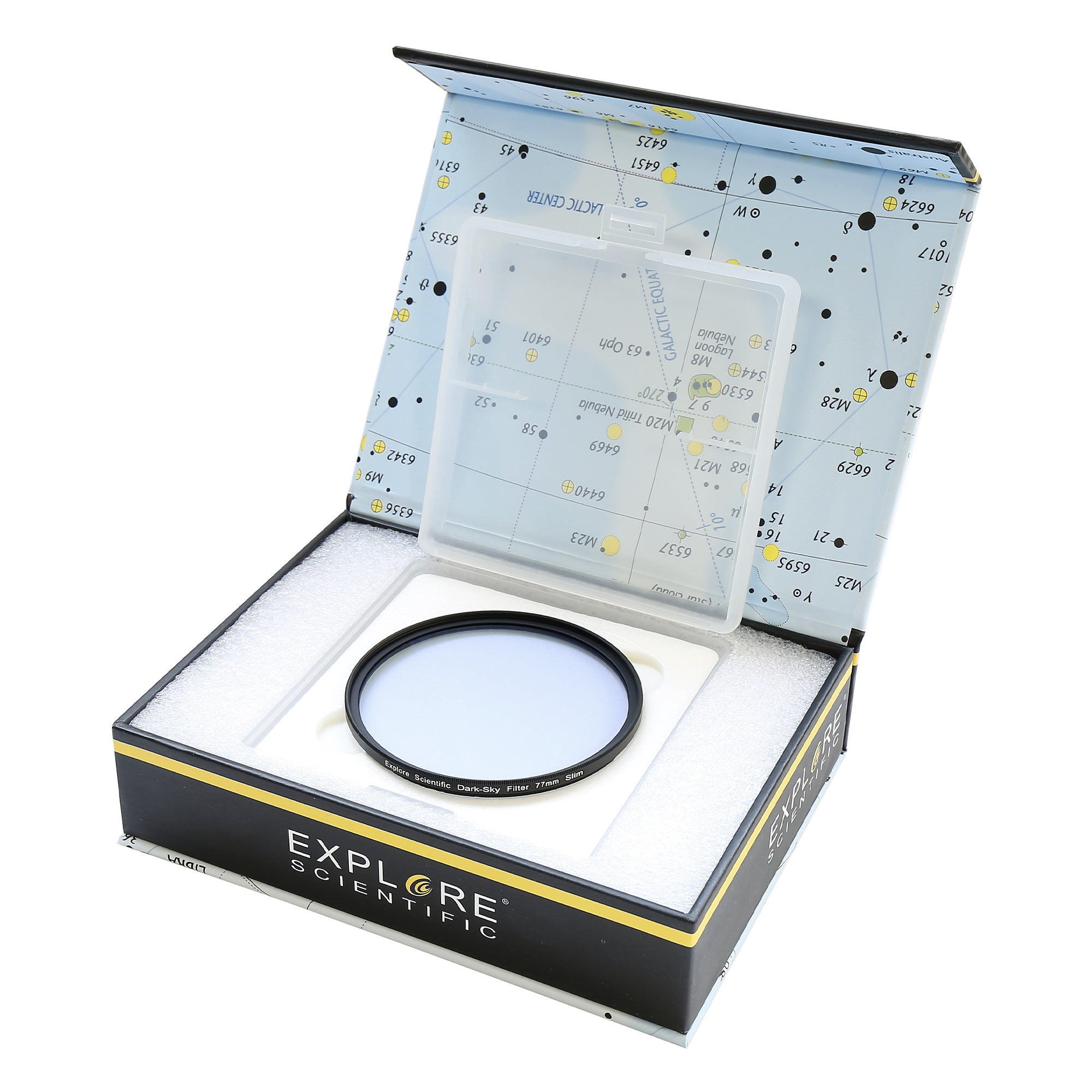
The Explore Scientific Dark Sky Filter, item 310260, is a 77mm screw-in filter made for camera lenses rather than telescopes. Explore Scientific describes it as a universally applicable dark sky filter for photo lenses, particularly suited to increasing contrast in aurora and deep-sky photography. The substrate is a special optical glass containing neodymium oxide, which absorbs strongly in a narrow band centred on the 590nm sodium line while passing 550nm green and 630nm red at over 90 per cent. The frame is black anodised aluminium with a construction height of just 4mm, a slim profile chosen specifically so the filter does not vignette on wide-angle lenses.
Who It's For
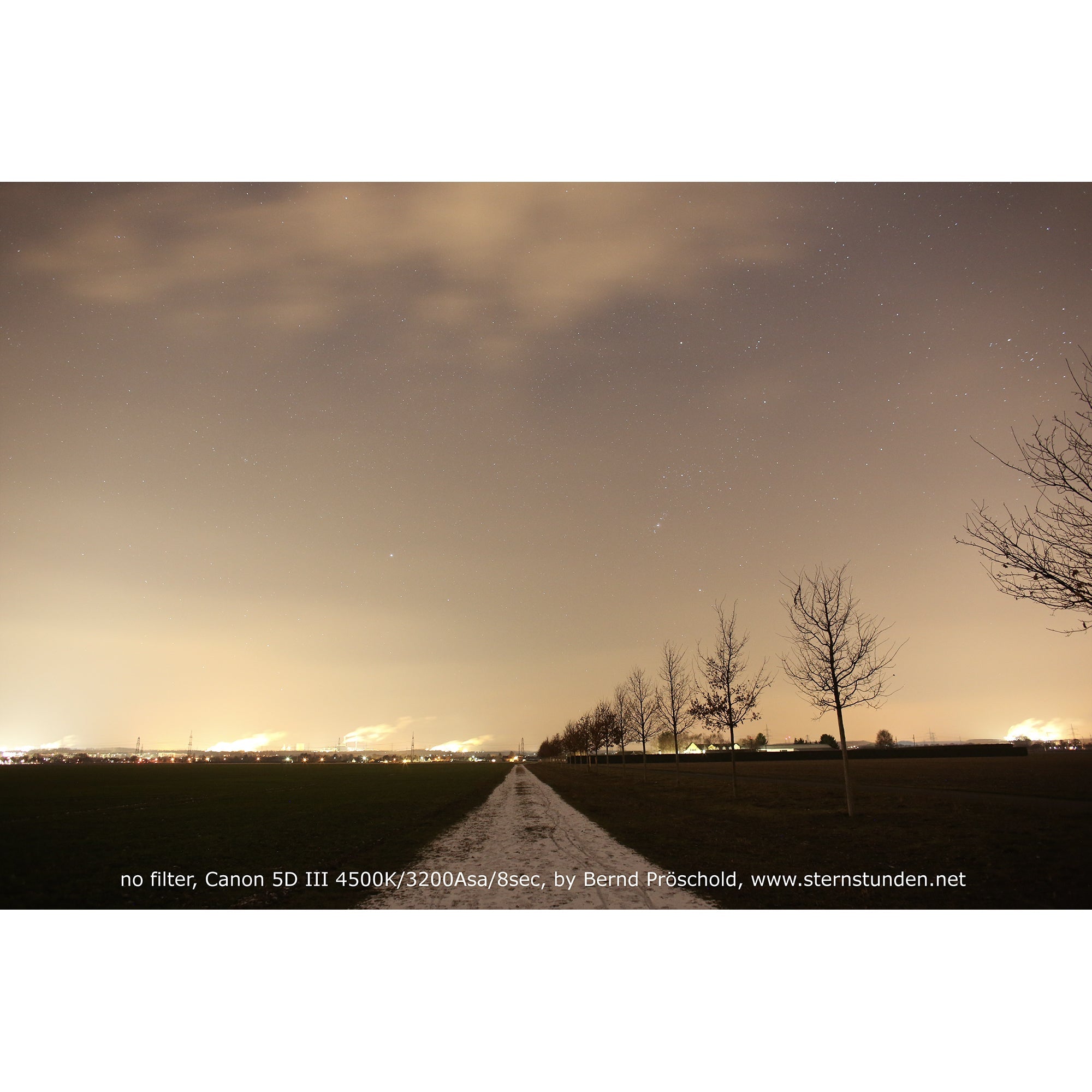
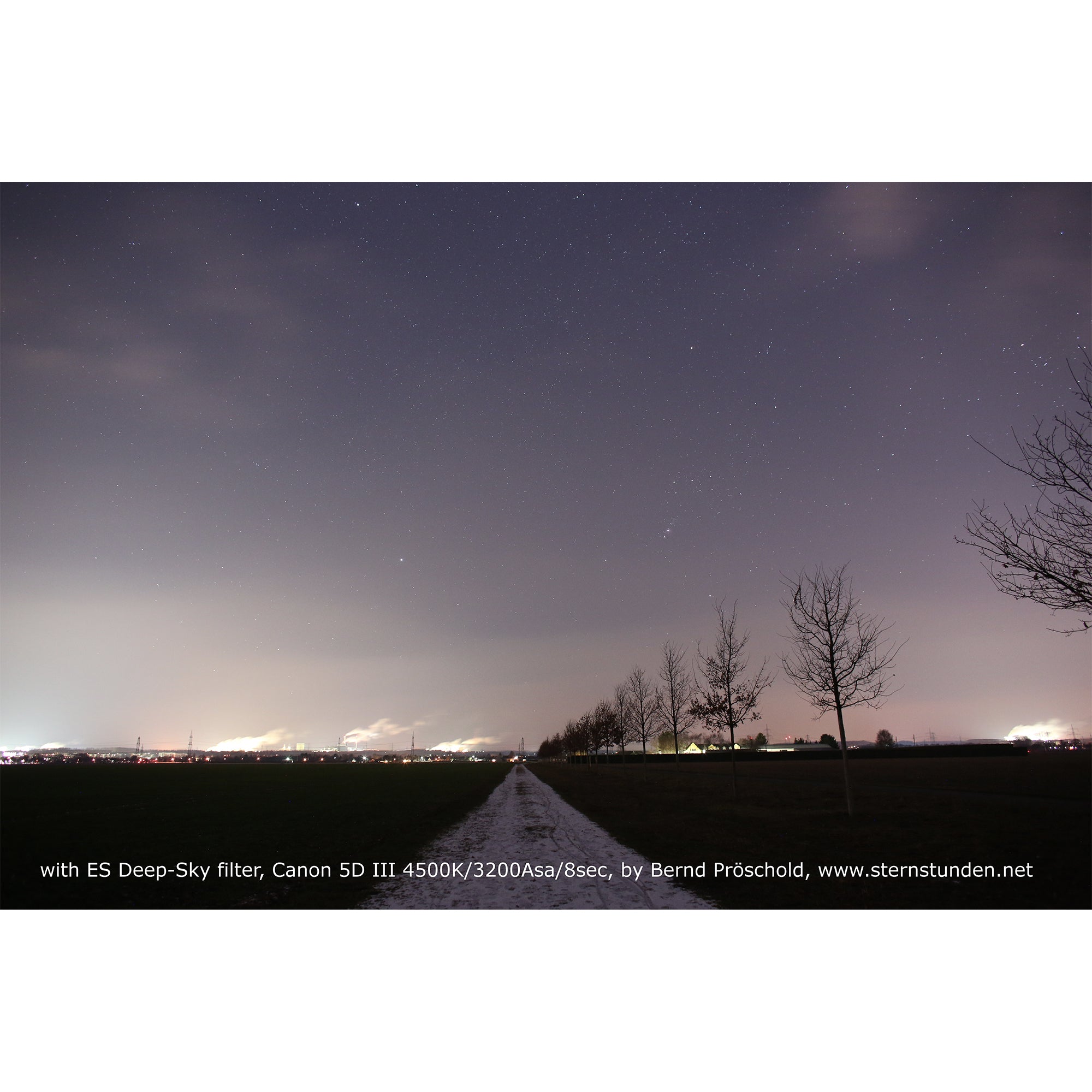
This is for the photographer shooting nightscapes, aurora and wide-field Milky Way frames from anywhere within reach of town lighting. The problem it addresses is specific and quite different from what a telescope filter deals with. A camera sensor records colour through red, green and blue channels, and the yellow of sodium vapour street lighting and greenhouse lighting lands across both the red and the green channels at once. Once that has happened, the skyglow is entangled with exactly the colours you are trying to record, the red of hydrogen emission and the green of aurora, and no amount of work in post-processing separates them cleanly. Blocking the sodium line at the point of capture keeps the channels distinct so the red and green in your image mean something.
It is also the practical answer for anyone who does not want to modify their camera. Clip-in interference filters that sit between lens and camera body mean disassembly, careful handling near the sensor, and a filter that only fits one body. This one threads onto the front of the lens like any other 77mm filter, goes on and off in seconds, and moves between bodies freely, which makes it realistic for time-lapse work and for travel where you are shooting on the move.
Key Features & Design
- Blocks the 590nm yellow sodium line, suppressing sodium vapour street lighting and greenhouse lighting
- Transmits over 90 per cent at 550nm green and 630nm red, the bands that carry aurora and hydrogen emission signal
- Slim 4mm construction height, chosen to avoid vignetting on wide-angle lenses
- Standard 77mm filter thread, so it fits directly on the front of a 77mm lens with no camera modification
- Special optical glass with neodymium oxide, an absorption glass rather than an interference coating
- Black anodised aluminium frame, which resists handling wear and limits internal reflection off the ring
- Natural night sky colour reproduction, with the correction confined to a narrow band rather than a broad cast
Filter Design
The important engineering decision here is absorption rather than interference. An interference filter builds its passband from stacked thin-film layers, and the wavelength at which those layers cancel depends on the angle at which the light crosses them. Light entering the corner of a fast wide-angle lens arrives at a very different angle from light down the centre, so an interference filter mounted in front of such a lens shifts its passband across the frame and produces uneven colour. Neodymium oxide glass works differently. The neodymium ion has an absorption band that sits over the yellow region near 590nm, and because that absorption is a property of the material itself rather than of a layer structure, it behaves the same regardless of the angle of incidence. That is what makes the filter usable in front of a 14mm or 24mm lens where an interference filter would not be. The 4mm frame height serves the same goal from the mechanical side: a standard filter ring intrudes into the field of a very wide lens and darkens the corners, so the mount is cut down to keep clear of it.
Recommended Uses
- Aurora photography, where separating green and red emission from yellow skyglow is the whole battle
- Wide-field Milky Way and nightscape work from suburban or semi-rural sites
- Night sky time-lapse sequences, where a screw-in filter can stay on the lens for hours unattended
- Wide-field imaging of emission nebulae with a camera lens on a star tracker
- General night photography where sodium lighting is casting an orange wash over the scene
Compatibility and Accessory Notes
The filter fits any lens with a 77mm front filter thread directly. Lenses with smaller threads can use it with an inexpensive step-up ring, though on the widest lenses a step-up ring reintroduces the very intrusion into the field that the slim mount was designed to avoid, so test for vignetting at your widest focal length and largest aperture before you rely on it. Some ultra-wide and fisheye lenses have bulbous front elements with no filter thread at all and cannot take a front filter of any kind. Slim frames also vary in whether they carry a front thread for stacking or for a lens cap, so if you need to keep a cap or hood on top, contact our team in Bolton and we will confirm what this frame will accept before you order. It works with any camera body, mirrorless or DSLR, modified or unmodified.
Good to Know Before You Order
Explore Scientific publishes no shipping weight for this item, so we are confirming it on our own scales before the listing goes live. That is why it is currently unpublished. Contact us and we will give you a shipping figure for your address. On performance, be realistic about what a sodium-line filter can and cannot do. It is aimed at one specific pollutant. Broad-spectrum white LED street lighting, which now dominates in many municipalities, emits right across the visible band and cannot be notched out this way, so under LED-lit skies the improvement is modest. Under older sodium lighting it is substantial. The filter also removes some light, which means slightly longer exposures, and like any front-mounted glass it can produce ghosting if a bright lamp is in or just outside the frame. Custom white balance is worth setting with the filter fitted. The filter is supplied on its own; step-up rings, caps and hoods are separate.
Frequently Asked Questions
Will it vignette on my wide-angle lens? The 4mm slim frame is designed specifically to avoid that, and it is the reason to choose this filter over a standard-height one. On extremely wide lenses, and particularly if you add a step-up ring, test a frame at your widest setting to be sure.
Does it need a modified camera? No. It threads onto the front of the lens and works with any standard camera body, which is the main practical advantage over clip-in filters that sit in front of the sensor.
Will it help under white LED street lights? Only a little. Neodymium glass targets the yellow sodium line near 590nm. LED lighting is broadband and there is no narrow band to remove, so the honest answer is that this filter is at its best where sodium lighting still dominates.
Can I use it on a telescope? Not directly. It is built around a 77mm photographic thread for camera lenses. For telescope work, ask us about the light pollution filters made in 1.25-inch and 2-inch astronomical cells.
Bottom Line
If you photograph aurora or wide-field night skies near sodium-lit towns, this filter fixes a problem at capture that is genuinely difficult to fix afterwards, and the slim mount means you can use it on the wide lenses that matter most for that work. It is a simple screw-in accessory with no camera modification involved. Contact our team in Bolton if you would like help matching it to your lens set or choosing step-up rings.
You may also like
Recently viewed
Recent Blog Posts
View all
Your Guide Graph Is Lying to You
Read More

D-Size vs V-Size: A Complete Guide to Telescope Dovetail Systems
Read More

What Is Back Focus in Astrophotography? Telescope Reducers, Flatteners, and Spacing Explained
Read More