


- Description
Product Overview
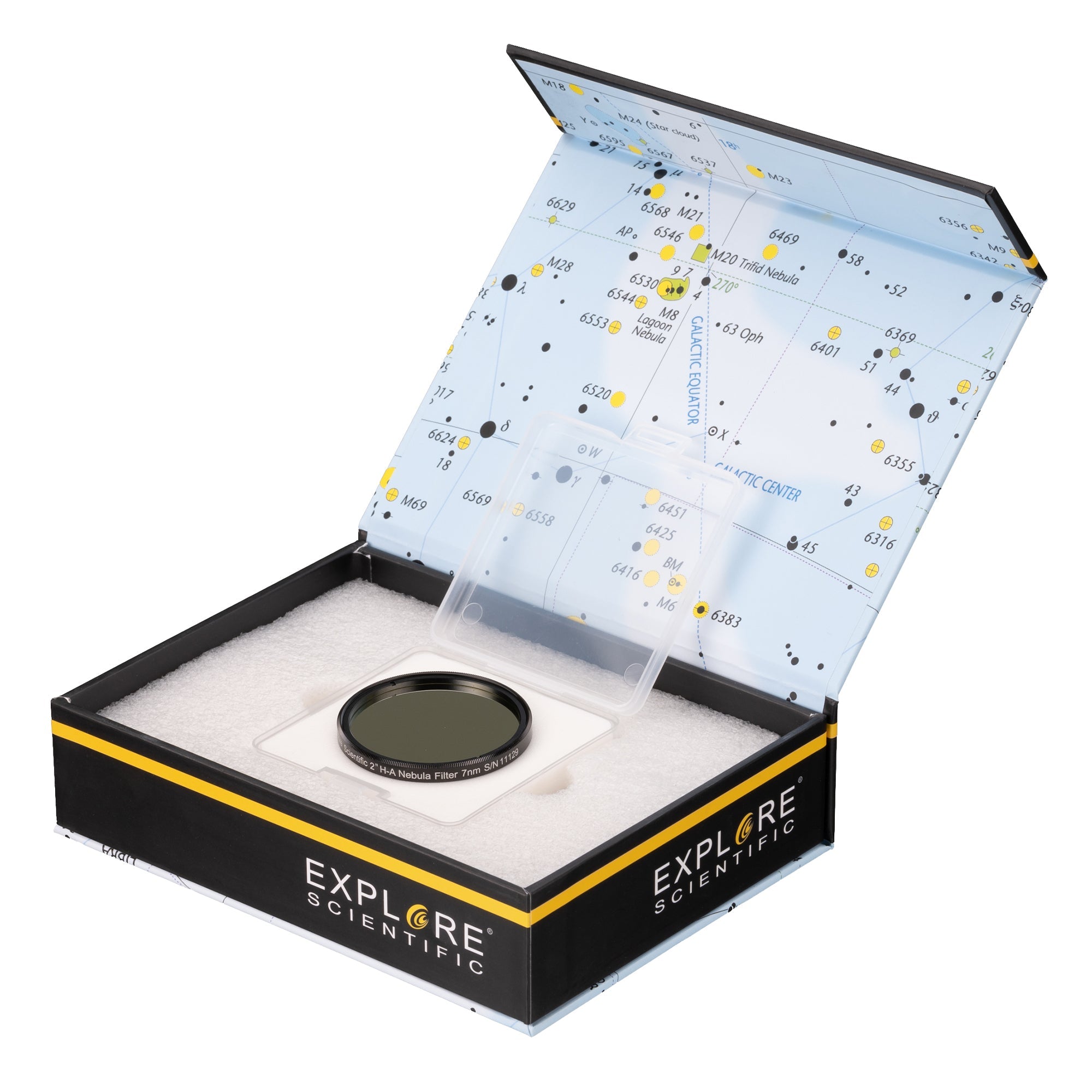
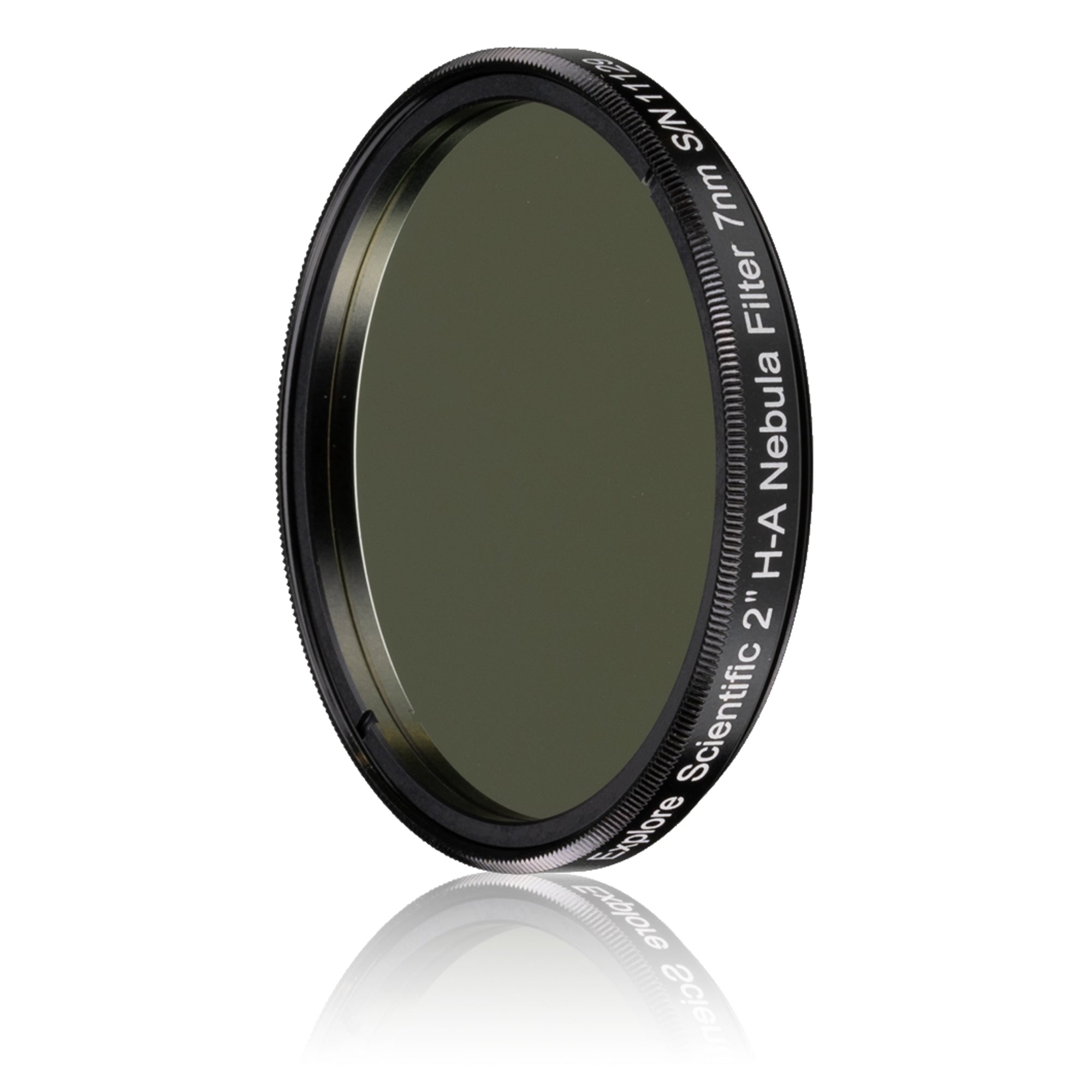
The Explore Scientific 2-inch H-Alpha Nebula Filter with a 7 nm passband is the tighter of the company's two 2-inch hydrogen filters. Explore Scientific describes what it does without hedging: it blocks all other colours and nearly all artificial light, letting through only the hydrogen emission lines, and the effect is that structure appears in photographs where an unfiltered frame looks empty. The company developed it exclusively for astrophotography and calls it a must for urban astrophotographers, noting that it is especially effective when the sky is slightly brightened. It is mounted in a 2-inch cell and supplied with an individual test report.
Who It's For
The argument for narrowing the band is different for hydrogen than it is for sulphur or oxygen, and it is worth understanding why. Narrowing the window from 12 nm to 7 nm cuts the continuum background you collect by roughly forty percent while the emission line, which is a fraction of a nanometre wide, passes through as strongly as before. The image gets darker overall and the nebula does not, which is the entire point. The reason this is a comfortable trade with hydrogen specifically, and an uncomfortable one with sulphur, is that hydrogen-alpha is normally the strongest line in an emission nebula by a considerable margin. You have signal to spend, so spending some of it on contrast is a reasonable bargain rather than a sacrifice.
That makes this the hydrogen filter for people whose limiting factor is the sky rather than the target. If you image from a genuinely bright suburban or urban site, if you want to keep working within a few days of full moon, or if you are shooting targets that sit low over a city light dome, the 7 nm window keeps the background down where the 12 nm filter starts to fill in. It suits full-frame and large APS-C monochrome cameras in 2-inch wheels and drawers, and it is at its best on systems around f/5 and slower, where the angular spread across a converging beam is modest enough that the tighter passband stays parked on 656.3 nm from centre to corner. On a very fast wide-field astrograph, or on nights where you only get an hour of sky, the 12 nm version will still serve you better.
Key Features & Design
- 7 nm passband on the hydrogen emission line at 656.3 nm
- Around forty percent less continuum sky background than a 12 nm filter for the same nebular signal
- Mounted 2-inch cell for full-frame and large APS-C sensors and 2-inch filter wheels
- Blocks mercury and sodium vapour lamp emission, the dominant components of urban skyglow
- Explore Scientific developed it exclusively for astrophotography and recommends it for brightened skies
- Narrow enough to hold contrast through moonlight, wide enough to stay practical on moderate focal ratios
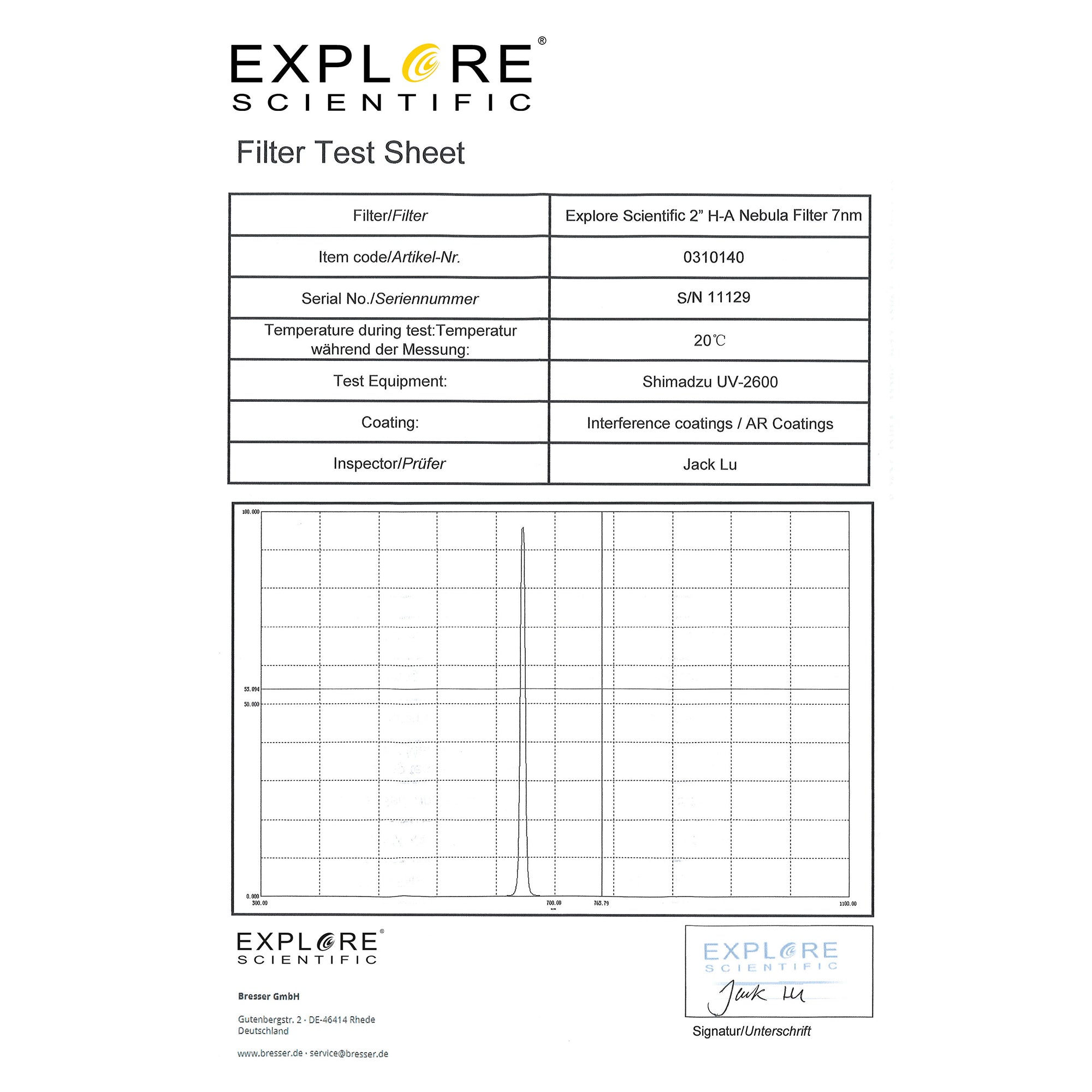
- Individual test report for your specific filter included in the scope of delivery
Filter Design
The transmission window is produced by a dielectric interference coating, and its two most important behaviours both follow from the same physics. First, the band is defined at normal incidence: light striking the coating at an angle satisfies the interference condition at a shorter wavelength, so the passband shifts toward the blue as the beam converges or as a ray heads for the edge of the field. Second, the size of that shift is the same in nanometres regardless of how wide your window is, which means it costs you proportionally more the tighter the filter. Seven nanometres is a well-judged compromise for a 2-inch filter: it leaves roughly three and a half nanometres of margin either side of the hydrogen line, enough that a moderate light cone and a large sensor still see the line near peak transmission, while removing a substantial slice of the background that a 12 nm filter admits. Push much narrower than this in a 2-inch cell close to a big chip and you begin trading real corner transmission for background suppression you may not need.
Recommended Uses
- Hydrogen-alpha imaging from light-polluted urban and suburban sites
- Working through moonlit periods when broadband and wider narrowband filters lose contrast
- Emission nebulae, supernova remnants and hydrogen-rich star-forming regions on large sensors
- High-contrast hydrogen luminance layers for blending into broadband colour images
- Moderate focal ratio refractors and reflectors with 2-inch filter wheels or drawers
Compatibility and Accessory Notes
The cell carries the standard 2-inch filter thread and screws into a 2-inch nosepiece, a 2-inch star diagonal, a 2-inch eyepiece barrel or the carousel of most 2-inch filter wheels. Wheels and drawers designed around unmounted 36 mm or 50.8 mm discs will not take a mounted cell, and slim drawers may not have the clearance, so it is worth confirming that before you order. Any mounted filter adds glass to the optical path and moves focus slightly rearward, which is a detail worth accounting for in the spacing between a reducer or field flattener and your sensor. If you are pairing this with sulphur and oxygen filters, remember that hydrogen tolerates a tighter window better than the other two lines do, so a mixed-bandwidth set is a defensible choice rather than an error, provided you plan your exposures accordingly. Our team in Bolton will confirm fit against your wheel, drawer or diagonal if you send us the model.
Good to Know Before You Order
Explore Scientific publishes no shipping weight for this item, so we are confirming it on our own scales before the listing goes live. That is why it is currently unpublished. Contact us and we will give you a shipping figure for your address. Beyond that: Explore Scientific is explicit that this filter was developed for astrophotography alone, and a 7 nm window in the deep red is of no practical use at the eyepiece. Explore Scientific also does not publish peak transmission, substrate details or a full out-of-band blocking specification for this filter, so we do not quote numbers we cannot source; the individual test report in the box gives the measured curve for the filter you receive. Delivery is the filter and that report, with no camera, wheel, adapter or diagonal included.
Frequently Asked Questions
Why is 7 nm sensible for hydrogen when 6.5 nm is demanding for sulphur? Because the underlying signal is different. Hydrogen-alpha is usually much the strongest line in an emission nebula, so you can afford to trade some throughput for background suppression. Sulphur is the weakest, so the same trade leaves you scraping for signal. Bandwidth choices should follow line strength, not just the number on the box.
Can I image through a full moon with this? Within reason, yes, provided the moon is not close to your target. The narrower window is exactly what keeps moonlit continuum out of the frame, and it is the main reason to choose this over the 12 nm version.
Is it too narrow for my f/4 astrograph? Explore Scientific does not publish a focal ratio limit. As a practical guide, 7 nm is comfortable around f/5 and slower and starts to lose corner transmission on very fast systems with large sensors. If you are near that boundary, contact us with your optics and sensor size and we will give you our honest read.
Does it need a monochrome camera? It works best with one. On a Bayer-array colour camera only the red photosites see the hydrogen line, and their own dyes cost you further transmission, so you are paying for a premium filter and using a quarter of your sensor.
Bottom Line
This is the hydrogen filter for imagers fighting a bright sky: tight enough to suppress the background that ruins urban and moonlit frames, but sitting on a line strong enough to absorb the cost. On a moderate focal ratio and a large monochrome sensor it is the version that produces the cleanest hydrogen data. Contact us if you would like help choosing between it and the 12 nm filter for your site and your optics.
You may also like
Recently viewed
Recent Blog Posts
View all
Your Guide Graph Is Lying to You
Read More

D-Size vs V-Size: A Complete Guide to Telescope Dovetail Systems
Read More

What Is Back Focus in Astrophotography? Telescope Reducers, Flatteners, and Spacing Explained
Read More