



- Description
- Specifications
Product Overview
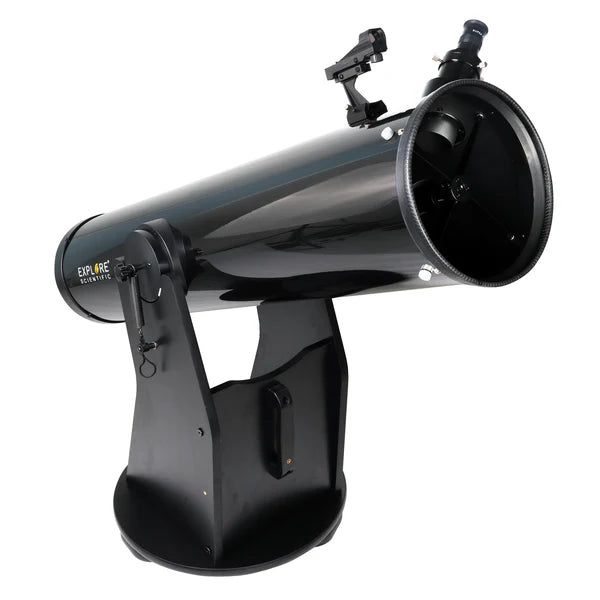
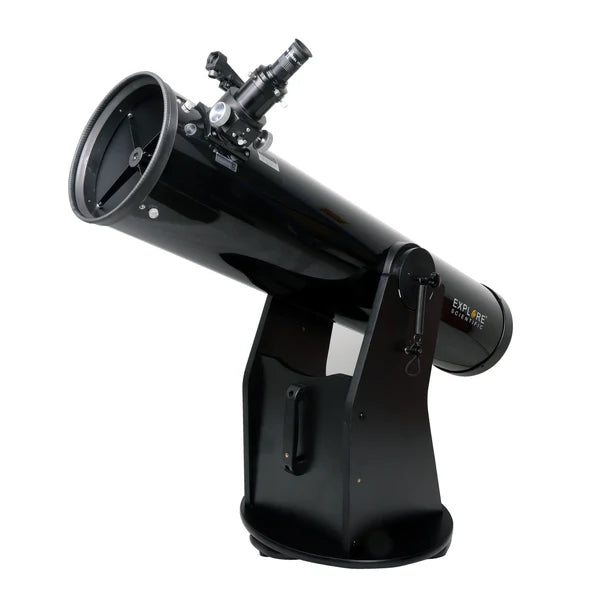
The Explore Scientific 8-inch Dobsonian pairs a 208mm Newtonian reflector with an altazimuth Dobsonian base. Explore Scientific publishes a primary mirror diameter of 208mm and a focal length of 1219mm, which works out to f/5.9 — a fast focal ratio that keeps the tube short for the aperture and keeps low-power fields wide.
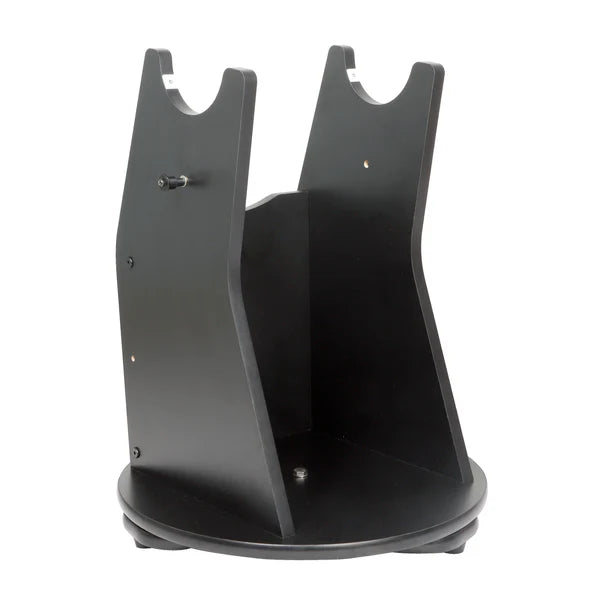
The two published weights are separate: the optical tube is 19 lbs 15.5 oz and the base is 18 lbs 11 oz. Together that is a little over 38 lbs, but it moves in two pieces, and the tube alone is what has to be lifted.
The tube carries a 2-inch Crayford focuser, and the base uses a spring tension balance system so the tube stays where it is pointed as eyepieces of different weights go in and out. In the box: a 25mm Plössl eyepiece giving 49x at this focal length, a red-dot finder scope, a smartphone adapter and a dust cover.
Who It's For
- Deep-sky observers: a 208mm primary gathers on the order of 880 times the light of a 7mm dark-adapted pupil, which is the single figure that decides how much of a faint galaxy or nebula is actually there to see.
- Observers who want aperture per dollar: a Dobsonian spends its cost on the mirror rather than on drive electronics, and this is a good match if your priority is what you can see rather than what the mount can automate.
- People who observe from home or a short drive away: two pieces at roughly 20 lbs each carry easily, and the base sits directly on the ground with no tripod to level.
- Casual imagers: the supplied smartphone adapter covers Moon and bright-planet phone photography through the eyepiece.
Key Features & Design
- 208mm primary mirror: the published aperture, and the figure that sets both light grasp and resolving power.
- 1219mm focal length at f/5.9: fast enough for wide, bright low-power fields, and long enough that a 6mm eyepiece still reaches 203x.
- 2-inch Crayford focuser: takes 2-inch eyepieces directly and 1.25-inch eyepieces through an adapter, so the widest true fields the tube can produce are available.
- Dobsonian base with spring tension balance: the tension system holds the tube against changes in eyepiece weight instead of relying on friction alone.
- 25mm Plössl eyepiece included, which Explore Scientific rates at 49x in this telescope.
- Red-dot finder scope for zero-magnification aiming, which suits a hand-pointed altazimuth telescope.
- Smartphone adapter included for afocal photography through the eyepiece.
- Published weights: optical tube 19 lbs 15.5 oz, base 18 lbs 11 oz.
Optical Design
A Newtonian reflector uses a concave primary mirror at the closed end of the tube and a small flat secondary near the open end, which turns the converging beam sideways to a focuser on the tube wall. Because the light path folds once, a 1219mm focal length fits inside a tube far shorter than a refractor of the same focal length, and because mirrors reflect all wavelengths identically there is no chromatic aberration in the objective at all — the colour fringing question that follows achromatic refractors simply does not arise here.
The trade is alignment. Two mirrors held at a fixed relationship inside a tube that gets carried, tipped and cooled will drift slightly out of collimation over time, so a Newtonian is checked and nudged back periodically. It is a five-minute job with a collimation cap or laser collimator once the routine is familiar, and it is the normal maintenance of the design rather than a fault. We stock collimation tools and can include one with the telescope.
At f/5.9 the incoming cone is fast, and fast paraboloidal mirrors show coma — stars towards the edge of a wide field taking on a small comet-like flare while the centre stays sharp. It is most visible in wide-field eyepieces at low power. A coma corrector removes it, and that is the usual upgrade path for observers who use 2-inch wide-field eyepieces heavily.
Recommended Uses
- Deep-sky observing — galaxies, globular clusters, nebulae and the fainter Messier and NGC objects.
- Lunar and planetary observing at higher magnification on steady nights.
- Wide-field sweeping of the Milky Way through a 2-inch low-power eyepiece.
- Smartphone photography of the Moon and bright planets using the supplied adapter.
- Club nights and public outreach, where quick hand-aiming is worth more than a go-to routine.
Compatibility and Accessory Notes
- Eyepieces: the 2-inch Crayford focuser accepts 2-inch eyepieces directly and 1.25-inch eyepieces through a 2-inch to 1.25-inch adapter. At 1219mm, a 30mm eyepiece gives 41x, the supplied 25mm gives 49x, a 12mm gives 102x and a 6mm gives 203x.
- Filters: both barrel sizes take standard threaded filters. Broadband and narrowband nebula filters are the usual first addition on an 8-inch, since aperture and filter work together on low-surface-brightness targets.
- Coma corrector: an f/5.9 paraboloid benefits from one when wide-field 2-inch eyepieces are in use. Ask us and we will match one to the focuser.
- Finder upgrade: the supplied red-dot finder is a zero-power aiming device. Many observers add an optical or right-angle finder alongside it for star-hopping; the base pattern is not published by Explore Scientific, so we can check that against a specific finder before you order.
- Tracking: the Dobsonian base is a manual altazimuth mount. Objects drift with the sky and are nudged back by hand, and a wider apparent-field eyepiece buys more time between nudges at high power.
Good to Know Before You Order
- It arrives and moves as two pieces. The tube is 19 lbs 15.5 oz and the base 18 lbs 11 oz, so nothing weighs more than about 20 lbs at a time, and both parts travel in a car boot with the seats up.
- A Newtonian is collimated periodically. This is routine for the design rather than a defect, and a collimation cap or laser makes it a short job before an observing session.
- The base does not track. Objects drift out of the field and are pushed back by hand, which is quick at low power and more frequent at high power. Wide apparent-field eyepieces lengthen the interval, and we can suggest ones that suit f/5.9.
- Explore Scientific publishes no shipping weight, limiting magnitude, resolution or secondary mirror figure for this model, so those rows read as not published rather than being estimated. If any of them are decisive for you, we will put the question to our Explore Scientific representative.
Frequently Asked Questions
Is it difficult to set up?
Night to night it is about as simple as telescopes get: the base goes on level ground, the tube goes into the base, the finder and eyepiece push in, and observing starts. There is no tripod to level, no polar alignment and no power. The one skill to pick up is collimation — checking that the mirrors are aligned — which is a short routine with a collimation cap and is done before a session rather than during it.
What magnification does it give?
Divide 1219 by the eyepiece focal length. The supplied 25mm gives 49x, a 12mm gives 102x and a 6mm gives 203x. On a steady night an 8-inch will use around 300x to 400x on the Moon and planets; most nights the atmosphere sets the ceiling lower than that.
Can I photograph with it?
The supplied smartphone adapter covers the Moon and the bright planets through the eyepiece, and that works well. Long-exposure deep-sky imaging is a different proposition, because an undriven altazimuth base does not track the sky; that work belongs on an equatorial mount.
Will I need extra eyepieces?
The 25mm at 49x is a good general-purpose starting point. A shorter focal length for lunar and planetary detail is the usual next purchase, and the 2-inch focuser opens up wide-field eyepieces the 1.25-inch size cannot match. Tell us what you want to look at and we will suggest two that complement the 25mm.
Bottom Line
In short: a 208mm f/5.9 Newtonian at 1219mm focal length on a spring-tension Dobsonian base, with a 2-inch Crayford focuser, a 25mm Plössl at 49x, a red-dot finder, a smartphone adapter and a dust cover included — eight inches of aperture that is ready to observe minutes after it comes out of the car. If you would like a shortlist of eyepieces, a filter or a collimation tool to go with it, tell us what you plan to observe and we will put a sensible set together.
| Item Number | ES-ON20859 |
|---|---|
| Optical Design | Newtonian Reflector on Dobsonian Base |
| Primary Mirror Diameter | 208mm |
| Focal Length | 1219mm |
| Focal Ratio | f/5.9 |
| Optical Tube Weight | 19lbs. 15.5 oz. |
| Base Weight | 18lbs. 11 oz. |
| Focuser | 2-inch Crayford |
| Eyepiece Included | 25mm Plössl (49x) |
| Finder Included | Red Dot Finder Scope |
| Also Included | Smartphone Adapter; Dust Cover |
| Mount Type | Manual Altazimuth (Dobsonian), Spring Tension Balance |
| Secondary Mirror Size | Not published by vendor |
| Mirror Coatings | Not published by vendor |
| Limiting Magnitude | Not published by vendor |
| Resolution | Not published by vendor |
| UPC | 81180303659 |
You may also like
Recently viewed
Recent Blog Posts
View all
Your Guide Graph Is Lying to You
Read More

D-Size vs V-Size: A Complete Guide to Telescope Dovetail Systems
Read More

What Is Back Focus in Astrophotography? Telescope Reducers, Flatteners, and Spacing Explained
Read More