


- Description
- Specifications
Product Overview
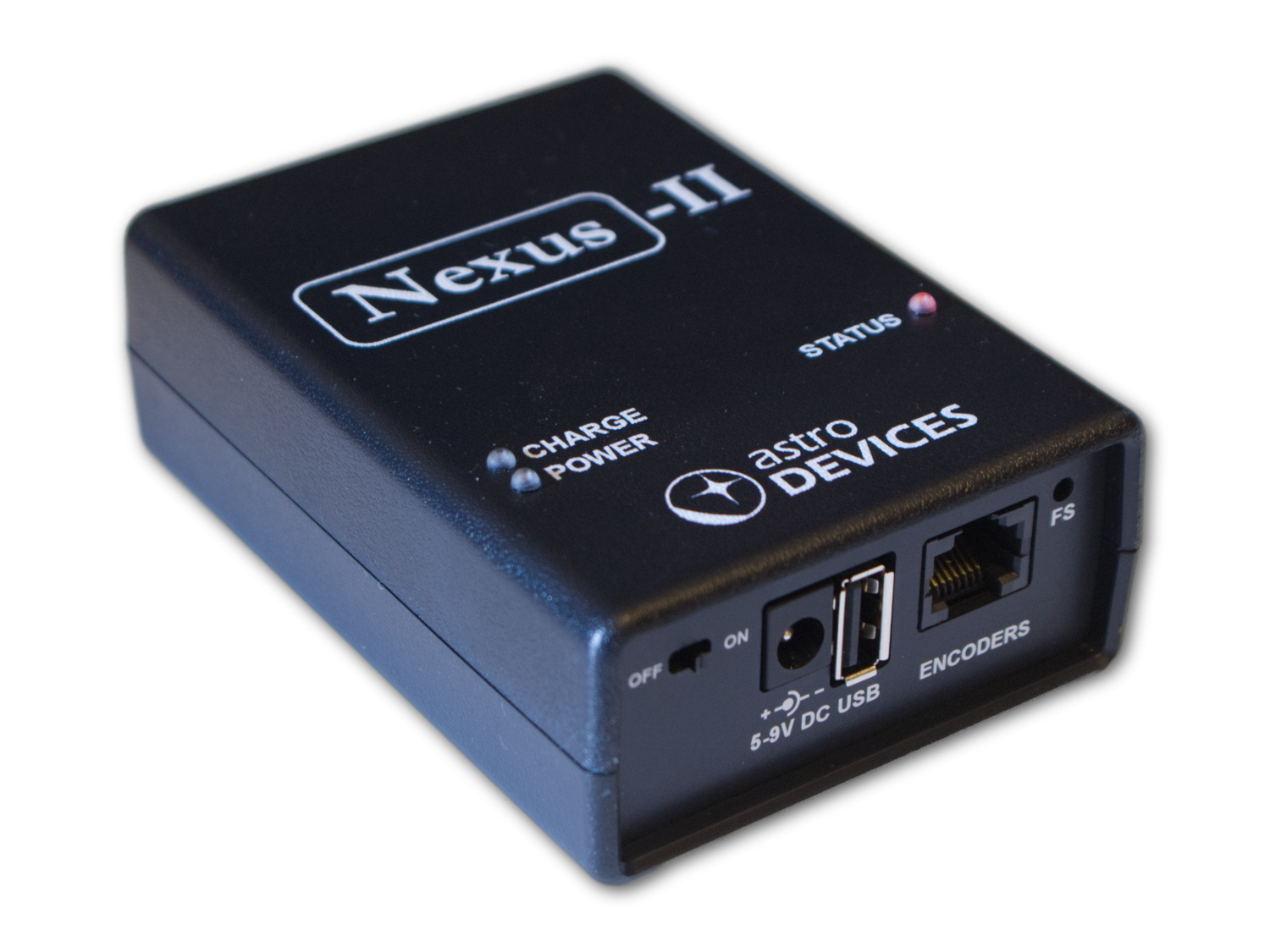
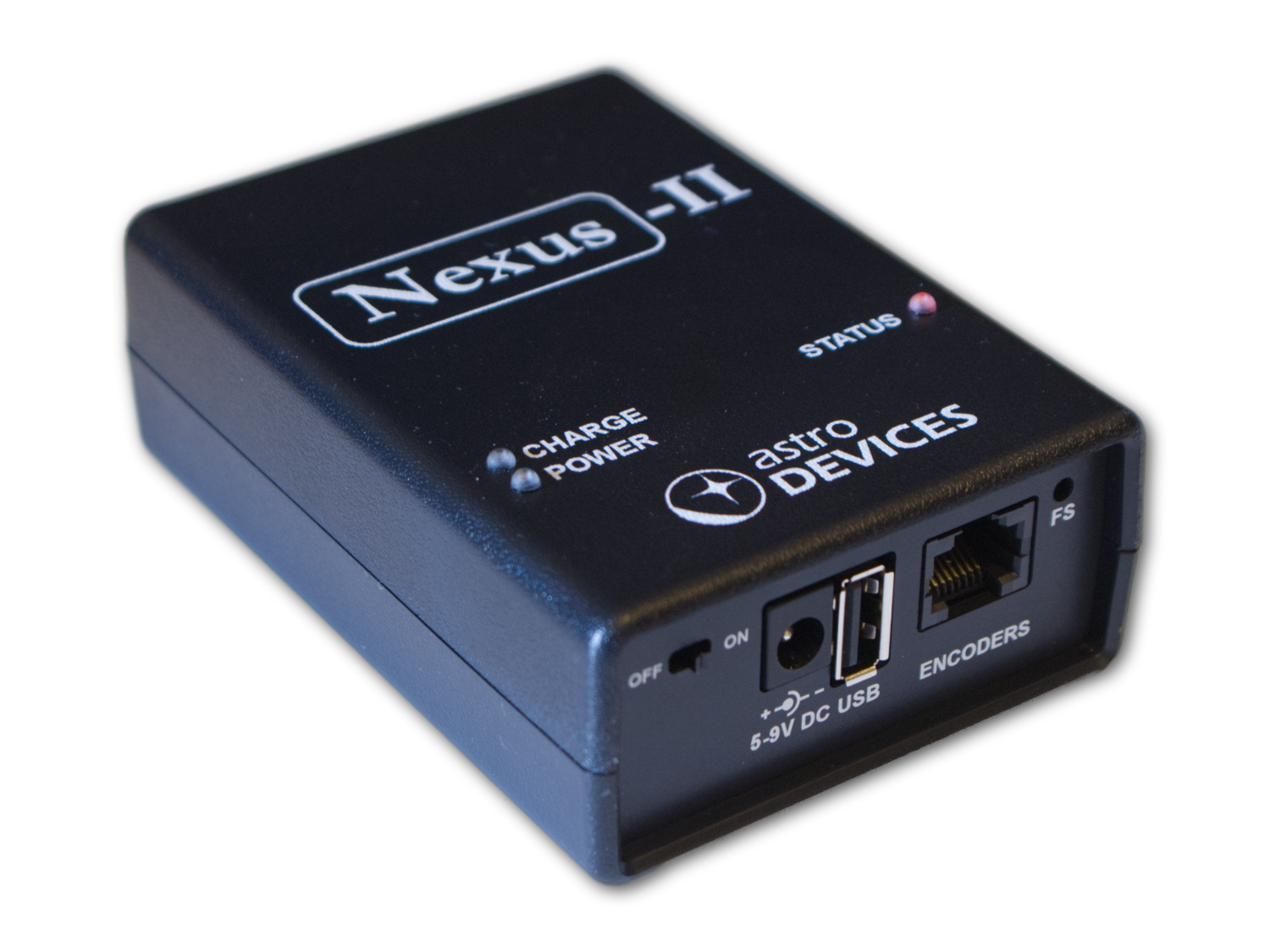
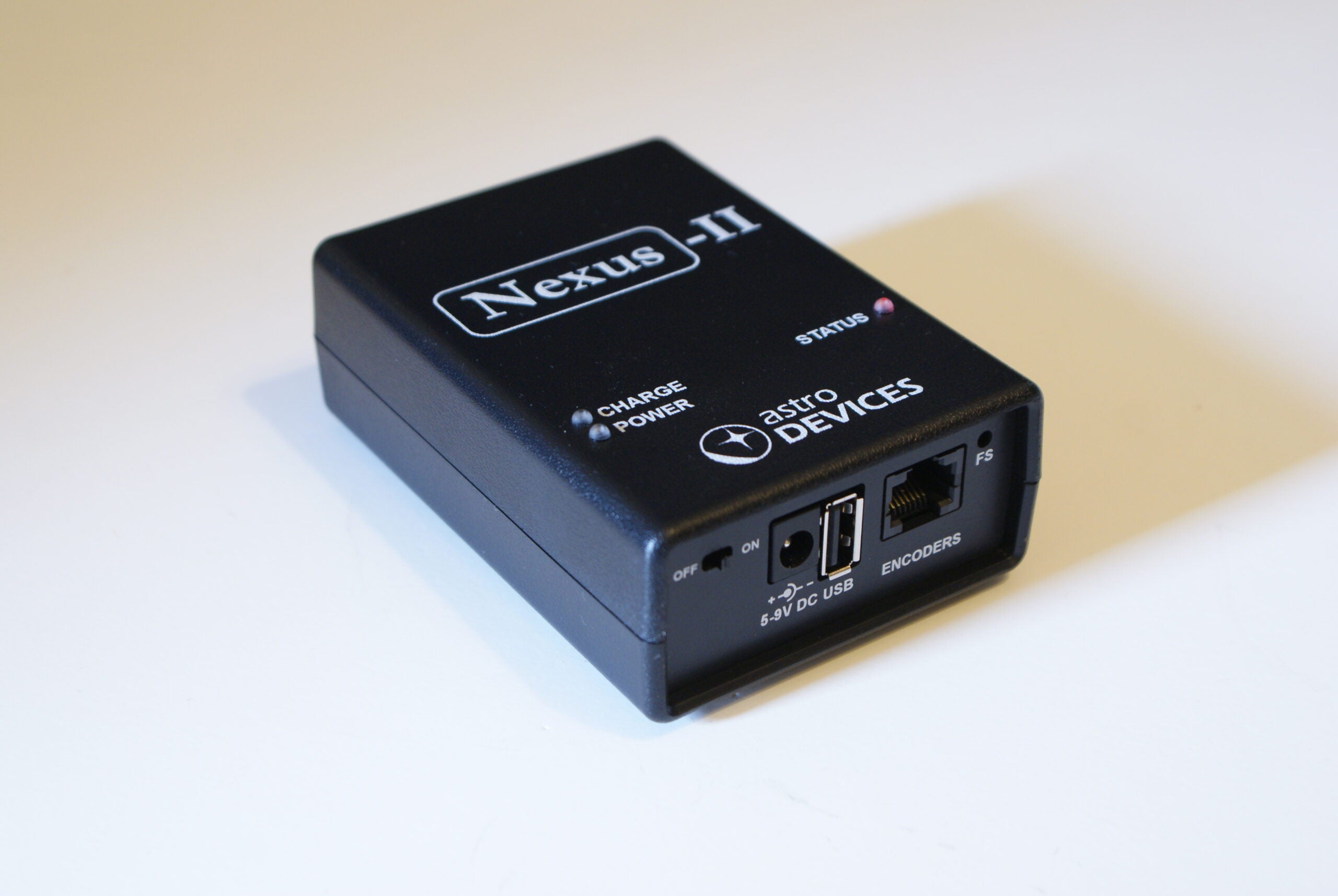
The Astro Devices Nexus-II combines Digital Setting Circles and a USB serial-to-WiFi interface in one compact package. It links your telescope's optical encoders to the planetarium software you already run, so your device screen shows where the telescope is pointing and guides you object to object. Running on an internal rechargeable lithium battery, it delivers up to 11 hours of use per charge and communicates as a Class I WiFi device with a range of up to 150 metres. The unit measures 75 x 105 x 36 mm and weighs 350 g.
Who It's For
The Nexus-II suits visual observers running a push-to (or SiTech-driven go-to) setup who want their telescope's position mirrored wirelessly on a phone, tablet, or computer. If you use SkySafari on an iPad at the eyepiece, or Cartes du Ciel on a laptop, and you want to leave cables behind, this is the interface that ties the encoders to that software.
Key Features & Design
- Wireless DSC and serial-to-WiFi in one: Works as a wireless digital setting circles unit, as wireless DSC alongside a SiTech motor controller, or as a plain USB serial-to-WiFi adapter.
- Up to 11 hours of battery life: An internal rechargeable lithium battery powers a full night of observing, topped up over the supplied USB cable.
- Broad software support: Talks to SkySafari Plus/Pro, Starry Night, Cartes du Ciel, TheSky, and more across iOS, Android, Windows, and Mac OS X.
- Class I WiFi, up to 150 m: Connects in either Access Point or Infrastructure mode (WEP/WPA/WPA2), so it can host its own network or join an existing one.
- High-resolution encoder handling: Reads TTL quadrature optical encoders with practically unlimited pulses per second.
- SiTech protocol: Supports the SiTech communication protocol for use with SiTech motor controllers.
- Protected and simple: Reverse-polarity protection guards the input, and a single USB port keeps connections straightforward.
Design and Electronics
Inside its 75 x 105 x 36 mm enclosure, the Nexus-II pairs an encoder interface with a WiFi radio and its own power source, which removes the need for a separate serial cable, WiFi dongle, and external battery. The wide operating range of -20°C to 50°C (-4°F to 120°F) covers cold winter nights through warm summer sessions. Because it can operate as its own access point, it works in the field with no existing network nearby, and it falls back to joining an infrastructure network when one is available.
Recommended Uses
Use the Nexus-II to add wireless push-to guidance to a Dobsonian or equatorial telescope fitted with optical encoders, to feed telescope position into a planetarium app for star-hopping and object identification, or to bridge a SiTech-driven mount to your software over WiFi rather than a wired serial link.
Compatibility and Accessory Notes
The Nexus-II reads TTL quadrature optical encoders, which are sold separately and matched to your telescope's axes. On the software side it connects to SkySafari Plus/Pro, Starry Night, Cartes du Ciel, TheSky, and other apps that accept a WiFi telescope connection, on iPhone, iPad, iPod touch, Apple computers, Kindle Fire, Android phones and tablets, and Windows PCs and tablets. For go-to control it works with a SiTech motor controller using the SiTech protocol.
Good to Know Before You Order
- Encoders are separate: The package includes the Nexus-II unit, its user manual and setup guide, and a 0.3 m USB charging cable. Encoders are chosen and purchased to fit your specific telescope.
- Charging cable length: The included USB cable is 0.3 m, intended for recharging rather than a permanent tethered run.
- Weight and size: At 350 g and 75 x 105 x 36 mm, it mounts easily on the telescope or rides in an accessory pocket.
Frequently Asked Questions
Is it difficult to set up?
No. The Nexus-II creates its own WiFi network or joins an existing one, and you point your planetarium app at that connection following the included setup guide. Once the encoders are wired to the unit, alignment is handled within the app.
Which apps does it work with?
SkySafari Plus/Pro, Starry Night, Cartes du Ciel, TheSky, and other planetarium software that supports a WiFi telescope connection on iOS, Android, Windows, and Mac OS X.
How long does the battery last?
Up to 11 hours on a full charge, which covers a typical observing night, and it recharges over the supplied USB cable.
Does it need an existing WiFi network?
No. It can act as its own access point in the field, and it can also join an existing WEP/WPA/WPA2 network in Infrastructure mode.
Can it drive a go-to mount?
Yes, when paired with a SiTech motor controller it supports the SiTech communication protocol for go-to operation.
Bottom Line
The Nexus-II is a self-contained way to put your telescope's position on the screen you already use, combining wireless digital setting circles, a serial-to-WiFi bridge, and an 11-hour battery in a 350 g unit that pairs with SkySafari and other leading planetarium apps.
| Functions | Wireless DSC, wireless DSC with SiTech motor controller, USB serial-to-WiFi adapter |
|---|---|
| Battery life | Up to 11 hours |
| Battery type | Rechargeable lithium |
| Operating temperature | -20°C to 50°C (-4°F to 120°F) |
| Protocol supported | SiTech communication protocol |
| Encoder support | TTL quadrature optical encoders, practically unlimited pulses per second |
| Ports | One USB port |
| WiFi | Class I WiFi device (up to 150 metres range) |
| Networks | Access Point and Infrastructure (WEP/WPA/WPA2) |
| Compatible platforms | iOS, Android, Windows, Mac OS X |
| Weight | 350 g |
| Dimensions | 75 × 105 × 36 mm |
You may also like
Recently viewed
Recent Blog Posts
View all
Your Guide Graph Is Lying to You
Read More

D-Size vs V-Size: A Complete Guide to Telescope Dovetail Systems
Read More

What Is Back Focus in Astrophotography? Telescope Reducers, Flatteners, and Spacing Explained
Read More