
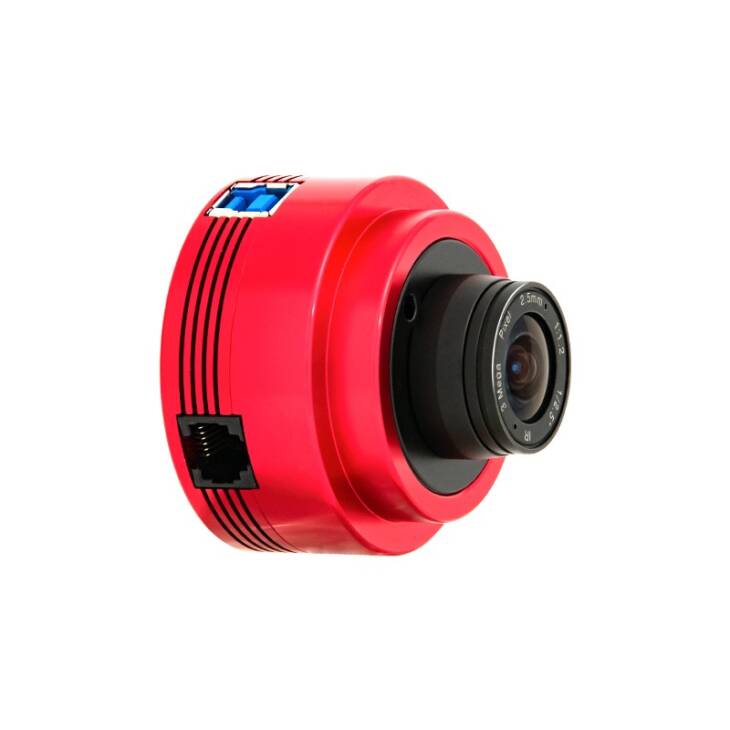
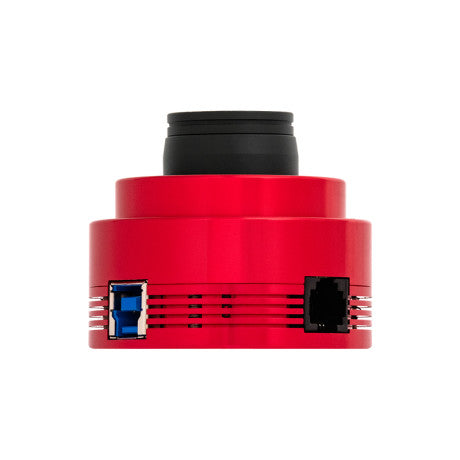
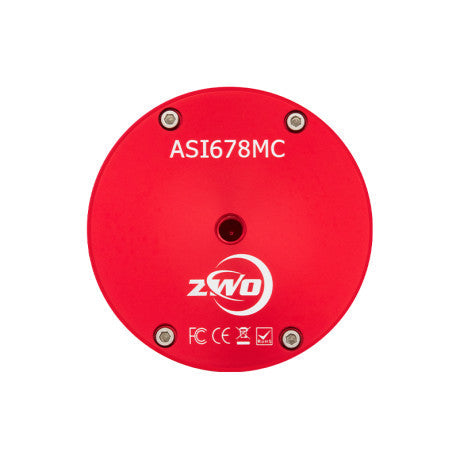


- Description
- Specifications
Product Overview
The ZWO ASI678MC is a colour planetary camera based on Sony’s IMX678 back-illuminated CMOS sensor. It uses a 1/1.8-inch sensor with 3840 × 2160 resolution, 2 µm pixels, 12-bit ADC, USB 3.0 transfer, and a built-in 256 MB DDR3 cache.
This camera is aimed at high-resolution solar system imaging: planets, the Moon, solar work with proper filtration, and near-infrared capture with filters such as 850 nm IR-pass or 890 nm methane-band filters. Compared with the older ASI178 series, the ASI678 family keeps a similar sensor format while improving read noise, near-infrared response, and amp-glow control.
Who It’s For
This is a good match if you want a one-shot-colour camera for planetary, lunar, solar, and compact-field imaging without moving into a cooled deep-sky camera. The 2 µm pixel size works well for high image scale on shorter focal-length or moderately barlowed planetary setups, while the colour sensor keeps the capture workflow simpler than a monochrome camera with filters.
Key Features & Design
- Sony IMX678 colour sensor: 1/1.8-inch STARVIS 2 CMOS sensor with 3840 × 2160 resolution.
- 2 µm pixels: Small pixels support fine sampling for lunar and planetary imaging.
- High near-infrared sensitivity: Useful for IR-pass lunar and planetary imaging, especially when seeing conditions favour longer wavelengths.
- No amp glow: Cleaner frames and easier calibration compared with cameras that show glow during longer exposures.
- 256 MB DDR3 cache: Helps stabilize high-speed data transfer and reduce frame-dropping risk.
- USB 3.0 interface: Supports fast planetary and lunar capture workflows.
Optical / Mechanical Design
The ASI678MC uses the IMX678 back-illuminated sensor with a 1/1.8-inch format and 8.86 mm diagonal. ZWO highlights the sensor’s near-infrared response as a key strength of the ASI678 family, making the camera useful beyond standard RGB planetary capture.

Mechanically, the camera uses the familiar compact ZWO planetary-camera body with USB 3.0 and ST4 connections. It has a 12.5 mm back-focus distance and supports the standard 1.25-inch/T-mount connection path shown by ZWO.
Recommended Uses
- Planetary imaging: Jupiter, Saturn, Mars, Venus, and other high-frame-rate solar system targets.
- Lunar imaging: High-resolution Moon imaging with fine surface detail.
- Solar imaging: Solar capture when used with proper front-mounted solar filtration or a dedicated safe solar system.
- Near-infrared capture: IR-pass and methane-band imaging where the sensor’s NIR sensitivity is useful.
- Compact-field imaging: Small bright targets and EAA-style use where an uncooled small-format camera makes sense.
Compatibility and Accessory Notes
The ASI678MC connects by USB 3.0 and includes an ST4 guide-port connection. ZWO’s connection diagram shows the camera used with a 1.25-inch T-mount connection and an optional 1.25-inch filter in the optical path.

Important Limitations
- Uncooled camera: This is not a cooled long-exposure deep-sky camera.
- Small sensor format: The 1/1.8-inch format is best for solar system and compact targets, not wide-field imaging.
- Colour sensor: Choose the ASI678MM if you need monochrome sensitivity or filter-based imaging.
- Solar safety: Never image the Sun without a proper safe solar filter or dedicated solar telescope system.
Frequently Asked Questions
Is the ASI678MC a colour camera?
Yes. The ASI678MC is the colour version of the ASI678 family.
Is this good for planetary imaging?
Yes. The small 2 µm pixels, USB 3.0 interface, low read-noise behaviour, and high near-infrared response make it well suited to planetary imaging.
Can it be used for deep-sky imaging?
It can be used for some compact bright targets and EAA-style work, but it is mainly an uncooled solar system camera.
How is this different from the ASI678MM?
The ASI678MC is colour and simpler to use for one-shot-colour capture. The ASI678MM is monochrome and better suited to filter-based work and maximum sensitivity.
Bottom Line
In short: the ASI678MC is a compact colour IMX678 camera for high-resolution planetary, lunar, solar, and near-infrared imaging, with small 2 µm pixels, USB 3.0 transfer, no amp glow, and a simple one-shot-colour workflow.
Optical Diagram Reports
ZWO publishes the ASI678MC/MM quantum-efficiency response, including the colour ASI678MC curve and the monochrome ASI678MM relative response.

| Product Name | ZWO ASI678MC |
|---|---|
| Camera Type | Colour planetary / solar system camera |
| Sensor | Sony IMX678 CMOS |
| Sensor Format | 1/1.8-inch |
| Sensor Diagonal | 8.86 mm |
| Resolution | 3840 x 2160 |
| Megapixels | 8.29 MP |
| Pixel Size | 2 microns |
| ADC | 12-bit |
| Interface | USB 3.0 |
| Guide Port | ST4 |
| Built-in Memory | 256 MB DDR3 cache |
| Back Focus | 12.5 mm |
| Amp Glow | No amp glow |
| Primary Uses | Planetary, lunar, solar, near-infrared and compact-field imaging |
You may also like
Recently viewed
Recent Blog Posts
View all
Your Guide Graph Is Lying to You
Read More

D-Size vs V-Size: A Complete Guide to Telescope Dovetail Systems
Read More

What Is Back Focus in Astrophotography? Telescope Reducers, Flatteners, and Spacing Explained
Read More