
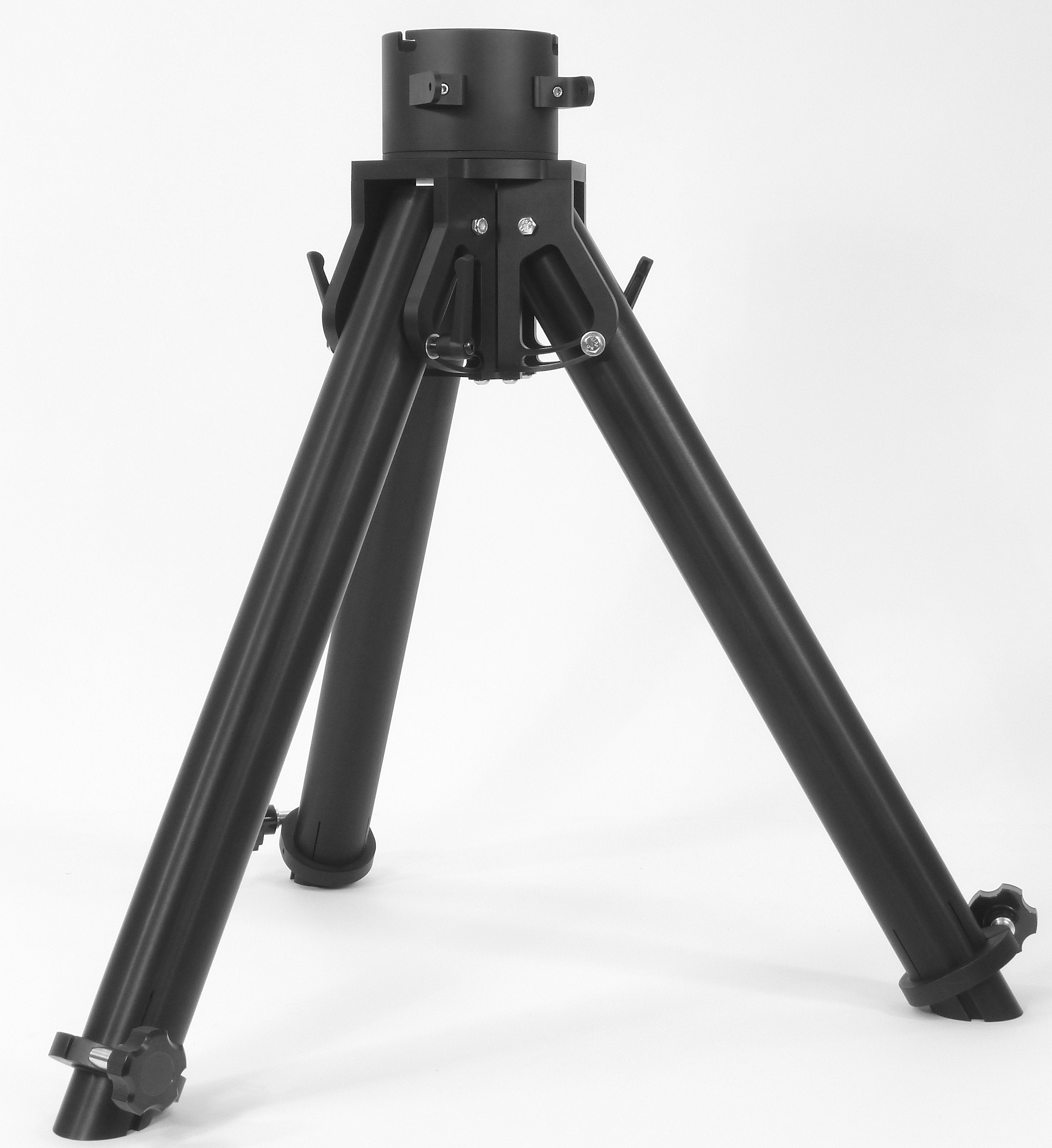

- Description
- Specifications
Product Overview
This is Losmandy's folding heavy-duty tripod supplied with the MA top already fitted, ready for a GM 8, GM811 or G-11 mount. Adjustable legs give a height range of 33 to 52 inches, it folds to 14 by 14 by 39 inches, and Losmandy rates it to carry up to 425 lb at a tripod weight of 35 lb. The electronics bracket is not included unless the tripod is bought with a mount head or a Gemini 2 unit.
Who It's For
This is the tripod to buy if the mount is staying put and the instrument is substantial. A 425 lb rating is far beyond what any Losmandy head will carry, which is the point — the tripod stops being part of the error budget. At 35 lb it moves in one piece between a garage and a pad, and folded at 14 by 14 by 39 inches it fits a car boot, but it is not a tripod you walk to a dark site with. That is the LW's job.
Key Features & Design
- MA top fitted, machined to take GM 8, GM811 and G-11 mounts.
- Carries up to 425 lb at a tripod weight of 35 lb.
- Adjustable legs, 33 to 52 inches from ground level to the top of the tripod.
- 34 inches tip to tip with the legs retracted, 53 inches extended.
- Folds to 14 by 14 by 39 inches with the legs retracted.
- 29 inches between leg centres when retracted but spread — a wider footprint than the LW's 25.
- MA top doubles as a pier adapter, so the same interface works on a permanent pier.
Recommended Uses
Long-exposure imaging with a heavy refractor, astrograph or SCT on a G-11, GM811 or GM 8 head. Visual observing with a large instrument at up to the 52-inch height. Semi-permanent backyard setups where the tripod lives in place. A stable base for a mount that will later move to a pier, since the MA interface carries over.
Compatibility and Accessory Notes
- Mounts: the MA top fits GM 8, GM811 and G11G heads. It is the tripod supplied with the G11G and GM811G with HD tripod packages.
- For a G11T or Titan, the larger MAL top is the one you need — see the MAL-topped version.
- Electronics bracket: Losmandy notes it is not supplied unless the tripod is bought with a mount head or a Gemini 2 unit. Ask us and we will confirm what your order includes.
- Height: the 4-inch, 8-inch and 12-inch extensions raise the MA top further, which helps a long refractor clear the legs.
- Vibration: glow-in-the-dark vibration pads fit the adjustable legs — 5 inches across for contact area, and they glow for up to 15 hours.
- Transport: the wheeled tripod case is made for it.
- Hardware: the tripod knob set attaches a GM 8 or G-11 head without tools, and tripod screws are available as spares.
Good to Know Before You Order
- 35 lb. This is a tripod you site and leave, or move in one deliberate trip. The LW tripod at 15 lb is the travelling option.
- The MA top is for GM 8, GM811 and G-11 heads. A G11T or Titan needs the MAL, which is a 7-inch adapter against the MA's 6.
- The electronics bracket comes with the mount, not the tripod — worth checking against your order if you are buying the tripod on its own.
- The 425 lb rating is the tripod's, not the mount's. Your instrument capacity is set by the equatorial head; the tripod simply stops being the limiting factor.
- Specifications are Losmandy's published figures.
Frequently Asked Questions
Is it difficult to set up?
No. The legs slide onto the centre column and lock with the leg clamps, and the mount drops onto the MA top and bolts down — the tripod knob set does that without tools.
Which mounts does the MA top take?
GM 8, GM811 and G11G heads. For a G11T or Titan you want the MAL-topped tripod.
How does it compare with the LW tripod?
35 lb against 15, a 425 lb rating against 80–100 lb for imaging, and a 29-inch footprint against 25. The HD is the stiffer, heavier base; the LW is the one that travels.
Can I use it on a pier later?
The MA adapter itself is made for both tripod and pier use, so the mount interface carries over.
How tall does it stand?
33 to 52 inches from the ground to the top of the tripod, before the mount or any extension tube.
Bottom Line
In short: Losmandy's 35 lb folding HD tripod with the MA top fitted, 33 to 52 inches, rated to 425 lb — the base for a GM 8, GM811 or G-11 that you want out of the error budget.
| Model | Losmandy folding heavy-duty tripod with MA top |
|---|---|
| Type | Folding tripod with adjustable legs, MA adapter fitted |
| Weight | 35 lb |
| Load rating | Carries up to 425 lb |
| Height range | 33" to 52", ground level to top of tripod |
| Tip to tip, legs retracted | 34" |
| Tip to tip, legs extended | 53" |
| Folded dimensions | 14" x 14" x 39" with legs retracted |
| Leg spread | 29" between leg centres when retracted but spread |
| Top adapter | MA, 6.0" diameter x 4.0" high, machined for GM 8, GM811 and G-11 mounts |
| Electronics bracket | Not included unless purchased with a mount head or Gemini 2 unit |
| Case | Wheeled HD tripod case available separately |
| Source | Losmandy folding HD tripod and MA adapter product data |
You may also like
Recently viewed
Recent Blog Posts
View all
Your Guide Graph Is Lying to You
Read More

D-Size vs V-Size: A Complete Guide to Telescope Dovetail Systems
Read More

What Is Back Focus in Astrophotography? Telescope Reducers, Flatteners, and Spacing Explained
Read More