


- Description
- Specifications
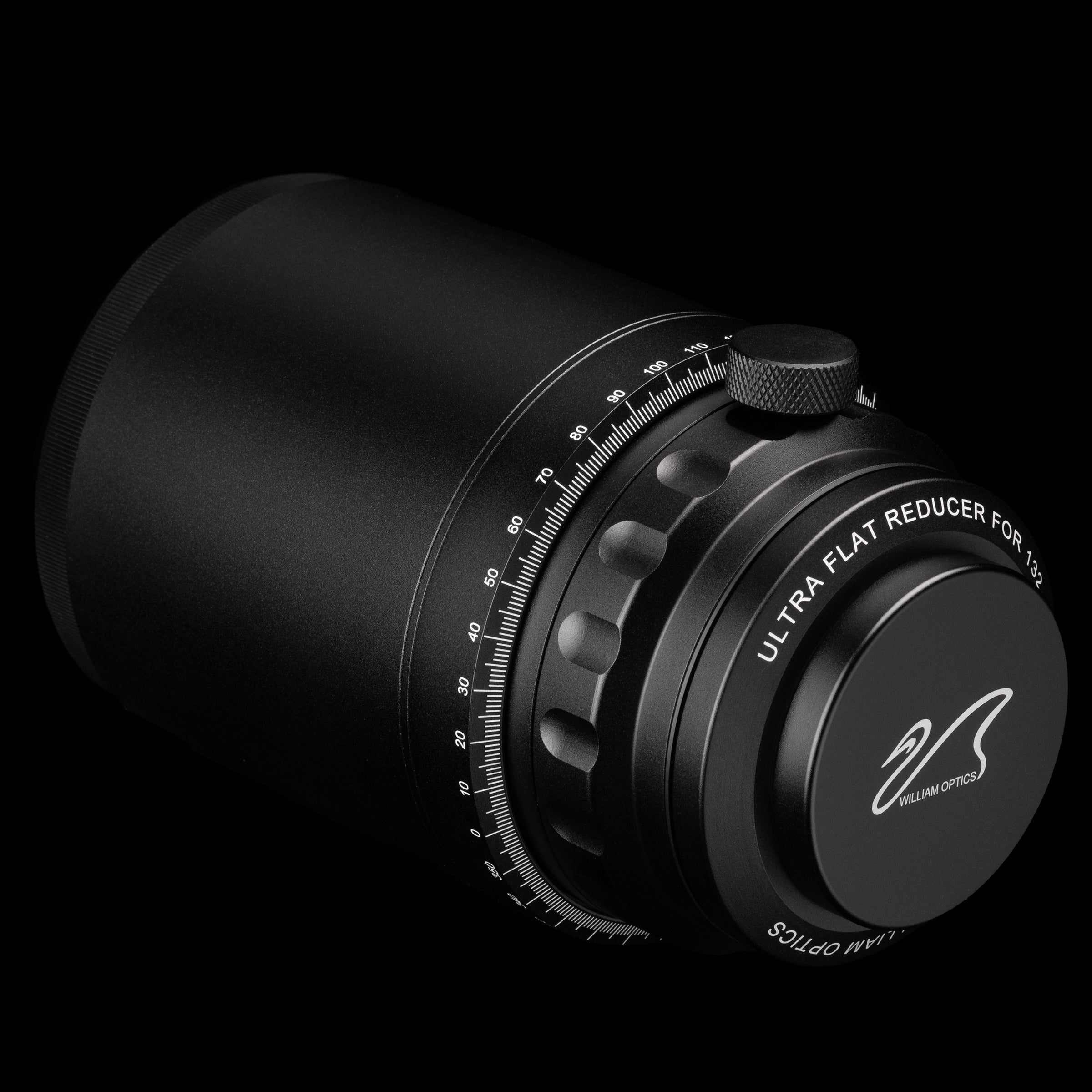
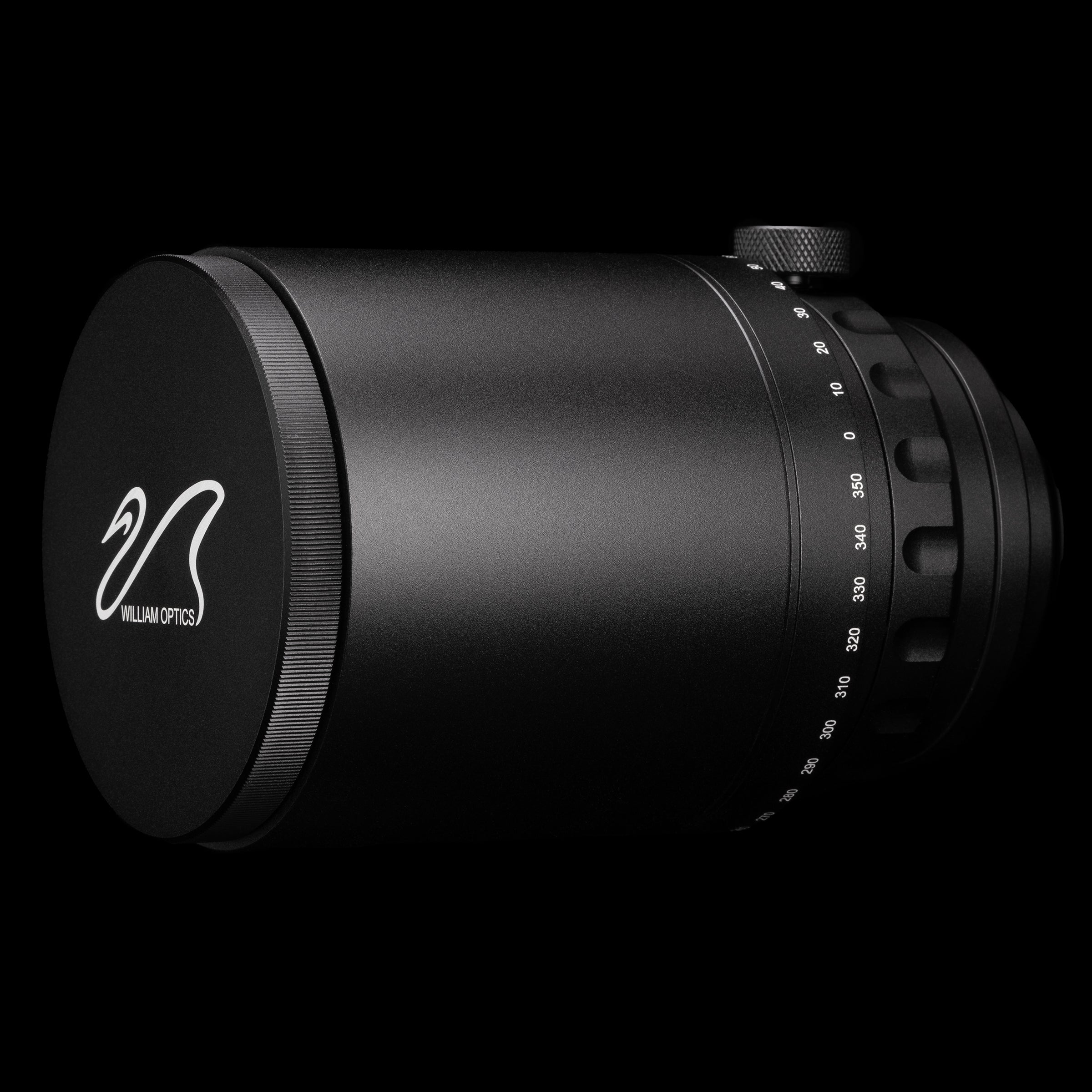
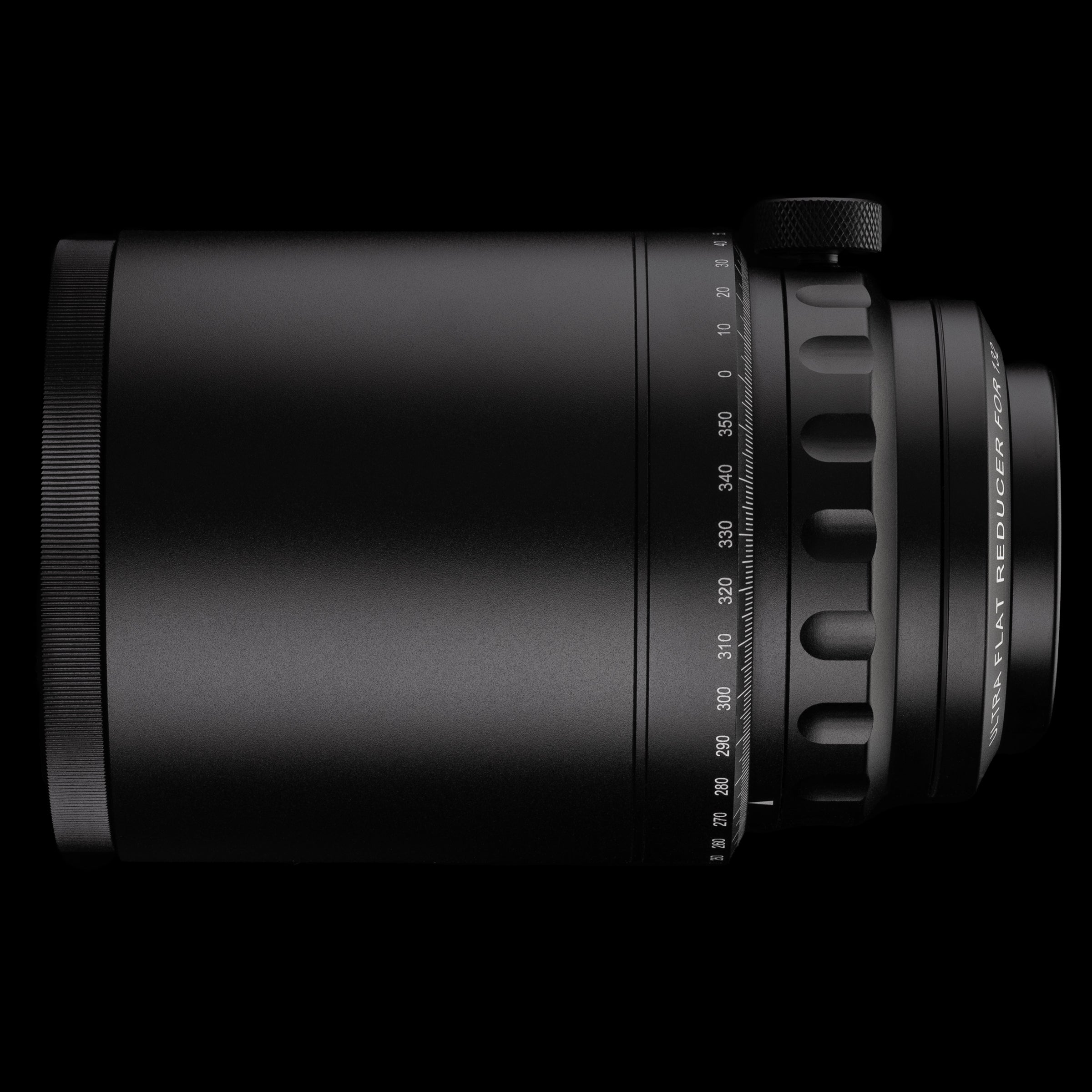
The William Optics Ultra Flat 132 is a 0.79x reducer-flattener built as the matched corrector for the William Optics Fluorostar 132. It is a three-element, three-group design with a 137.5 mm optical length, an M92 x 1 telescope-side thread, and an M54 x 0.75 camera-side thread. On the Fluorostar 132 it delivers a corrected image circle of 43.2 mm at 55 mm of backfocus, and it weighs 1096 g.
Who It's For
This is a good match if you already own — or are ordering — a Fluorostar 132 and intend to image with it. It is the corrector that pairs with that telescope, so the decision is less about choosing between flatteners and more about whether you want the 0.79x reduced configuration rather than the native focal length.
It suits a deep-sky imaging rig running a full-frame or APS-C camera. Setting it up is refreshingly direct: the supplied PVC gasket sets the 55 mm spacing on the Fluorostar 132, so there is no adjustment ring to dial in and no trial-and-error before your first session.
Key Features & Design
- 0.79x reduction: multiplies the native focal length and focal ratio of the Fluorostar 132 by 0.79. Because focal ratio scales linearly and light-gathering per unit area scales with its square, the reduced configuration collects roughly 1.6x more light per unit time (1 / 0.79²) than the native configuration.
- 3 groups, 3 elements: a three-element corrector group, each element air-spaced as its own group.
- 137.5 mm optical length: the corrector's own contribution to the imaging train, before your camera spacing. This is a long assembly — nearly twice the optical length of the Ultra Flat 156 — so account for it when planning the train.
- M92 x 1 x 6.5 mm telescope thread: threads directly to the Fluorostar 132 focuser drawtube — no push-fit, no adapter.
- M54 x 0.75 x 4 mm camera thread: the camera-side interface from which 55 mm of backfocus is measured.
- 43.2 mm corrected image circle: on the Fluorostar 132, covering a full-frame sensor (43.3 mm diagonal).
- 1096 g: plan your focuser load and any rotator or filter wheel accordingly.
Optical / Mechanical Design
A reducer-flattener does two jobs at once. Fast refractors of this aperture project a field that is curved rather than flat — stars that focus sharply at the centre fall progressively out of focus toward the edges, because the natural focal surface is a shallow bowl rather than a plane, and your sensor is a plane. The corrector group flattens that surface onto the sensor. The 0.79x element compresses the image scale at the same time, shortening the effective focal length and lowering the focal ratio, which shortens the exposure needed for a given signal.
The three-element, three-group construction is what allows both corrections to be made without reintroducing colour error at the edges. The consequence is that spacing tolerance drives corner star quality: the design is computed for one specific separation between the M54 thread and your sensor. Under-space it and corner stars elongate radially; over-space it and they elongate tangentially. The centre of the frame looks fine either way, which is why the corners are the place to check your work — and why the supplied gasket, which sets the spacing for you on the Fluorostar 132, is worth using as directed.
Recommended Uses
- Deep-sky astrophotography with a Fluorostar 132 in its reduced 0.79x configuration
- Full-frame and APS-C cooled camera imaging where a flat field to the corners is required
- Wider framing than the Fluorostar 132 delivers natively — larger nebulae, extended galaxy fields
- Shorter sub-exposures at the same signal level, useful under mediocre guiding or shorter imaging windows
Compatibility and Accessory Notes
William Optics publishes this corrector as the match for the Fluorostar 132. On the Fluorostar 132 it requires 55 mm of backfocus and needs no adjustment — set the spacing with the supplied PVC gasket as directed. Backfocus is measured from the M54 x 0.75 camera-side thread to your sensor plane, and the total must account for every component in the train: filter drawer or filter wheel, off-axis guider, rotator, and the camera's own sensor-to-flange distance.

The telescope side is M92 x 1, threading straight to the Fluorostar 132. The camera side is M54 x 0.75; most cooled astronomy cameras present an M48 or T2 interface, so confirm what your specific camera and filter hardware need to reach M54 and budget that adapter's optical length within the 55 mm figure — not on top of it. If you are not sure what your train adds up to, send us your camera and filter setup and we will work it out with you.
William Optics also publishes a back focus adjustment guide for the Ultra Flat series. If you are matching a different William Optics telescope, contact us before ordering — the Fluorostar 156 uses the Ultra Flat 156, and the Fluorostar 132 is also listed as compatible with the FLAT 68III, FLAT 7A, and FLAT 8 correctors at their own respective reduction factors.
Good to Know Before You Order
- Imaging accessory: this is an optical corrector for astrophotography. It has no application in a visual train with an eyepiece.
- Matched to the Fluorostar 132: the 43.2 mm image circle and 55 mm backfocus are the figures William Optics publishes for that telescope. Other William Optics refractors pair with their own correctors — if you are matching a different model, get in touch and we will confirm the right one.
- Spacing matters: corner star shape depends on hitting the 55 mm backfocus. On the Fluorostar 132 the supplied PVC gasket sets it, with no further adjustment needed.
- Camera-side adapter: the corrector presents M54 x 0.75, while most cooled cameras and filter wheels use M48 or T2. An adapter is usually needed and is sold separately — its optical length counts toward the 55 mm, not on top of it. We can help you identify the right one for your camera.
- Sensor coverage: the 43.2 mm corrected circle on the Fluorostar 132 covers a full-frame sensor (43.3 mm diagonal). William Optics lists this corrector for APS-C and full frame.
- Optical length: at 137.5 mm this is a long corrector — worth checking against your focuser travel and any dew shield or clearance constraints.
Frequently Asked Questions
What telescope does this work with?
William Optics lists it as the matched corrector for the Fluorostar 132, with a 43.2 mm image circle at 55 mm backfocus and no adjustment required.
Is it difficult to set up?
No. On the Fluorostar 132 it threads straight to the M92 drawtube and the supplied PVC gasket sets the 55 mm spacing for you — there is no adjustment ring to dial in and no trial-and-error. The main thing to get right is the total distance from the M54 thread to your sensor, and we are happy to check that with you before you order.
Can I use it for visual observing?
No. It is a reducer-flattener for imaging. It has no place in a visual train.
What backfocus do I need?
55 mm, measured from the M54 x 0.75 camera-side thread to your sensor plane. Use the supplied PVC gasket as directed; the Fluorostar 132 pairing requires no further adjustment.
Will it cover a full-frame sensor?
Yes. The published corrected image circle on the Fluorostar 132 is 43.2 mm, and a full-frame sensor has a 43.3 mm diagonal — so the corrected field is sized to full frame. William Optics lists the camera format as APS-C and full frame.
What is the difference between this and the Ultra Flat 156?
Both are 0.79x correctors, but they are computed for different telescopes: the Ultra Flat 132 is matched to the Fluorostar 132 and the Ultra Flat 156 to the Fluorostar 156. They also differ mechanically — 137.5 mm optical length here versus 75.5 mm on the 156. They are not interchangeable.
Do I need any additional adapters?
Very likely on the camera side. The corrector presents M54 x 0.75; most cooled cameras and filter wheels use M48 or T2. Any adapter you add consumes part of the 55 mm backfocus budget. Tell us what camera you are running and we will point you to the right adapter.
Does it change my focal length?
Yes — it multiplies the native focal length and focal ratio of the Fluorostar 132 by 0.79, which widens the field and shortens the exposure needed for a given signal.
Bottom Line
In short: the matched 0.79x reducer-flattener for the Fluorostar 132. It threads on at M92, presents M54 to your camera, needs 55 mm of backfocus with the supplied gasket, and delivers a flat 43.2 mm field sized to a full-frame sensor. Spacing is the one figure worth measuring carefully — the corners are where it shows.
Optical Diagram Reports
William Optics publishes measured diagram reports for the Ultra Flat 132 on the Fluorostar 132. These show the corrected performance across the field rather than a marketing claim about it.


| Product type | Reducer-flattener (optical corrector) |
|---|---|
| Flattener power | 0.79x |
| Lens type | 3 groups, 3 elements |
| Optical length | 137.5 mm |
| Telescope thread | M92 x 1 x 6.5 mm |
| T-mount (camera) thread | M54 x 0.75 x 4 mm |
| Camera format | APS-C / Full Frame |
| Matched telescope | Fluorostar 132 |
| Back focus (Fluorostar 132) | 55 mm |
| Adjustment (Fluorostar 132) | No adjustment required — use the supplied PVC gasket accordingly |
| Image circle (Fluorostar 132) | 43.2 mm |
| Weight | 1096 g |
| Recommended use | Deep-sky astrophotography — imaging only, not for visual observing |
You may also like
Recently viewed
Recent Blog Posts
View all
Your Guide Graph Is Lying to You
Read More

D-Size vs V-Size: A Complete Guide to Telescope Dovetail Systems
Read More

What Is Back Focus in Astrophotography? Telescope Reducers, Flatteners, and Spacing Explained
Read More