
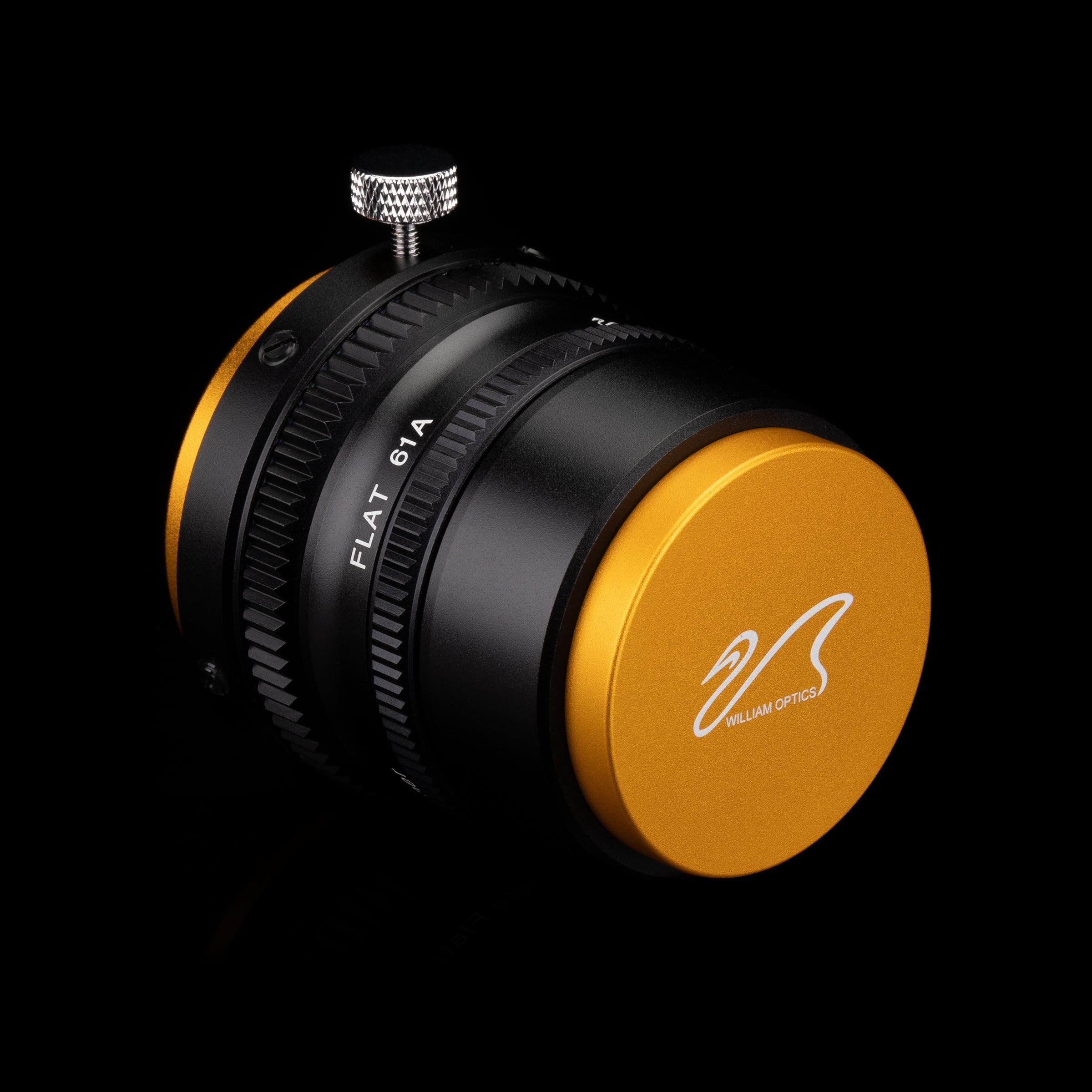

- Description
- Specifications
The William Optics FLAT 61A is a 1.0x field flattener designed to improve edge-to-edge star sharpness when imaging with compatible William Optics refractors, especially the Zenithstar 61. It helps correct field curvature so astrophotographers can capture cleaner stars across APS-C and full-frame camera sensors.
Who Is This Product Best For?
The FLAT 61A is best for astrophotographers using a Zenithstar 61 or compatible small William Optics refractor who want a flatter imaging field for deep-sky photography.
Why Choose This Product?
- 1.0x correction: Flattens the field without reducing focal length.
- APS-C and full-frame support: Designed for common astronomy and DSLR/mirrorless camera setups.
- Camera adapter support: Uses an M48 camera-side thread and supports common T-mount ecosystems.
Recommended Uses
- Wide-field deep-sky astrophotography
- Improving star shape at the edge of the frame
- Zenithstar 61 imaging setups
Compatibility and Accessory Notes
Use the recommended back focus spacing for your telescope and camera. Customers should confirm camera adapter, T-ring, and spacing requirements before imaging.
Important Limitations
This is an imaging accessory, not a visual observing accessory. Correct spacing is required for best results.
Frequently Asked Questions
Does the FLAT 61A reduce focal length?
No. It is a 1.0x field flattener.
Which telescope is it mainly for?
It is primarily intended for Zenithstar 61 imaging systems.
Our Recommendation
Choose the FLAT 61A if you image with a Zenithstar 61 and want cleaner corner stars without changing the telescope’s focal length.
| Product Type | Field flattener |
|---|---|
| Reduction Factor | 1.0x |
| Primary Compatibility | Zenithstar 61 and compatible William Optics refractors |
| Primary Use | Astrophotography field correction |
| Important Note | Correct backfocus spacing is required for best results |
You may also like
Recently viewed
Recent Blog Posts
View all
Your Guide Graph Is Lying to You
Read More

D-Size vs V-Size: A Complete Guide to Telescope Dovetail Systems
Read More

What Is Back Focus in Astrophotography? Telescope Reducers, Flatteners, and Spacing Explained
Read More