
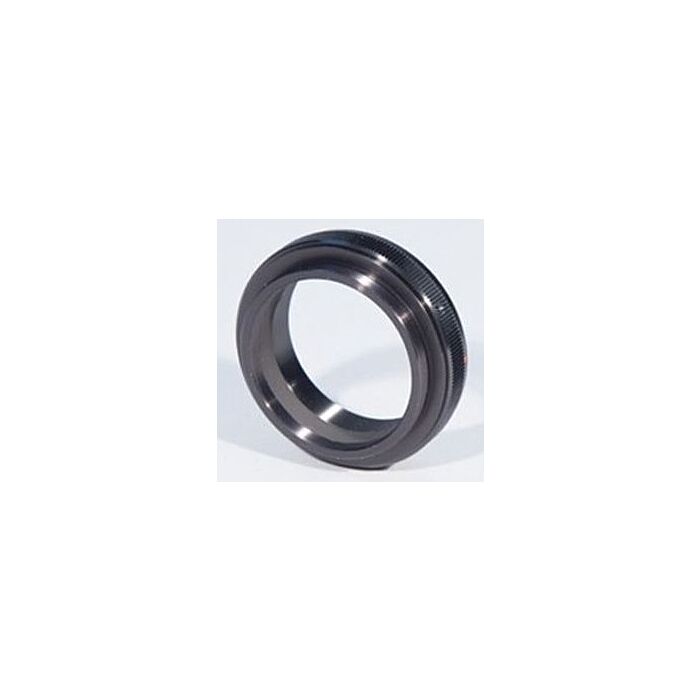

- Description
- Specifications
- Downloads
Product Overview
Takahashi's Wide T-Mount DX-WR for Nikon, part TKA01255, is the camera-side ring that mounts a Nikon F-mount body onto a Takahashi telescope's wide-mount system. Takahashi lists its telescope-side thread as M54 x 0.75 male, and the camera side bayonets straight onto an F mount — mirrorless Nikon bodies need an F-to-mirrorless adapter in addition.
It sits at the very back of the imaging train, the last ring before the camera itself.
Who It's For
This is a good match if you shoot with a Nikon F-mount body and are building or completing a Takahashi wide-mount imaging train — the DX-WR wide ring, your Nikon body, and this T-ring connecting the two.
Takahashi builds the DX-WR to two different taper diameters, 49 mm for Nikon and 52 mm for Canon, and the rings aren't interchangeable between mounts — Canon shooters need the separate Canon EOS version.
Key Features & Design
- M54 x 0.75 male telescope-side thread: threads onto Takahashi's wide-mount ring system.
- Nikon F-mount camera side: bayonets directly onto a Nikon F-mount body.
- Wide taper design: Takahashi's DX-WR series uses a wider taper than the standard T-mount DX-S, aimed at reducing play with heavier bodies.
Recommended Uses
- Prime-focus imaging with a Nikon body through a Takahashi telescope's wide-mount system.
- Completing a DX-WR imaging train alongside the matching wide ring.
Compatibility and Accessory Notes
- Nikon F mount only. It isn't compatible with the Canon EOS version of this ring — the two use different taper diameters.
- Threads onto Takahashi's M54 x 0.75 wide-mount ring, not directly onto a telescope's drawtube.
- Backfocus contribution: as the last part before the camera body, its contribution to total backfocus is normally worked out from your camera's own flange distance instead — send us your telescope and camera body and we'll work out the full spacing with you, alongside our Takahashi Back Focus Guide.
Good to Know Before You Order
- It needs the matching DX-WR wide ring ahead of it to complete the train — this ring alone doesn't attach to a telescope. Tell us what you already have and we'll confirm the parts list.
- Mirrorless Nikon bodies — a Z-series body, for instance — need a Nikon F-to-Z adapter alongside this ring, since it's built for the F-mount bayonet.
Frequently Asked Questions
Is it difficult to set up?
No — it threads onto the wide ring and the camera bayonets on the way any T-ring mounts.
Does it fit Canon cameras?
No. Canon EOS bodies need the separate Canon DX-WR ring, built to a different taper.
Does it come with the wide ring itself?
No — this is the camera-side T-ring only. The wide ring is a separate part.
Does it add optical path length?
Its contribution to backfocus comes from your camera's flange distance rather than the ring itself — send us your imaging train and we'll confirm the full spacing.
Bottom Line
In short: Takahashi's Nikon F-mount T-ring for the DX-WR wide-mount system — M54 x 0.75 to the wide ring, F-mount bayonet to the camera. It's what connects a Nikon body to a Takahashi wide-mount imaging train.
| Type | Mechanical camera T-ring — no optical element |
|---|---|
| Takahashi designation | Wide T-Mount DX-WR for Nikon |
| Telescope-side interface | M54 x 0.75 male |
| Camera-side interface | Nikon F mount |
| In the box | Takahashi Wide Mount T-Ring for Nikon (DX-WR) |
Shopping Guide
- Takahashi English Catalog 2025 — PDF, 8.63 MB
System Charts, Diagrams and Adapter Guides
- Takahashi Telescope Backfocus Table — PDF, 71 kB
You may also like
Recently viewed
Recent Blog Posts
View all
Your Guide Graph Is Lying to You
Read More

D-Size vs V-Size: A Complete Guide to Telescope Dovetail Systems
Read More
What Is Back Focus in Astrophotography? Telescope Reducers, Flatteners, and Spacing Explained
Read More