
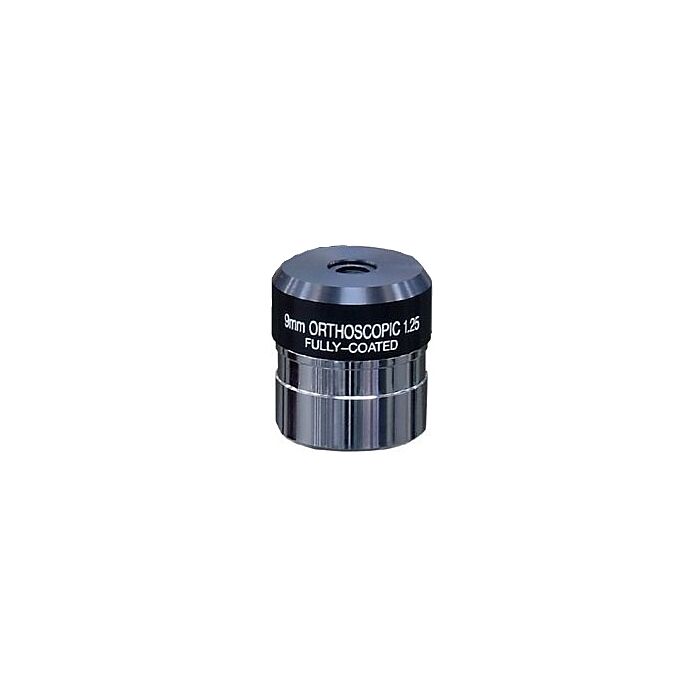

- Description
- Specifications
- Downloads
Product Overview
The Starbase OR-9mm is a 9mm orthoscopic eyepiece from Takahashi's Starbase accessory line, built on the series' 4-elements-in-2-groups design for low center-field distortion. It has a 45° apparent field of view, 7mm of eye relief, weighs 52g, and Takahashi lists an overall body size of 33mm x 35mm (diameter x length) for this model — one of the shorter, higher-power focal lengths in the Starbase orthoscopic range.
Who It's For
This is a good match if you want a high-power eyepiece for planetary detail, lunar close-ups, or splitting tighter double stars, on nights when the seeing supports it.
Key Features & Design
- Orthoscopic 4-element, 2-group design: low distortion at the center of the field, where high-power planetary detail lives.
- 45° apparent field of view: steady framing even at high power.
- 7mm eye relief: workable without glasses; tighter for eyeglass wearers.
- 52g weight: negligible load on the focuser.
Optical / Mechanical Design
At short focal lengths, the correction an orthoscopic design holds at the center of the field matters more, not less — that's exactly where high-power planetary and lunar detail is formed. The 9mm OR keeps the same four-element, two-group layout as the rest of the Starbase orthoscopic series, scaled down for the shorter focal length and correspondingly higher magnification.
Recommended Uses
On a Takahashi TSA-120 (900mm, f/7.5) the OR-9mm gives about 100x, a solid all-around planetary magnification. On a Takahashi FS-60CB (355mm, f/5.9) the same eyepiece yields roughly 39x, useful for brighter deep-sky objects at moderate power on a smaller travel scope. Divide any Takahashi tube's focal length by 9mm for the magnification on your own setup.
Good to Know Before You Order
Not parfocal with the rest of the range: expect to refocus when you swap eyepieces.
7mm eye relief is tighter than the longer Starbase focal lengths: workable bare-eyed; eyeglass wearers may find it easier to observe without glasses and adjust focus for their own correction instead.
Frequently Asked Questions
Is it difficult to set up?
No — it threads directly into a standard 1.25” focuser or diagonal.
What is it best used for?
High-power visual observing — planetary detail, lunar close-ups, and tighter double stars.
How does it compare to the OR-6mm?
Same 4-element orthoscopic design and barrel convention; the OR-9mm's slightly longer focal length gives a somewhat lower magnification and more forgiving eye relief.
What telescopes does it fit?
Any Takahashi refractor or reflector with a standard 1.25” focuser or diagonal.
Bottom Line
A 9mm orthoscopic eyepiece with a 45° field, 7mm eye relief, and a 52g weight — a high-power option for planetary and lunar detail. If you're building a full eyepiece set and want help matching focal lengths to your telescope, send us your setup and we'll work it out with you.
| Optical design | Orthoscopic, 4 elements / 2 groups |
|---|---|
| Focal length | 9mm |
| Apparent field of view | 45° |
| Eye relief | 7mm |
| Size (Φ x L) | 33mm x 35mm |
| Weight | 52g |
Shopping Guide
- Takahashi English Catalog 2025 — PDF, 8.63 MB
You may also like
Recently viewed
Recent Blog Posts
View all
Your Guide Graph Is Lying to You
Read More
D-Size vs V-Size: A Complete Guide to Telescope Dovetail Systems
Read More
What Is Back Focus in Astrophotography? Telescope Reducers, Flatteners, and Spacing Explained
Read More