
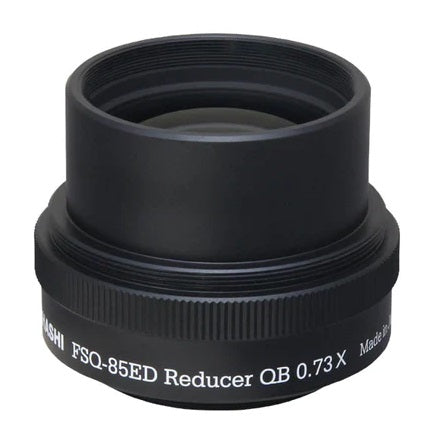

- Description
- Specifications
- Downloads
Product Overview
The RD-QB 0.73x is the current-generation reducer for the FSQ-85EDX, Takahashi's BabyQ Petzval astrograph. Built with four elements in two groups using a newer, highly refractive low-dispersion ED glass, it brings the native 450mm f/5.3 down to 330mm f/3.9 while holding a 44mm image circle that covers full-frame sensors.
Who It's For
This is a good match if you own the FSQ-85EDX and want the widest, fastest field it can deliver — large nebula complexes, Milky Way fields, and wide star clusters on a full-frame sensor.
Key Features & Design
- 0.73x reduction: 450mm f/5.3 becomes 330mm f/3.9 on the FSQ-85EDX.
- 44mm image circle: covers full-frame digital sensors with the corrected field.
- New ED glass formula: four elements in two groups, an updated design over the earlier QE0.73x reducer with improved field curvature performance.
- M72 x 1 input, M56 x 0.75 output threads, with an internal 58mm filter thread, in a compact 78 x 63mm, 520 g housing.
Optical / Mechanical Design
The FSQ-85EDX's four-element Petzval design is already corrected for a wide native field; the RD-QB 0.73x uses the newer low-dispersion ED formula to speed that field up to f/3.9 while holding the 44mm image circle needed for full-frame coverage. Takahashi positions it as the direct successor to the earlier QE0.73x reducer, with better field curvature control at the same reduction factor.
Recommended Uses
Wide-field, full-frame deep-sky imaging on the FSQ-85EDX — large nebula complexes, star clusters, and Milky Way fields where a fast, wide, flat field matters more than reach.
Compatibility and Accessory Notes
Takahashi publishes this reducer for the FSQ-85EDX.
| Telescope | Native | With RD QB0.73x | Image circle | Back focus |
|---|---|---|---|---|
| FSQ-85EDX | 450mm f/5.3 | 330mm f/3.9 | Φ44mm | 72.2mm |
An internal 58mm filter thread accepts common filter sizes without a separate holder. For spacing this reducer against your camera and filter wheel, see the Takahashi Back Focus Guide.
Good to Know Before You Order
Supersedes the earlier QE0.73x reducer: if you are matching this against an older FSQ-85EDX system chart that references the QE0.73x, the resulting focal length and ratio are the same but the internal glass and field curvature performance differ.
Built for imaging, not eyepiece use: the reduced, flattened field has no benefit for visual observing.
Frequently Asked Questions
Is it difficult to set up?
No — it threads onto the FSQ-85EDX's M72 x 1 drawtube and presents an M56 x 0.75 output with a fixed 72.2mm back focus.
What is it best used for?
Wide-field, full-frame deep-sky imaging on the FSQ-85EDX.
Does it accept filters?
Yes — a 58mm internal filter thread is built into the unit.
Is this the same as the older QE0.73x reducer?
It reduces to the same 330mm f/3.9, but uses a newer ED glass formula with better field curvature control — send us your current setup if you are upgrading and we will confirm compatibility.
Bottom Line
The RD-QB 0.73x brings the FSQ-85EDX to a wide, fast 330mm f/3.9 with a full-frame-covering 44mm image circle and a fixed 72.2mm back focus, at 520 g.
| Type | Focal reducer, 4 lenses in 2 groups (RD QB0.73x) |
|---|---|
| For telescope | FSQ-85EDX (450mm f/5.3 native) |
| Resulting focal length | 330mm |
| Resulting f-ratio | f/3.9 |
| Image circle | Φ44mm |
| Back focus | 72.2mm |
| Input interface | M72 x 1, male |
| Output interface | M56 x 0.75, male |
| Internal filter thread | 58mm |
| Dimensions | 78mm x 63mm |
| Weight | 520g |
| Part number | TKA37580 |
Shopping Guide
- Takahashi English Catalog 2025 — PDF, 8.63 MB
- Takahashi Telescope Backfocus Table — PDF, 71 kB
You may also like
Recently viewed
Recent Blog Posts
View all
Your Guide Graph Is Lying to You
Read More
D-Size vs V-Size: A Complete Guide to Telescope Dovetail Systems
Read More
What Is Back Focus in Astrophotography? Telescope Reducers, Flatteners, and Spacing Explained
Read More