
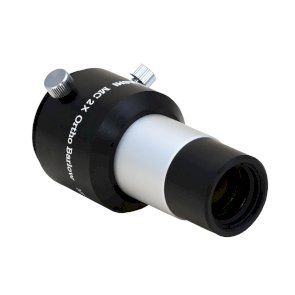
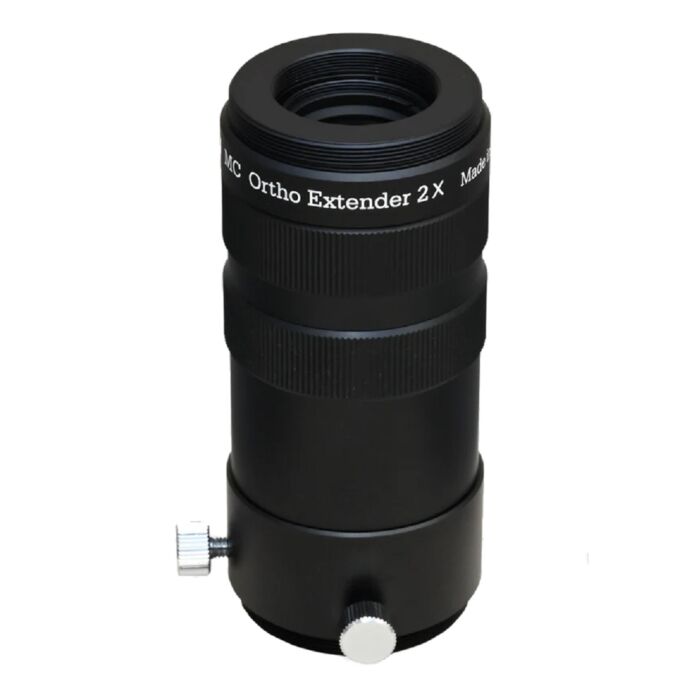


- Description
- Specifications
- Downloads
Product Overview
The Ortho Extender 2x is Takahashi's 2x Ortho Barlow: a 130 g, 46 mm x 91 mm barlow lens with a 31.7 mm (1.25") input barrel, designed to double focal length without adding aberration to an already well-corrected telescope. Unlike a fixed 2x Barlow, its actual magnification is a function of back focus — published by Takahashi as M = 2 + 0.0121 × b, where b is the distance in mm behind the Barlow. At zero back focus it is exactly 2.00x; add distance behind it, as a diagonal or T-mount train does, and the figure climbs from there.
Who It's For
This is what you need if you observe or image the moon, planets or double stars and want to reach beyond your eyepiece set's shortest focal length — or add reach for a small-sensor camera — without introducing the aberration a lower-quality Barlow adds.
Optical / Mechanical Design
The magnification formula is the part worth understanding before you buy. Takahashi publishes three reference points: at 0 mm of back focus — an eyepiece inserted directly — magnification is exactly 2.00x. Behind a T-mount train (roughly 50 mm of back focus), it works out to about 2.61x. Behind a prism star diagonal, at 63.5 mm of back focus, it reaches 2.77x. The lens design — two elements in one group — is built to hold correction across that whole range rather than being optimized for one fixed spacing, and for visual use it is parfocal: swapping eyepieces at a given back focus does not require refocusing. On the camera side, the barrel is a 31.7 mm female sleeve with an M42 x 0.75 male T-thread built in, so it accepts a T-mount directly as well as a standard 1.25" eyepiece or camera nosepiece.
Recommended Uses
- High-power lunar and planetary observation with your existing 1.25" eyepieces, at roughly 2x their marked magnification.
- Small-sensor planetary and lunar imaging through the T-thread, where the extra reach concentrates detail on a small chip.
- Double star splitting at the higher power the 2x factor provides.
Compatibility and Accessory Notes
The barrel accepts standard 31.7 mm (1.25") accessories on the input side. On the output side, the built-in M42 x 0.75 thread takes a T-mount directly, or a 1.25" eyepiece for direct visual use. Because the actual magnification depends on what sits behind the Barlow — a diagonal, a T-mount adapter, or nothing at all — the figure to check is your own back focus, not a single quoted number. If you want your exact magnification worked out for your eyepiece, diagonal or camera train, send us the details and we will calculate it with you.
Good to Know Before You Order
- Magnification is not a single fixed number. It runs from 2.00x at zero back focus up to 2.77x behind a prism diagonal, per Takahashi's published formula. Check where your accessory sits in that range before assuming a flat 2x.
Frequently Asked Questions
Is it difficult to set up?
No — it drops into the eyepiece holder or camera train like any 1.25" accessory, with no adjustment needed.
Why isn't the magnification always exactly 2x?
Because a Barlow's power depends on how far behind it the image forms. Takahashi publishes the relationship as M = 2 + 0.0121 × b: 2.00x with an eyepiece inserted directly, climbing to 2.77x with 63.5 mm of back focus behind a prism diagonal.
Does it work for imaging as well as visual use?
Yes — the built-in M42 x 0.75 T-thread takes a camera directly, and the parfocal design means eyepiece and camera views stay in focus together at a given spacing.
What's it best used for?
Lunar and planetary work — visual or imaged — where extra reach on your existing eyepieces or a small sensor is the goal.
Bottom Line
In short: a 130 g, parfocal 2x Barlow whose real magnification runs from 2.00x to 2.77x depending on what's behind it — tell us your eyepiece or camera train and we'll work out your number.

| Type | 2x Ortho Barlow |
|---|---|
| Optical design | 2 lenses in 1 group |
| Nominal magnification | 2.00x at 0 mm back focus |
| Magnification formula | M = 2 + 0.0121 × b (b = back focus in mm) |
| Magnification examples | 2.00x direct eyepiece (b=0mm) / 2.61x T-mount photography (b=50mm) / 2.77x behind prism diagonal (b=63.5mm) |
| Size (Φ x L) | 46 mm x 91 mm |
| Weight | 130 g |
| Input | 31.7 mm (1.25") male barrel |
| Output | 31.7 mm (1.25") female barrel + M42 x 0.75 male T-thread |
| Focus behaviour | Parfocal — no refocus when swapping eyepieces at a given back focus |
Shopping Guide
- Takahashi English Catalog 2025 — PDF, 8.63 MB
System Charts, Diagrams and Adapter Guides
- 2x Ortho Barlow Magnification Chart — JPG
- Takahashi Telescope Backfocus Table — PDF, 71 kB
You may also like
Recently viewed
Recent Blog Posts
View all
Your Guide Graph Is Lying to You
Read More

D-Size vs V-Size: A Complete Guide to Telescope Dovetail Systems
Read More

What Is Back Focus in Astrophotography? Telescope Reducers, Flatteners, and Spacing Explained
Read More