


- Description
- Specifications
- Downloads
Product Overview
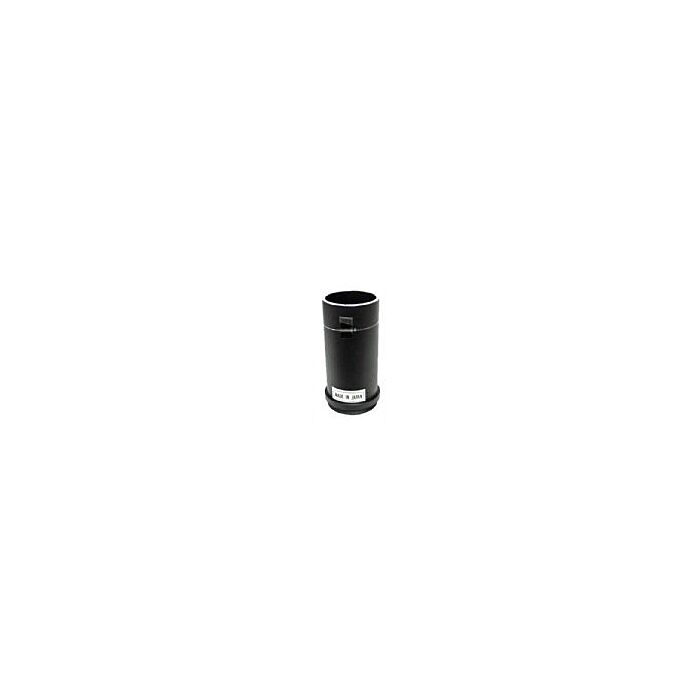
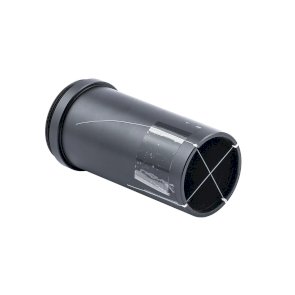
The Newtonian Collimating Tube with Crosshair is a machined alignment tool built for centering the secondary mirror on Takahashi's Epsilon-series Newtonian astrographs. A wire crosshair is stretched across the objective end of the tube, giving you a fixed reference point to center against the reflection of the primary mirror. It threads via M36.4 x 1 to the Collimating Eyepiece (TKA00441, sold separately), and together the two function as a Cheshire eyepiece. At 39.5 mm in diameter, 80 mm long and 50 g, it fits in a case with the rest of your collimation kit.
Who It's For
This is a good match if you run a Takahashi Epsilon astrograph and check secondary mirror centering as part of your regular collimation routine.
Key Features & Design
- Fixed wire crosshair: stretched across the objective end, giving a stable reference point for centering the primary mirror's reflection.
- M36.4 x 1 male thread: mates directly to the Collimating Eyepiece for a combined Cheshire-eyepiece assembly.
- Machined construction: holds the crosshair's position precisely, session after session.
- Purpose-built for Epsilon optics: matched to the secondary mirror geometry of Takahashi's hyperbolic Newtonian astrographs.
Optical / Mechanical Design
Threaded to the Collimating Eyepiece, the assembly works as a Cheshire eyepiece: you sight through the eyepiece's peephole, and the crosshair in this tube gives you a fixed target to center the secondary mirror's shadow against. The crosshair wire is taped across a notch at the tube end and can be replaced if it's ever damaged.

Recommended Uses
Secondary mirror collimation on Takahashi Epsilon 130D, Epsilon 160ED and Epsilon 180ED astrographs; paired use with the Collimating Eyepiece for a full Cheshire-style alignment check before an imaging session.
Compatibility and Accessory Notes
Threads via M36.4 x 1 to the Collimating Eyepiece (TKA00441), which is sold separately and required to complete the Cheshire-eyepiece assembly.
Good to Know Before You Order
It ships without the Collimating Eyepiece. The two parts are sold separately and thread together to form the full Cheshire-eyepiece assembly.
Takahashi matches it to its own Epsilon astrographs. If you're aligning a different Newtonian, send us the model and we can help you work out the right collimation tool for it.
Frequently Asked Questions
Is it difficult to set up?
No. It threads onto the Collimating Eyepiece by hand, and the crosshair is already fitted at the factory.
What is it best used for?
Centering the secondary mirror on a Takahashi Epsilon astrograph as part of routine collimation.
Do I need any other accessories?
Yes — the Collimating Eyepiece (TKA00441) threads onto this tube to complete the Cheshire-eyepiece assembly.
Does it work on non-Takahashi Newtonians?
Takahashi designs it around its own Epsilon-series secondary mirror geometry.
Bottom Line
A crosshair-equipped alignment tube matched to Takahashi's Epsilon astrographs, threading to the Collimating Eyepiece for a complete Cheshire-style secondary mirror check.
| Product code | TKA00442 |
|---|---|
| Attachment | M36.4 x 1 male thread |
| Diameter | 39.5 mm |
| Height | 80 mm |
| Weight | 50 g |
| Compatibility | Takahashi Epsilon-series Newtonian astrographs; requires Collimating Eyepiece TKA00441 (sold separately) |
Shopping Guide
- Takahashi English Catalog 2025 — PDF, 8.63 MB
You may also like
Recently viewed
Recent Blog Posts
View all
Your Guide Graph Is Lying to You
Read More

D-Size vs V-Size: A Complete Guide to Telescope Dovetail Systems
Read More

What Is Back Focus in Astrophotography? Telescope Reducers, Flatteners, and Spacing Explained
Read More